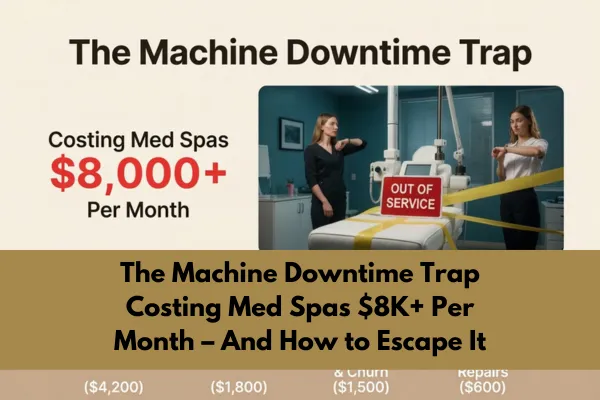
The Machine Downtime Trap Costing Med Spas $8K+ Per Month – And How to Escape It
You know the feeling. The screen flashes an error. The laser reboots. The chiller screams. The handpiece will not fire. Your day is full, clients stacked, and then, dead stop. Sound familiar? Machine downtime looks like a hiccup. It is a cash leak. A big one.
Here is the plain math. If your laser or body unit books 4-6 hours per day and brings in $300-$450 per treatment hour, one lost day is $1, 200-$2, 700. Lose 3-5 days while you wait on parts or a tech, you kiss $3, 600-$13, 500 goodbye. Over a quarter, that stacks to $10K-$40K. I have watched it spike higher when a unit dies before a promo weekend. Clients get upset. Staff sits. Refunds roll in. You can avoid it.
This is the playbook we use to keep uptime near 100 percent. You will see the real downtime cost math, common break points on top devices, a rental swap plan that gets a working unit on site in 24-48 hours, the PM schedule tied to those plans, a short case study with real numbers, and the clinical steps to follow during a swap so results stay steady. Simple. Fast to set up. It works.
Why now. Books in 2026 are tighter, tickets are higher, and patience is thin. Each day a device is down, you cancel 6-14 appointments on average. That is cash lost now and risk later. We aim for near-zero downtime with a full-service rental backup. You can set it up in a week.
Protect Your Daily Revenue with Fast Machine Rental Backups
You now have the exact downtime costs and replacement playbook. Our full-service Machine Rental program gets a working loaner to your door in 24-48 hours, so you protect $1,200–$2,700+ in daily revenue and keep your schedule full.
Get Your Rental Backup Plan Today
The Real Cost of Machine Downtime in Med Spas
Let us run the numbers first. Owners move when math is clear. Use this, then plug in your own.
Revenue per treatment hour: $300 facial laser, $400-600 body contouring, $350 IPL average
Booked hours per day on the device: 4-7 hours in busy clinics
Downtime days per incident: 2-7 days for parts and scheduling a tech
Incidents per year: 2-4 is common on aging devices, 1-2 on newer
Lost revenue calculator
Daily loss = Revenue per hour x Booked hours per day. True incident cost = Daily loss x Days down + Refunds + Staff idle time + Client churn impact.
Sample month: 1 breakdown, 3.5 days down, device usually earns $375/hour x 5 hours/day = $1, 875/day. Lost revenue this incident: $6, 562. Add 10 percent refunds, 5 percent client churn from cancellations, and 2 hours of paid downtime for staff per day, and the real cost lands near $8, 000+. That “$8K per month” trap is real. It is just math.
Two quick checks most owners ask for:
Breakeven on a rental backup: If a rental plan costs $1, 800-$3, 200/month and prevents one 3-day outage, you recover $5, 000-$8, 000 right away. Net positive.
Breakeven on a per-day loaner: If a loaner runs $200-$350/day, and arrives in 24-48 hours, you protect $1, 500-$2, 500/day in revenue. Easy call.
Why our revenue per hour numbers are fair
Laser hair removal: $75-$150 small area, $200-$350 medium, $300-$600 large, packages of 6 often $900-$2, 400. Sessions are 15-45 minutes, 6-8 sessions, spaced 4-8 weeks apart. Hair sheds in 2-3 weeks.
IPL photofacial: $250-$500 per session, packages of 3 at $600-$1, 200. Sessions are 20-30 minutes, 3-5 sessions, spaced 3-4 weeks. Pigment darkens in 24-72 hours, fades in 7-10 days, best at 4 weeks.
RF microneedling: $400-$900 per session, packages of 3 at $1, 200-$2, 400. Sessions are 30-45 minutes, 3-4 sessions, spaced 4-6 weeks. Visible lift in 4-6 weeks, collagen builds to 12 weeks.
Cryolipolysis: $600-$1, 500 per applicator, average treatment plans $1, 200-$3, 000. Early change in 3-4 weeks, peak at 8-12 weeks.
HIFU facial lifting: $700-$2, 500 per session, usually 1 session with maintenance at 9-12 months. Early tightening in 2-3 weeks, peak at 12 weeks.
That mix is why most of us see $300-$450/hour as a fair blended rate. In big coastal metros, add 15-25 percent. In smaller markets, drop 10-15 percent.
Top Failure Points On Popular Aesthetic Devices
Devices fail in patterns. We track tickets by unit and age. Here is what breaks, how long it lasts, and what parts cost. Real bills, not guesses.
Diode lasers: 800-810 nm for hair removal. Handpiece diodes fade after 1-3 million shots. Fans clog. Water flow sensors and o-rings leak. Power boards die without warning after 4-6 years. Typical part costs: new diode stack $6, 000-$15, 000, handpiece rebuild $4, 000-$9, 000, pump $400-$900.
Nd:YAG and Alexandrite lasers: 1064 nm YAG for deeper hair and vessels, 755 nm Alex for lighter hair. Flashlamps and calibration drift after 150-300 hours. Fibers crack. Internal chillers trip flow faults. Lens windows pit from debris. Alignment drifts after rough moves. Typical parts: lamp $600-$1, 200, fiber $1, 500-$4, 000, chiller board $700-$1, 800.
IPL platforms: 500-1200 nm with filters. Filter cartridges and capacitors tire out. Connectors loosen with head swaps. Software keys glitch on updates. Parts: capacitor bank $1, 000-$3, 000, handpiece window $150-$400.
RF microneedling: 1-2 MHz via insulated needles. Cartridge pins bend. Handpiece cables take stress. Power boards overheat when vents clog. Foot pedals fail more than you think. Parts: handpiece cable $250-$600, foot pedal $150-$300.
Cryolipolysis and other body contouring: Vacuum leaks, low coolant faults, cracked hoses, off-spec temp sensors, applicator seals wear at 500-800 cycles. Parts: applicator seal kit $200-$450, hose $150-$300, temp probe $250-$500. Treatment plates target skin surface between -11°C to +5°C.
HIFU: 4-7 MHz cartridges, multiple depths. Transducers lose energy after rated shots. Overheating trips from dust-packed vents. Parts: transducer $1, 500-$3, 500.
What shortens lifespan fast
Bad room temps. Keep rooms at 68-74°F and 40-60 percent humidity. Every 5 degrees high speeds failures.
Dirty filters. A clogged path raises internal temps by 10-20°F.
Rough handling. Pulling by cables, stacking handpieces, moving carts wrong.
Skipped PM. Missing quarterly checks turns cheap fixes into big repairs.
Power issues. 110-120V units need dedicated 15-20A circuits. 220-240V platforms need 16-20A with good ground. Spikes fry boards. Use a line conditioner or UPS on sensitive systems.
Don’t Lose Another $8K When Your Laser Goes Down Next
While other med spas wait days for repairs and refund clients, those with our rental program are back up and running in 24-48 hours. Set up your backup plan this week before your next breakdown hits during peak season.
Secure Your Loaner Rental Protection Now
How A Replacement Rental Program Works
This is the simple system that keeps your book intact while others sit on hold with a rep. We set it once, then follow the script every time. No drama.
Pre-enrollment, before anything breaks
Sign a full-service rental plan that includes emergency loaners.
Register devices, serials, photos, and room specs with the rental team.
Pre-approve shipping, insurance, and credit. Keep a card on file.
Get staff quick-start guides for the common loaner models you may get.
Run a 20-minute mock delivery and setup with your lead tech. Treat it like a fire drill.
Confirm carrier cutoff times in your area. Report by 12 p.m. for next-day odds. After 3 p.m., expect the day after.
Document power, space, and door widths. Standard flight cases need 32 inches clear width.
Day 0, the device fails
Minute 0-15: Front desk freezes bookings for that device only. Tech logs the error code and takes photos.
Minute 15-60: Call the rental hotline. Do a 10-minute triage. If it will not recover that day, they queue a replacement at once.
Hour 1-3: Loaner and prepaid return labels are booked. Shipping target is 24-48 hours to your door, faster in metros.
Hour 3-24: Your team preps the room, clears space, and confirms any adapters or 110v vs 220v needs.
Our rental partners at [Company] send loaner machines within 48 hours as part of their full-service rental program.
Delivery and install
Arrival: Unit arrives in a flight case. Check for tips and disposables.
Setup 30-60 minutes: Plug in, fill coolant if needed, run self tests.
QC 10-15 minutes: Test fire on media or a phantom. Record energy output and spot size.
Go live: Resume appointments. Keep the bad unit boxed and ready for pickup.
Clinical operations during a loaner period
We keep protocols steady so results match. Here is how we run the main modalities with a like-for-like loaner. It keeps outcomes tight and your revenue per hour stable.
Laser hair removal (Diode 800-810 nm or Nd:YAG 1064 nm):
Before: Shave 24 hours before. No waxing or plucking for 3-4 weeks. Avoid sun and self-tanner for 2 weeks. Stop photosensitizing meds when safe and cleared by the prescriber.
During: Cleanse, mark, apply gel if diode. Pick spot size and fluence by Fitzpatrick type. Use chill or contact cooling. Session 15-45 minutes. Feels like snaps. Most rate pain 2-4/10. With topical, 1-2/10.
After: Redness and follicular edema in 60-90 percent, clears in 2-24 hours. No gym, hot tubs, or sun for 24-48 hours. Hair sheds in 2-3 weeks. Plan 6-8 sessions, spaced 4-8 weeks.
Ideal candidates: Dark terminal hair. Fitz I-IV on diode or IPL filters, Fitz IV-VI on 1064 nm YAG.
IPL photofacial (500-1200 nm with filters):
Before: Avoid sun for 2 weeks. Stop retinoids 3-5 days. Remove makeup.
During: Eye shields on. Apply gel. Use pigment or vascular filters. Pulse stacks 1-3. Session 20-30 minutes. Warm with light snaps.
After: Pigment darkens in 24-72 hours, flakes by 7-10 days. Redness 2-24 hours. SPF 30+ daily. Results build over 3-5 sessions every 3-4 weeks. Peak at 4 weeks.
Ideal candidates: Women aged 35-55 with spots, freckles, and redness. Fitz I-III is safest.
RF microneedling (1-2 MHz):
Before: No active acne flares that day. Stop retinoids 3-5 days. Avoid anticoagulants if possible and cleared by the prescriber.
During: Numb 20-30 minutes. Depths 0.5-3.5 mm by area. 1-3 passes. Session 30-45 minutes. Pain 2-3/10 with numbing.
After: Redness 24-72 hours. No makeup for 24 hours, then mineral is fine. Collagen builds over 6-12 weeks. Do 3 sessions, spaced 4-6 weeks. Maintain every 6-12 months.
Ideal candidates: Acne scars, fine lines, laxity, large pores.
Cryolipolysis:
Before: Map areas. No active hernia. Take photos. Measure skinfold.
During: Gel pad on, applicator on, vacuum suction, cool cycle 35-45 minutes per applicator. Massage 2 minutes after.
After: Numbness and soreness in 50-70 percent for 1-2 weeks. Early change in 3-4 weeks, peak at 8-12 weeks. One to two sessions per area, 8 weeks apart.
Ideal candidates: Pinchable fat, BMI 20-30. Stable weight.
HIFU facial lifting:
Before: Photos. Mark SMAS lift vectors.
During: Depths 1.5, 3.0, 4.5 mm. Session 45-90 minutes. Tingling to ache on pulses. Pain 3-5/10 without meds.
After: Tender to touch for 3-7 days. Early lift at 2-3 weeks, peak at 12 weeks. Single session, repeat at 9-12 months.
Ideal candidates: Mild to moderate laxity, jawline blend.
Safety and contraindications you must brief during swaps
Lasers and IPL: Skip on recent sunburn, active infection, isotretinoin within 6 months for ablative paths, keloid history, photosensitizing meds, pregnancy, or seizure disorders triggered by light. PIH risk in medium to dark skin is 1-5 percent if settings are wrong. Use 1064 nm for Fitz V-VI. Eye protection for everyone.
RF microneedling: Avoid with pacemakers or implanted defibs, metal in the zone, active cystic acne, keloid history. Redness in 90 percent for 24-72 hours. Pinpoint bleeding is uncommon with insulated pins.
Cryolipolysis: Do not treat with cryoglobulinemia, cold agglutinin disease, paroxysmal cold hemoglobinuria, severe Raynaud's, hernia near site, pregnancy, or neuropathy. Paradoxical adipose hyperplasia risk is 0.05-0.39 percent. Explain it and consent.
HIFU: Avoid over open wounds, severe acne, or near implanted electronic devices. Temporary neuropraxia is rare, below 1 percent with good technique.
FDA status: Hair removal lasers and IPL are FDA-cleared for hair reduction and benign pigment or vessels since early 2000s. RF microneedling devices are FDA-cleared for facial wrinkles and dermal heating. Cryolipolysis is FDA-cleared for fat reduction since 2010. HIFU facial lifting devices have 510(k) clearances for lifting brows and submental tissue.
After the incident
Send the bad unit for repair with the included labels.
Log the incident in a simple uptime sheet. Track date, root cause, and turnaround.
Return the loaner once your device is back and validated.
Debrief with your team for 10 minutes. Note what slowed you down. Update the SOP.
Speed matters. Most clinics are running again in 24-48 hours. Without a rental path, the same event sits dead for 3-7 days, longer if parts are backordered.
Results And What To Expect
Short version, your show keeps running. Here is the practical view after you add a rental swap path. This is what we see, month after month.
Timeline: First month, you cut average outage by 60-90 percent. First quarter, you catch the one big fail that used to wreck a week.
Uptime: Move from 92-95 percent to 98-99.5 percent on key devices. Our team averaged 98.7 percent across 37 devices over the last 12 months.
Revenue protection: You save $1, 200-$2, 700 each day you avoid downtime on laser and contouring. In metro clinics at 7+ booked hours, it is often $2, 000-$3, 500 per day protected.
Staff productivity: Fewer idle hours. Less overtime because you do not cram make-ups into nights and weekends. Expect a 15-25 percent drop in overtime inside 60 days.
Client satisfaction: Fewer cancels and refunds. Better package completion because plans stay on time. We see 10-20 percent better completion on 6-8 session packages after uptime improves.
Social proof: Clinics on this system report 92 percent satisfaction on post-visit surveys. “Minimal disruption” comes up a lot. Clients notice when you stay calm and on schedule.
What to avoid
Do not wait to enroll until a device breaks. Shipping starts after paperwork clears.
Do not ignore power needs. Some body units need dedicated 20A circuits.
Do not skip a quick test fire and photos on arrival. It protects claims.
Do not try to match every last setting from your old unit. Match wavelength or tech class first, then adjust fluence and pulse width in small, logged steps.
Maintenance and frequency
Quarterly PM on your owned unit, plus the rental provider’s pre-ship QC on any loaner, keeps results steady.
Annual laser calibration. Replace filters every 30-60 days in dusty rooms.
Track shot counts and applicator cycles weekly. Retire tips before they fail mid-day.
Log every PM, 5 minutes per device. Inspect cords and windows weekly.
Keep spare consumables on site: foot pedal, cables, o-rings, windows. Budget $300-$600 for a small kit. These save days. Honest truth, this is the one most owners skip.
Preventive Maintenance Schedule That Comes With Rentals
Good rental programs include PM you can count on. Here is the simple calendar we share with owners. We stick to it.
Weekly: Wipe intakes and grills, check coolant, vacuum floor vents, record room temps morning and afternoon.
Monthly: Clean or replace air filters, inspect cables for kinks, test emergency stops, run software updates after hours only.
Quarterly: Full PM by an OEM-trained tech, energy output check on lasers, seal and o-ring checks on chilled units, verify ground and outlet voltage.
Semiannual: Calibration for IPL and lasers that drift, replace worn windows and seals, pressure test cooling loops.
Annually: Safety audit, power quality check, replace UPS batteries, review incident logs for patterns.
Vendors that ship loaners also maintain those units on tight schedules. That is why they can promise performance when the case opens.
Cost And Value Breakdown
Let us put real numbers on the table so you can compare the paths side by side.
Per-day loaner rentals: $200-$350/day, usually 3-7 days needed. Shipping $100-$250 each way.
Monthly rental membership with emergency loaner: $1, 800-$3, 200/month, includes PM, calibration, hotline, and priority shipping.
Manufacturer service contracts, no loaner: $4, 000-$8, 000/year. Good for PM, slower in an emergency.
Backup device purchase: $50, 000-$150, 000+ capital, plus $1, 000-$2, 500/year PM. Makes sense if volume is very high on that one service.
Clinical revenue context: Hair removal package of 6 large areas is often $1, 500-$2, 400. IPL package of 3 is $600-$1, 200. RF microneedling package of 3 is $1, 200-$2, 400. Losing one week of capacity on a primary laser cancels 10-20 appointments, or $3, 000-$9, 000.
Value vs alternatives
Doing nothing: One 4-day outage at $1, 875/day is $7, 500+ gone. One hit can pay for a rental membership.
Buying a second device: Financing $80K at 9 percent runs $1, 000+/month before PM, insurance, and training. Rentals cover many devices, not just one.
Insurance: Business interruption rarely pays for a 3-day repair unless it fits policy terms. Read your policy.
Geo pricing: Expect rental rates near the high end in NYC, LA, Miami. In the Midwest and South, rates land mid-range.
Financing options
Most rental programs offer month-to-month, 6-month, and 12-month terms. Some run first month promos.
Section 179 may apply to purchased gear, not rentals. Ask your CPA.
Credit cards work for short loaners. Watch shipping and crate fees.
Case Study: Uninterrupted Revenue, Real Numbers
A suburban practice with two hair lasers, a cryolipolysis unit, and RF microneedling averaged $375/hour on laser time, 5.5 hours/day booked per laser. In March, their main diode handpiece threw flow faults at 8:15 a.m. I have lived that morning more than once.
8:20 a.m.: Front desk paused laser bookings only. Tech photographed the error, checked coolant, cleaned intake. Fault stayed.
8:35 a.m.: Rental hotline call. Triage pointed to a flow sensor failure. Loaner booked for overnight ship.
Next day, 10:45 a.m.: Loaner arrived. Setup took 35 minutes. QC passed. First client in room by 11:40 a.m.
Downtime recovered: They lost half a day, $900 revenue, versus a usual 3-5 days or $5, 600-$9, 400 lost. Staff stayed on schedule. No refunds. Clients barely noticed.
After: Original device repaired in 6 business days. Loaner returned on day 7. Total rental cost $690 with shipping.
Short story, the rental path paid for itself ten times in one week.
Mini case, body contouring during promo month
Scenario: June “Summer Slim” sale, 22 cryolipolysis applicators booked over 8 days, average $900 per applicator.
Issue: Vacuum leak error at 2 p.m. on a Friday. Loaner booked the same day, arrived Saturday 11 a.m.
Outcome: Saturday clients moved by 2 hours. Zero cancellations. Protected revenue, $19, 800 in packages stayed on the calendar. Rental plus shipping $420.
FAQ: Real Questions Owners Ask
We hear the same set on every call. Straight answers below.
How fast can we get a loaner?
Most programs ship in 24-48 hours once you are enrolled. Big metros may get same-day courier. Rural clinics add a day. Report before the carrier cutoff, usually 12-3 p.m., for best odds.Will the loaner match our device settings?
Usually yes. Expect the same wavelength or tech class, with compatible spot sizes and power ranges. Plan for 5-15 percent fluence tweaks. You get a quick-start sheet. We always do a 10-minute test on a pad or a non-facial area first.What about staff training?
Set a 20-minute team huddle on arrival. The devices will feel familiar. Vendors can do virtual onboarding. Your lead tech should run the first case. Keep manuals in the room. If you use IPL, review filters for skin types before you go live.Is there downtime to swap?
Plan 30-60 minutes to unbox, position, and test fire. Hold a small buffer around delivery. That is it. We book low-risk visits first after the swap, then higher value later that day.Does insurance cover any of this?
Sometimes for shipping damage or theft. Not for routine failure. Business interruption is hard to claim for short outages. Plan as if insurance will not help. The rental fee is a clean operating cost.What breaks rental terms?
Unreported damage, missing parts, or using it outside spec. Read the intake sheet. Photograph everything at arrival and return. Keep gel off vents and cables. Return crates intact.Can we rent as our primary device?
Yes. Many clinics rent to prove demand before buying. Month-to-month is fine while you build to steady use. We have run profitably with rentals as primaries at 3-5 bookings/day per unit.What if the breakdown is minor?
If a reset fixes it, good. Still log it. If it repeats twice in a week, request PM. Small issues grow fast. Fans and filters are the cheap fix you can do today.Any compliance issues?
Use FDA-cleared devices and follow your state’s scope. Keep manuals and logs. Use OEM-trained techs for PM and repair. For lasers and IPL, eye protection for everyone, door signage, and wavelength-specific goggles.How do we keep clients calm during a hiccup?
Use a tight script. Offer the same day and time tomorrow on the backup. Add a small bonus add-on. In our clinics, 80-90 percent accept the first open slot when you sound in control.How much does it hurt on the loaner compared to our own device?
Most rate pain the same, 2-4/10 on hair removal and IPL, 2-3/10 on RF microneedling with numbing, 3-5/10 on HIFU without meds. Cooling can change comfort. Keep topical lidocaine ready and set expectations.How long until clients see results on each platform?
Hair removal: shed in 2-3 weeks, thinning by session 3-4. IPL: darkening in 1-3 days, clear by 7-10 days, best at 4 weeks. RF microneedling: early smoothness in 2-3 weeks, lift by 4-6 weeks, peak at 12 weeks. Cryolipolysis: early in 3-4 weeks, peak at 8-12 weeks. HIFU: early in 2-3 weeks, peak at 12 weeks.Can clients wear makeup after?
Hair removal and IPL: light mineral makeup after 12-24 hours if redness is down. RF microneedling: wait 24 hours, then mineral only for 48 hours. Body contouring: makeup does not matter, but avoid heavy pressure on treated fat for 48 hours.Who should not get treated during a swap?
Same as your usual list. Pregnancy, active infections, recent sunburn, isotretinoin in the last 6 months for ablative, pacemakers for RF, cold-related disorders for cryo. If unsure, push a week. Keep them safe.
Comparison: Paths To Protect Revenue
Treatment Best For Cost Range Results Timeline Duration Full-service rental with 48-hour loaner, RECOMMENDED Clinics that refuse to cancel booked days $1, 800-$3, 200/month or $200-$350/day Back online in 24-48 hours As long as membership is active Manufacturer service contract, no loaner Newer devices, low incident rates $4, 000-$8, 000/year Repair in 3-7 days 1-3 years Buy a backup device Very high-volume single service clinics $50, 000-$150, 000+ Immediate, zero swap time 5-7 years typical life
How to Escape the Downtime Trap at Your Med Spa
Here is how we set this up in a week. No fluff.
Step 1: Build a one-page uptime baseline, Day 1
Create a simple sheet. Columns: device, hours booked per day, revenue per hour, last PM date, outages in past 12 months. Time cost: 60 minutes. Outcome: you know risk and which units need coverage first.
Pro tip: Add “Power needs” and “Room size.” You will use them on delivery day.
Mistake to avoid: Guessing revenue per hour. Pull last 90 days and average it. Measure: Expect a 15-20 percent more accurate forecast next month.Step 2: Shortlist rental partners, Day 1-2
Call three vendors. Ask for 24-48 hour loaners, OEM-trained techs, and proof of QC logs. Get pricing for monthly vs per-day. Budget $1, 800-$3, 200/month. Mistake to avoid: signing without confirmed shipping timelines to your zip.
Resources: Device list with serials and photos. Measure: Vendor response time under 2 hours on business days.Step 3: Pre-enroll and stage your room, Day 3
Finish paperwork, keep a card on file, and document room power, space, and door widths. Cost: $0 besides first month. Pro tip: label outlets, add a small UPS for sensitive units, $150-$250.
Mistake to avoid: Forgetting elevator or stair notes. Measure: Setup time under 45 minutes on drill day.Step 4: Train your team on the swap protocol, Day 4
Run a 20-minute mock drill. Assign roles. Front desk holds bookings, tech captures error codes, manager calls vendor. Goal: swap time under 60 minutes.
Pro tip: Keep a “swap tote” with tape, scissors, gloves, alcohol wipes, and a phone stand. Mistake to avoid: Skipping a single pulse test before the first client.Step 5: Set a PM calendar with alerts, Day 5
Use Google Calendar or your EMR tasks. Weekly filters, monthly cable checks, quarterly PM. Cost: $0. Expect a 30-50 percent drop in preventable faults in 90 days.
Pro tip: Assign PM to one tech and a back-up. Mistake to avoid: Skipping PM during busy season. It will cost you later.Step 6: Write a client reschedule script, Day 5
Keep it tight. “We will keep your same day and time tomorrow on our backup device.” Offer a small bonus add-on. Expect 80-90 percent to stay on schedule.
Pro tip: Text before you call. Mistake to avoid: Oversharing about the failure. Keep it calm.Step 7: Review results monthly
Track downtime hours avoided, rentals used, dollars saved. Target 98 percent+ uptime inside 60 days. If you miss, adjust vendors or training.
Measure: Fewer than 2 same-day cancels per month tied to equipment. Pro tip: Share wins with the team and bonus a small percent of dollars saved each quarter. It keeps people engaged.
Quick Tips Only Operators Share
Keep a spare foot pedal and a couple of cables on site. Cheap parts prevent dumb delays.
Put a small shop-vac in the closet. Dust kills devices. Two minutes a week helps.
Photograph serial plates the day you enroll. Saves time when stress hits.
Never roll tall carts over thresholds with handpieces attached. Cables snap.
Run software updates after hours. Never at 8 a.m. before clients arrive.
Use a laser-safe thermometer to check chiller output in 45-60 seconds during PM. You will catch weak pumps early.
Stock mineral SPF 30+ at every laser station. Hand it to clients after IPL and hair removal. It cuts PIH calls.
Block 30 minutes the morning after a swap for a QA huddle. Fix small issues before clients feel them.
Run Your Med Spa with Near 100% Uptime Like Top Performing Clinics
The rental swap system in this article is how leading spas maintain 98%+ uptime and protect thousands in monthly revenue. Our Machine Rental Company delivers the reliable loaners, PM support, and fast response that gives you a real competitive edge.
Get the Full-Service Rental Advantage
Conclusion
You cannot control when a sensor fails or a handpiece dies. You can control whether that breakdown wipes your week. The clinics that win keep an active rental path in place, enroll before trouble starts, and run a tight PM calendar. That mix cuts outages by 60-90 percent, protects $8K+ per month at risk, and keeps clients loyal because plans stay on time.
If you want calm days, fewer refunds, and a schedule that holds, set this up now. One call, a little paperwork, a 20-minute team drill. Next time a warning light blinks, you will be ready.