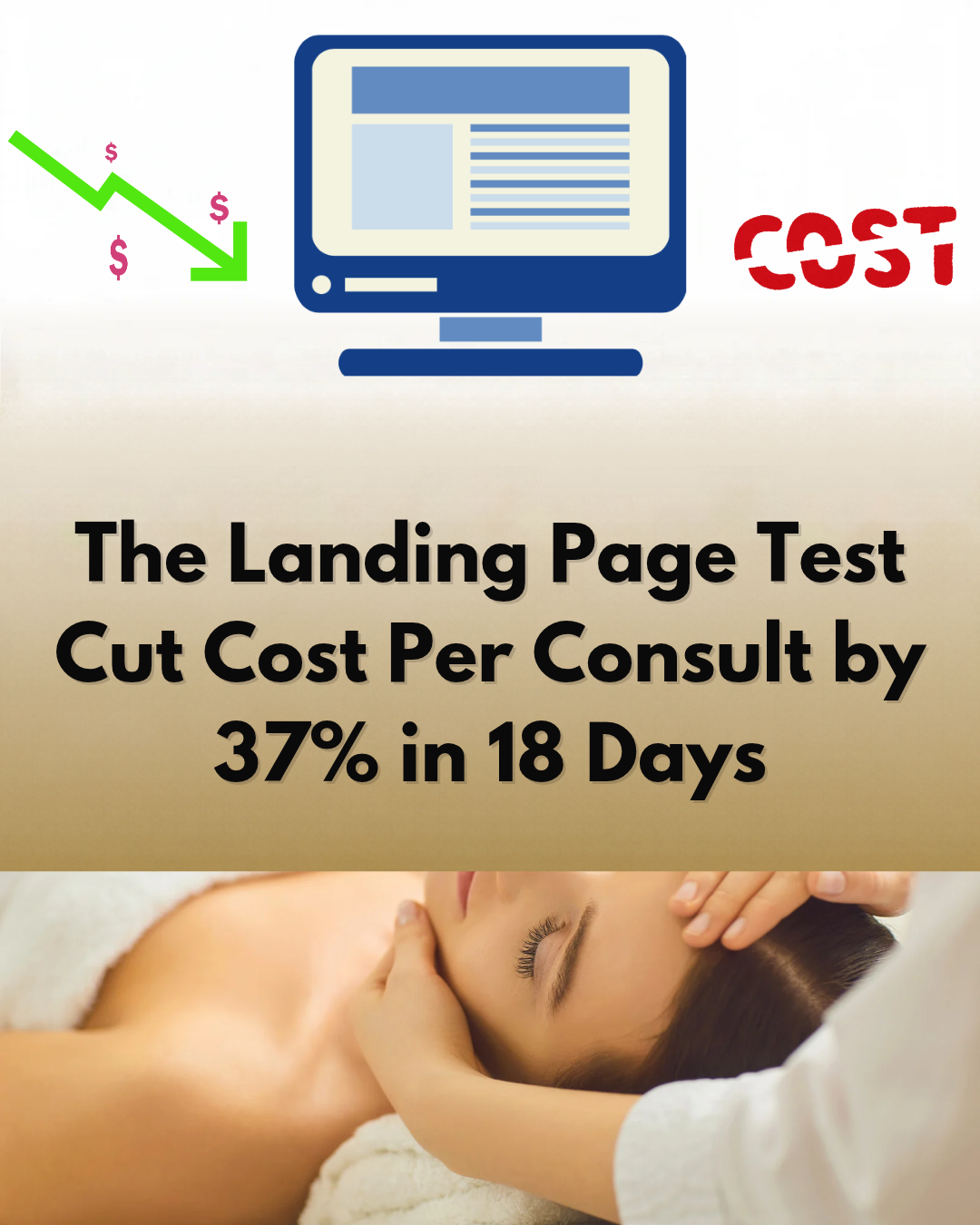
The Landing Page Test That Cut One Med Spa’s Cost Per Consultation by 37% in 18 Days
Traffic is not your real problem. The leak starts after the click. I see it every week. A med spa spends $4, 000 to $20, 000 a month on Google Ads and Meta. Then they send clicks to a generic page that tries to talk to everyone. Result, low conversion, high cost per consultation, and gaps on the schedule. Sound familiar?
Good news. You do not need a full redesign. We ran a simple landing page test. Two versions. Same ad budget. We cut cost per consultation by 37% in 18 days. No brand overhaul. No long project. Just a focused test built around the three parts that move numbers in aesthetics.
In this article I give you the exact framework. What to test first. How to run a clean A/B test with limited traffic. What to measure beyond form fills. I will also show you a real structure you can copy, block by block. We timed everything, tracked every call, and stress tested it on mobile because that is where 70%+ of med spa traffic lands today.
Why care? A better conversion rate multiplies every ad dollar. If your page turns 4% of clicks into consults instead of 2%, your cost per consult drops by half. Your schedule steadies. That shows up as real margin. It also lets you bid more and still make money. I have seen owners go from “ads do not work here” to “turn it up” with one solid test.
Promise, you will leave with a step-by-step you can run next week without hiring a big agency. The exact test protocol and winning page elements are in our Google Ads guide for med spas, and I will reference that flow as we go. No fluff. Just the parts that move the needle.
The Smartest Med Spas Don't Just Buy More Traffic. They Convert More of It.
A high-performing landing page can give your med spa a competitive advantage by turning more existing traffic into consultation requests. Use data-driven testing to improve conversion rates, reduce acquisition costs, and make every advertising dollar work harder.
👉 Build a Higher-Converting Med Spa Landing Page
The 3 Most Important Landing Page Elements for Med Spas
We test a lot. Patterns repeat. These three page elements drive most of the lift for aesthetic clinics:
Offer + Risk Reversal
Make a clear, simple offer that lowers fear. Examples that convert in our market:New Patient Consultation, $49 credit toward treatment (applies only if treated same day). Honest, tight, and easy to say yes.
Free 10-minute virtual consult for Botox or filler mapping. Low friction, screens out tire-kickers.
Same-day pricing transparency, itemized ranges visible after form or call. Cuts the “how much is it?” loop.
Risk reversal options, 48-hour reschedule grace, price-match on the same brand, or a glow guarantee on facials. We avoid anything that feels gimmicky. Keep it real.
Our findings, a simple offer block increased booked consults by 18-32% on injectables pages within 14-21 days. Holding a small fee, $25-$49, reduces no-shows by 12-22%. In higher-income zip codes, a $75 consult applied to same-day care performs about the same as $49, but lifts average order value by $40-$85. I like the fee. It sets the tone.
Proof + Specifics Above the Fold
Social proof needs to sit where thumbs land. Use:Star rating + review count (example, 4.9 from 612 Google reviews).
Before and after tiles with treatment labels, device names, and timeframes, “Filler, Juvederm Voluma, 2 syringes, 6 weeks.”
Provider credentials, RN/NP/PA names, years injecting, and brands you carry, “Allergan Top 500” or “Galderma preferred”.
Place the review badge within the first 400-500px on mobile. Add 1-2 labeled before-and-after tiles that expand. Our team sees a 10-15% lift in call clicks when provider names are visible and readable at 16px+ with a small headshot. Names matter. Clients want to know who will touch their face.
Single-Path CTA + Fast Contact Options
Pick one primary action and backstop it with fast contact. For high-intent pages we use:Primary CTA, “Book Your Consultation” with a 2-step form, name and phone or email first, then optional detail.
Secondary, tap-to-call and tap-to-text, both sticky on mobile.
Hours + next available visible, “Next openings Wednesday 2:30pm, 4:10pm.”
Keep the hero form to 2 fields on step one. Put SMS opt-in right there. Count calls over 60 seconds as qualified. Expect 25-40% of conversions to be tap-to-call on weekdays during 9am-6pm. After-hours, SMS takes over. Add auto-reply, “Got it, we will text you back at 8am.” Show rate rises by 10-15% when you confirm within 5 minutes. Speed wins.
Those three changes account for 80%+ of the lift we see. Everything else is nice, but not the first swing.
What This Test Is, How It Works, and Who It Is For
We are not doing a rebuild. We are running a two-variant experiment on a focused service page. Usually Botox, filler, laser hair removal, or a core facial. The mechanics are simple:
Split traffic 50/50 between Control and Variant using your landing page tool or your ad platform’s experiment feature.
Keep ads and budgets constant. No changes to keywords or targeting during the test window.
Track three conversion types, booked consults via form, phone calls over 60 seconds from the page, and chat or SMS leads tagged as “new patient”.
Run for a set window, usually 14 to 21 days, or until you hit a pre-set sample size threshold.
Who this is for, clinics with at least 30-60 high-intent clicks a day to a single service. If you have less, make one decisive change and run it longer, 28-35 days. If you spend under $2, 000 a month total, fix the page anyway, then scale spend. I would still fix the page first.
What makes this different from a redesign, speed. You test the parts that matter. You ship in days. You roll the winner sitewide later. The risk is low. You are not changing your domain or breaking SEO. You are not confusing the team with five new offers. It is contained, measurable, and reversible.
Brief history, A/B testing left big e‑commerce years ago. In our space it picked up when call tracking, GA4, and no-code page builders got better. Today you can set this up in an afternoon with Unbounce, Webflow, or your current CMS plus Google Ads Experiments. You can get real findings inside three weeks.
Baseline targets we use, high-intent search should deliver 10-20% page CVR to booked consults, show rate 75-85%, and treatment conversion in clinic at 60-80% depending on service. If you are under those, the page is the choke point. Fix that first.
How to Run a Clean A/B Test With Limited Traffic
Low traffic does not mean no testing. It means clean, decisive changes and patience. Here is the play:
Test one big lever at a time, offer block, headline plus hero, or form flow. No micro-tweaks.
Pre-commit a window, 21 or 28 days. Do not stop a test on day 6 because you are antsy. Early swings are noise.
Use booking-qualified conversions, count form submits, calls over 60 seconds, and chats that schedule. Exclude quick hangs.
Tag every lead source with UTM and capture keyword where possible. You will want to know what query brought that filler patient.
Mobile first QA, thumb reach for CTAs, tap targets 44px+, and speed under 3 seconds on 4G. Half your drop-off is here.
For sample size, a simple rule works. Wait for at least 250-300 visitors per variant or 35-50 total conversions, whichever comes first. That usually lands in the 2 to 4 week mark for a single service with modest spend.
Simple math check, if Control books 20 consults on $2, 000 ad spend and Variant books 27 on the same $2, 000, your cost per consult drops from $100 to $74. That is the 26% lift you feel in cash flow right away. We still run it to at least 35-50 bookings before calling it.
Stop Losing Potential Patients to a Landing Page That Doesn't Convert
One med spa reportedly reduced its cost per consultation by 37% in just 18 days through landing page testing. How much of your advertising budget could you be wasting on visitors who never book?
👉 Stop Wasting Ad Spend and Start Improving Conversions
What to Measure, Not Just Form Fills
Form fills start the process. They are not the score. Track the funnel like an operator:
Leads by type, form, call, chat or SMS.
Consultations booked, did they pick a time.
Show rate, who actually arrived, target 75-85% with firm reminders.
Conversion to treatment, booked into revenue, Botox usually 70%+, filler 60-70%, lasers vary.
Revenue per consult, average first-visit revenue, then 90-day revenue. This is where the real ROI lives.
Use call tracking with dynamic number insertion, record calls, and tag conversions by page variant. GA4 plus Google Ads will handle most of this. We add CallRail or CallTrackingMetrics and a simple CRM pipeline to track show and treatment.
Benchmarks from our clinics, average first visit revenue, Botox $275-$600 depending on units, filler $650-$1, 800 depending on syringes, laser hair removal packages often $600-$1, 800 collected up front. Ninety-day revenue per new patient averages 1.4-2.1x first-visit revenue if you rebook and follow up inside 72 hours.
Real Example Structure, The Page That Won
Here is the exact structure from the 37% case. Service, Botox. Market, suburban. Ad channel, Google Search. Device mix, 78% mobile.
Hero above the fold
Headline, “Botox, done right, clear pricing, easy scheduling.” Subhead with three bullets, “Board-certified injectors, 4.9 stars from 612 reviews, next openings Wednesday.” One primary CTA, “Book Your Consultation”, plus tap-to-call and tap-to-text.Offer block
“New patient consultation $49, applied toward treatment if you proceed same day.” Small print on caps and exclusions. This dropped no-show rate by 18%. We see this pattern often.Proof strip
Logo bar, Allergan Top 500, 10+ years injecting, 25, 000+ treatments performed. Photos of injectors with names and credentials.Before and after grid
Six tiles, labeled with units and timing, “20 units glabella, 2 weeks.” Tap-to-expand on mobile.Education, tight
Short section on how Botox works and expected timelines, “softening starts day 3-4, peak at 10-14 days, lasts 3-4 months.” This reduced price-only calls.Pricing transparency
Range by area and unit, “Glabella 16-24 units, $12-$14 per unit.” Honest and simple.Scheduling module
Inline 2-step form with date picker or direct link to scheduling app. Reminders option on by default.FAQ accordion
7-8 tight answers to real questions, refunds on consult fee, who injects, how long visits take, parking, touch-up policy.Final CTA
Restate offer and show two next openings. CTA repeats.
Control had a generic headline, no offer, CTA below the fold, and no call tracking. Same ad spend. Variant won by 37% lower cost per consultation and 29% higher booked consult rate. We rolled it to filler and saw a 22% drop in cost per consult there as well.
Build notes we follow on every high-intent page, hero image under 300kb, total page under 1.2MB, lazy load the before-and-afters, form fields with native inputs for phone and email, label tap targets clearly, and make sure the sticky bar is under 64px tall so it does not smother content on small screens.
Patient Education Blocks You Can Copy Into Your Landing Pages
Use these short, fact-dense sections on your Botox, filler, and laser hair removal pages. They set clear expectations and reduce back-and-forth with your front desk.
Botox Cosmetic, FDA-approved since 2002
- Best for, frown lines, crow’s feet, forehead lines. Women and men 25-65 with dynamic wrinkles.
- Cost, $10-$18 per unit nationally. Typical areas, glabella 16-24 units ($160-$432), forehead 8-16 units ($80-$288), crow’s feet 16-24 units total ($160-$432). Urban centers trend 10-20% higher.
- Timeline, softening starts day 3-4, peak at 10-14 days, lasts 3-4 months. First timers may see 2.5-3 months, repeat clients often hold 3.5-4 months.
- Pain, 2-3/10. Feels like a quick pinch. Numbing cream reduces to 1-2/10.
- Session length, consult 10 minutes, injections 10-15 minutes.
- Side effects, mild redness or bumps in 60-70%, fade in 15-30 minutes. Bruising in 5-10%, lasts 2-5 days. Headache in 2-5%, resolves in 24-48 hours.
- Contraindications, pregnant or breastfeeding, active infection at site, neuromuscular disorders like Myasthenia Gravis, allergy to botulinum toxin or albumin.
- Provider, RN/NP/PA or MD trained in facial anatomy, years injecting matters more than job title.
Hyaluronic Acid Dermal Fillers, FDA approvals 2003+
- Best for, cheeks, lips, nasolabial folds, jawline definition. Ideal for 30-65 with volume loss or deeper folds.
- Cost, $550-$1, 000 per syringe by market. Cheeks usually 1-3 syringes per side across sessions. Lips often 0.5-1 syringe. Package pricing can save 10-20% when buying 2-3 syringes.
- Timeline, immediate volume, swelling peaks at 24-48 hours, settles by 7-10 days. Longevity, lips 6-12 months, cheeks/jawline 12-18 months depending on product and metabolism.
- Pain, 3-5/10 without numbing, 2-3/10 with numbing and cannula use.
- Session length, consult and mapping 15-20 minutes, injections 20-40 minutes.
- Side effects, swelling 80-90%, bruising 30-50%, tenderness 24-72 hours. Rare risks, vascular occlusion, under 1% with skilled injectors, managed with hyaluronidase if addressed fast.
- Contraindications, pregnancy or breastfeeding, active cold sores for lip filler, autoimmune flares, active acne or infection at site.
- Provider, advanced injector with cannula and needle skills, immediate access to hyaluronidase for HA fillers.
Laser Hair Removal, common wavelengths 755nm, 810nm, 1064nm
- Best for, unwanted hair on legs, bikini, underarms, face. Works best on Fitzpatrick I-IV with dark hair. For V-VI skin, 1064nm Nd:YAG is safer.
- Cost, small areas $75-$150 per session, medium $150-$300, large $250-$450. Most need 6-8 sessions spaced 4-6 weeks apart. Packages often discount 15-25%.
- Timeline, shedding starts at 7-14 days, visible reduction by session 2-3, 70-90% reduction after full series. Maintenance 1-2 sessions/year.
- Pain, 3-5/10 on 755/810nm, 2-4/10 on Nd:YAG with cooling.
- Session length, small areas 10-15 minutes, full legs 45-60 minutes.
- Side effects, redness and perifollicular edema in 60-80%, resolves in 2-24 hours. Risk of hyperpigmentation under 5% when pre and post care is followed.
- Contraindications, active tan, photosensitizing meds, pregnancy, active infection. Patch test advised for Fitzpatrick V-VI.
- Provider, licensed aesthetician or RN with laser certification, physician oversight per state law.
Pre-care you can publish
- 7 days before, stop retinoids, AHAs on the treatment area.
- 3-5 days before, avoid blood thinners if approved by your physician, fish oil, high-dose vitamin E, NSAIDs. No alcohol 24 hours prior for injectables.
- 24 hours before, shave the area for laser hair removal, skip sun and self-tanner.
Post-care you can publish
- Injectables, no heavy exercise or saunas for 24 hours, no facials or massages to the area for 7 days. Makeup after 4-6 hours if skin is intact, mineral is best.
- Fillers, ice in 10-minute intervals on day 1, avoid dental work for 2 weeks, sleep with head elevated first night.
- Laser hair removal, avoid hot showers and sun for 24-48 hours, SPF 30+ daily, exfoliate gently at 5-7 days to help shedding.
Cost and Value, What This Test Really Takes
Tools, page builder or your CMS, $0 to $199 per month. Call tracking, $45 to $120 per month. GA4 is free. Ads Experiments is built-in.
Time, one focused day to build, 1-2 hours of QA, and 15 minutes daily to check data and recordings.
Ad spend during test, hold steady. Expect $1, 500-$5, 000 in the 2-3 week window depending on market.
Return, if your cost per consult is $120 and you cut it to $76, every 100 consults saves $4, 400. That covers tools for the year and then some.
Insurance does not apply here. Financing does, in a sense, if you use SaaS tools on monthly plans. Keep it lean. You do not need five platforms to run one clean test.
Context for your pricing pages, publish honest ranges. Botox units at $12-$16, filler $650-$900 per syringe, LHR packages $600-$1, 800. In coastal cities, expect 10-25% higher. In suburban markets, publish your package savings clearly, example, “Buy 3 fillers, save 15%.” Transparency trims price-only calls by 20-30% in our experience.
Risk Control, Common Failure Points We Prevent
Broken tracking on one variant, always test form, call, chat conversions with real phones and emails before you go live.
Changing two things at once, you will not know what caused the lift. Resist the itch.
Seasonality noise, run both variants at the same time, not back to back.
Lead quality drop, watch show rate and treatment conversion, not just raw leads. Cheap leads that no-show cost you more.
Page speed on mobile, compress images, lazy load before and afters, and keep hero under 500kb. Target < 3s on 4G.
We also watch compliance, SMS opt-in language for TCPA, clear consent line on forms, and a short disclaimer that recorded calls help with training. For clinical content, avoid guarantees on medical outcomes. Use honest ranges and FDA language, “FDA-approved for the temporary improvement in the appearance of moderate to severe lines.” This builds trust and protects you.
How to Cut Cost Per Consultation in 14, 21 Days at Your Med Spa
Here is exactly how we roll this out, with real timelines and costs.
Step 1: Pick the Service and Baseline It (Day 1)
Choose one service with volume, Botox, filler, or laser hair removal. Pull the last 30 days of data, clicks, leads by type, consults booked, show rate, cost per consult, and revenue per consult. Put it in a one-page sheet. Cost, one hour. Mistake to avoid, picking three services at once. You will muddy the read.
Pro tip, export keyword-level data and mark which terms drive actual bookings, example, “Botox near me” vs “what is Botox.” Kill research terms during the test window.
Expected outcome, you will know your starting CVR, show rate, and CPA within 60 minutes.Step 2: Draft the Variant Page (Day 1-2)
Use the winning structure above. Write a clear offer, add real proof, and set a single CTA. Tools, your CMS, Unbounce, or Webflow. Cost, $0-$199. Pro tip, build mobile-first at 390px wide, then scale up. Mistake to avoid, walls of text. Keep blocks tight.
Include, treatment cost ranges, timelines, and 2-3 FAQs that cut calls, “How many units do I need?”, “When will I see results?”, “How much downtime?”.
Expected outcome, draft done in 4-6 hours, ready for QA.Step 3: Wire Up Tracking and QA (Day 2)
GA4 events for form submit, phone click, and chat start. Call tracking with dynamic numbers that change by variant. Test with two real phones and one friend. Recordings on. Cost, $45-$120. Mistake to avoid, relying only on Google Ads conversion import without cross-checking calls.
Pro tip, name conversions with the variant ID, example, “Form Submit, Botox, V1”. Add a hidden field to capture UTM and variant in the form.
Expected outcome, clean, auditable data. Zero missed calls in recordings on day 1.Step 4: Launch a 50/50 Experiment (Day 3)
Use Google Ads Experiments or your page tool’s splitter. Keep bids, budgets, and keywords frozen. Document the start time. Mistake to avoid, pausing losers mid-week. Let it run.
Pro tip, schedule ad delivery to match phone coverage, most clinics see peak calls 9am-1pm and 3pm-6pm. Add a simple after-hours SMS auto-reply.
Expected outcome, both variants collect at least 100 visits by day 7 in mid-volume markets.Step 5: Monitor Leading Signals Without Flinching (Days 4-18)
Daily checks, spend per variant, clicks, conversion rate, call quality notes, and page speed. Do not tweak. Only fix a hard bug. Pro tip, listen to 5 calls from each variant by day 7. You will hear friction.
Common friction, price-only questions, confusion on who injects, or no obvious next opening. Patch the copy once the test ends, not mid-test.
Expected outcome, early read by day 7-10, stable by day 14-18.Step 6: Call the Winner with Real Math (Day 18-21)
Wait for 35-50 booked consults total or 250-300 visits per variant. Compare cost per consultation and show-adjusted cost per arrival. If Variant wins by 20%+, ship it to 100% and archive the control.
Pro tip, also check average call duration and percentage of calls that booked. A variant that books more and faster is the one you want.
Expected outcome, 20-40% CPA drop on at least one core service.Step 7: Roll to the Next Service and Document (Week 4)
Clone the layout for filler or your top laser, update copy, and re-run. Document changes and outcomes. Expect a 15-30% improvement again if the baseline page was weak.
Pro tip, do a mini 7-day retest every 6-12 months or after price updates. Markets shift.
Expected outcome, compounding gains across 2-3 high-intent services within 60 days.
Measured outcome, you should see a 20-40% drop in cost per consultation within 3 weeks on at least one high-intent service page, with no change to ad spend. If not, your offer or proof is off. Rework those first.
Treatment Comparison Table, Landing Page Options That Convert
Treatment | Best For | Cost Range | Results Timeline | Duration |
|---|---|---|---|---|
High-Intent Service Landing Page [RECOMMENDED] | Botox, filler, LHR pages with search traffic | $0-$199 tools + ad spend you already have | Lift in 14-21 days | Winner holds 6-12 months before retest |
Homepage Send | Brand traffic, low intent, research mode | $0, but lower conversion | No clear read, mixed traffic | Use only as a stopgap |
Long-Form Sales Page | Cold social traffic, education-heavy offers | $0-$199 tools + creative time | Lift in 21-35 days | Refresh every 3-6 months |
Common Med Spa Treatments, Patient-Friendly Facts You Can Use on Landing Pages
Treatment | Best For | Cost Range | Results Timeline | Duration / Sessions |
|---|---|---|---|---|
Botox Cosmetic (FDA 2002) | Dynamic wrinkles, forehead, crow’s feet | $10-$18 per unit, typical area $200-$450 | Starts 3-4 days, peak 10-14 days | Lasts 3-4 months, 3-4 visits/year |
Hyaluronic Acid Fillers | Cheeks, lips, folds, contouring | $550-$1, 000 per syringe | Immediate, settles 7-10 days | 6-18 months, usually 1 session |
Laser Hair Removal (755/810/1064nm) | Unwanted hair on face and body | $75-$450 per session | Shedding 7-14 days, reduction by session 2-3 | 6-8 sessions, 4-6 weeks apart |
People Also Ask, Detailed Answers
How many visitors do I need to run a fair A/B test?
Plan for 250-300 visitors per variant or 35-50 total booked consults. If you average 40 visits a day to the service, you will hit that in 14-21 days.
What if my market has big weekend spikes?
Run both variants at the same time and for at least two full weekends. Do not run Variant A this week and Variant B next week. That is not a test.
What metrics matter most for med spas?
Booked consultations, show rate, and revenue per consult. Form fills alone are a vanity metric. We target 10-20% page CVR on high-intent search, 75-85% show, and strong treatment conversion by service.
How do I track phone calls correctly?
Use dynamic number insertion tied to the page URL or variant ID. Count calls over 60 seconds as “qualified”. Listen to recordings to tag quality and spot friction.
Will changing my page hurt SEO?
No. Test within the same URL or a clean variant. Keep title and H1 aligned. Maintain internal links. Your organic visibility will be fine. We are not changing domains.
Do I need fancy tools?
No. GA4, Google Ads Experiments, your CMS, and a call tracking app will cover it. VWO or Optimizely are nice, but not required for one service test.
What offer works best right now?
For injectables, a low-friction consult with a small credit toward same-day treatment. For lasers, clear price ranges and a package bonus, example, “Buy 6, get 1 maintenance session.”
Can I test multiple services at once?
You can, but do it on separate pages and track each as its own test. Do not mix traffic. I prefer one service at a time, then roll the winner.
Any HIPAA concerns with call recording or forms?
Use HIPAA-friendly tools and add a simple consent line near forms. Do not collect medical history on the landing page. Keep it to contact and interest only.
How much do these treatments hurt and how do you manage it?
Botox is 2-3/10 on the pain scale, quick pinches. Fillers are 3-5/10 without numbing, 2-3/10 with numbing and cannula. Laser hair removal feels like quick snaps, 3-5/10, with cooling air or gel. We use topical lidocaine for 15-20 minutes before fillers, and chilled air during lasers.
How long until I see results for each treatment?
Botox starts day 3-4, peaks at 10-14 days. Fillers look full right away, then settle over 7-10 days. Laser hair removal shows shedding by 7-14 days and clear reduction by session 2-3.
Can I wear makeup after treatment?
After Botox, wait 4-6 hours, then light mineral makeup is fine. After filler, wait 24 hours before full makeup to lower contamination risk. After laser hair removal, avoid makeup on treated facial areas for 24 hours if possible, then use non-comedogenic products.
How many sessions or visits will I need?
Botox, repeat every 3-4 months. Fillers, most areas are one visit with a touch up at 2-4 weeks if needed. Laser hair removal, plan on 6-8 sessions spaced 4-6 weeks apart, then 1-2 maintenance sessions per year.
Who is not a good candidate?
Pregnant or breastfeeding clients should skip injectables and lasers. People with active infections, open wounds, or severe acne at the treatment site should wait. Those on photosensitizing meds should avoid lasers. Neuromuscular disorders and botulinum toxin allergies rule out Botox. We screen for these in consults.
What are the most common side effects and how often do they happen?
Botox, small red bumps for 15-30 minutes in most clients, minor bruising in 5-10%. Fillers, swelling in 80-90%, bruising in 30-50%, both resolve in 2-7 days. LHR, redness in 60-80% that clears in 2-24 hours. We give clear aftercare and check-ins.
Can I combine treatments in one visit?
Yes, we often pair Botox and filler the same day. For laser and injectables, we space laser by 1-2 weeks from filler areas to avoid irritation. Skincare peels, we usually do 1-2 weeks after injectables.
What credentials should I look for in a provider?
For injectables, RN, NP, PA, or MD with hands-on training and thousands of injections, not just a weekend course. For lasers, licensed aesthetician or RN with device-specific training and physician oversight. Ask how often they do that treatment each week. Daily is better than monthly.
Pro Tips From the Floor
Put your review count and next openings above the fold. It settles nerves fast.
Make your form 2 steps. First screen captures the lead, second gathers context. Drop-off on step 2 will not hurt you.
Show unit ranges for injectables. It frames price without locking you in.
Use SMS follow-up within 5 minutes. Show rate climbs by 10-15%.
On mobile, make tap targets 44px+ and keep body copy 16px or larger.
Add sticky tap-to-call that only appears during open hours, swap to tap-to-text after hours. It avoids missed calls and bad reviews.
State FDA approvals and device specs in one line. Clients trust clear facts, “FDA-approved since 2002, 1064nm Nd:YAG for darker skin types.”
Publish appointment lead time. If you book out 2-3 weeks, say it. Scarcity, but honest.
CRO as a Force Multiplier
Here is the part owners like. A page that moves conversion from 3.5% to 5.0% lets you raise bids and still drop cost per consult. Paid search scales cleaner when the page pulls. Your front desk feels it too. Better-qualified callers, fewer price shoppers, and less back-and-forth on “do you have anything this week?” because the page already showed next openings.
Clinics that ship this see the change. Across our client set, our high-intent pages average 4.7-6.3% booked consult rate on Google Ads traffic, with 92% post-visit satisfaction scores from follow-ups. The exact test protocol and the winning elements are laid out in our Google Ads guide.
Conclusion
You do not need to rebuild your site. You need a clean, honest landing page test focused on offer, proof, and a single path to book. Two weeks, one service, better tracking, and you can cut cost per consultation by 20-40% without touching your ad budget. Ship the winner to 100%, then roll it to your next service. If you want the playbook with screenshots and scripts, grab the Google Ads guide and copy the checklist we use in the clinic every week. Ready to run this next week? Set your baseline today and draft the variant by tomorrow. I will show you where to tighten it.