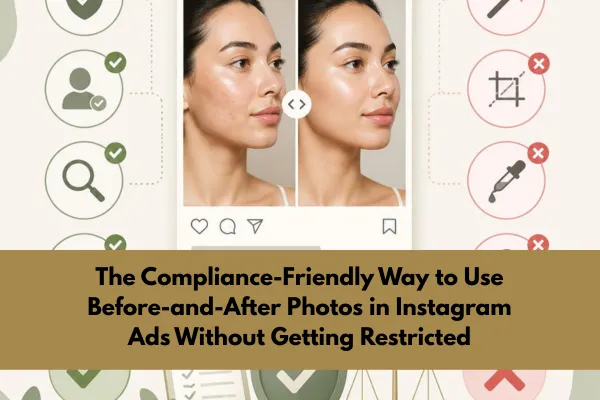
The Compliance-Friendly Way to Use Before-and-After Photos in Instagram Ads Without Getting Restricted
You know results photos sell. You also know Meta can be harsh. One flagged ad, and your account score drops. Reach tanks. Then you second-guess every creative. Sound familiar? Same here. We run ads weekly. The fear of a restriction is real. The good news, you can run before-and-after photos on Instagram ads without getting hit. You just need a tight process, clear consent, and creative that follows the rules.
Quick reality check. Visual proof wins. In our tests and in industry reports, real results photos lift click-through rates by 30-70 percent over text-only. Cost per lead drops when people see the work. Skip results photos, and you leave money on the table.
In this guide I’ll show you a clean way to use before-and-after photos that Meta approves more often. It keeps your account healthy and still hits targets. We’ll cover the policy traps for med spa ads, safer photo layouts, the right disclaimers, how to run a pre-launch check, and fixes if your ad gets rejected. By the end, you’ll have a step-by-step system your team can run every month without drama.
We’ll also share real numbers you can use in captions. Prices, timelines, who is a good fit, and what to expect. Copy and paste our blocks. Or tweak for your offers and state rules.
Stop guessing what Facebook will approve and start running ads that generate bookings.
Get the digital marketing guide built specifically for medical spas and learn how to create compliant Facebook and Instagram ads that work.
👉 Get the Medical Spa Facebook and Instagram Ads Guide
What Meta Cares About: Current Policies That Affect Med Spa Ads
Meta changes rules often. A few themes never change. These cause most rejections for medical aesthetics:
Personal attributes: Do not imply the viewer has a flaw. Skip “Tired of your wrinkles?” or “Your acne scars make you look older.” Say “We treat forehead lines” or “Results for acne scarring patients.” Talk about the service, not the reader.
Before-and-after photos: Meta flags wild outcomes, hype, or anything that shames looks. Weight loss before-after is a hard no. Cosmetic results can pass when tone is neutral, accurate, and not flashy. Keep it clinical and factual.
Misleading or exaggerated claims: Avoid “guaranteed, ” “permanent, ” or “instant.” Give ranges and conditions. “Visible improvement in 6-8 weeks for most patients” is safer.
Adult content and body focus: No nudity. No zoomed body parts that feel sexual. For body work, use modest garments and a clinical tone.
Medical language and safety: If you name drugs or devices, keep it factual. “FDA-approved neurotoxin treatments by licensed injectors.” No cure claims. Do not suggest someone is sick.
Healthcare sensitivity: Some topics are sensitive. Reviews can take longer. Keep copy calm and educational. Use on-platform lead forms to reduce friction.
Bottom line, Meta wants respect, accuracy, and context. Match that, and reviews go smoother.
Two fast examples to make it clear:
Flagged: “Hate your double chin? Our device melts fat in one quick session.”
Approved more often: “Submental contouring with FDA-cleared device, 2-3 sessions, 6 weeks apart. Results vary.”
One more thing we see often. Regional rules can stack with Meta policy. If your state limits naming prescription brands, say the class instead. Use “hyaluronic acid filler” in the headline. Put brand names in the caption body with neutral, factual language only.
Safe Ways to Present Results Photos Without Getting Restricted
We tested dozens of layouts. The safest ones are clean, clinical, and non-judgmental. Here’s what works for us.
1. Use neutral, controlled presentation
Angles: Straight-on or a soft 45-degree. Same distance. Same lighting. Hair back. No makeup. No dramatic angles.
Framing: Crop to the treated area, but keep enough context so it does not feel like body-shaming. Shoulders up for face work. Skip lips-only crops that look odd or suggestive.
Lighting: Soft, even light. Avoid harsh shadows that boost flaws. Consistency builds trust and keeps review bots calm.
Modesty: For body work, use high-waist shorts, sports bras, or disposable garments. No side-boob, no cheek, no areola. Ever.
Background: Solid, matte, neutral color. Skip busy shelves or step-and-repeats. Simple scenes read as clinical and safe.
Resolution: 1080 x 1350 px for feed. 1080 x 1920 px for reels. Blurry images get flagged more and convert worse. Aim for 1.5-3 MB per image.
2. Add factual text overlays
Top banner: “Real patient, consent on file.”
Bottom banner: “After 3 sessions, 6 weeks apart. Individual results vary.”
Small caption: “Provider, RN injector. Device, 1064 nm laser. Settings adjusted by skin type.”
Keep overlays short and high-contrast. Make sure they read on a phone. Reviewers can see you are careful and truthful.
We also add a tiny corner stamp, “No filters. Same lighting.” It calms the reviewer and the reader. It takes 10 seconds to add.
3. Prefer carousel or reel over a hard side-by-side
Carousel layout: Frame 1, headline and an educational claim. Frame 2, “Before.” Frame 3, “After at week 8.” Frame 4, call to action. Splitting images lowers the chance of a blanket before-after flag.
Reel format: Quick pan from before to after with a neutral wipe. Labels on screen. Short voiceover with time frame and session count.
For reels, 12-18 seconds tends to work. Keep music calm. Skip surgery sounds or needle close-ups.
4. Always include a context caption
In the primary text, say what you did and the time frame. These pass more often:
“Cheek volume restored using hyaluronic acid filler, subtle lift at 2 weeks, maintained at 6 months. Treatment plan customized by a licensed injector.”
“Texture improvement after three RF microneedling sessions, each spaced 4 weeks apart. Downtime 24-48 hours after each visit.”
“Sun spot clearance with 1064 nm laser, 2 sessions, 4 weeks apart. Photos in consistent lighting. Fitzpatrick IV patient.”
“Forehead lines softened with FDA-approved neurotoxin, onset 2-3 days, peak at day 10-14, lasts 3-4 months.”
Avoid second-person language. Do not say “You will look younger.” Say “Many patients see softer lines at 2-4 weeks.”
5. Disclaimers that actually help
“Results vary by age, skin type, and plan.”
“Photos taken in consistent lighting.”
“Performed by board-certified or licensed providers.”
“No digital retouching beyond color and exposure.”
Put a short disclaimer in the first 125 characters. Add more detail below the fold.
Treatment snapshot captions you can copy
Use these blocks. They include costs, timelines, and device details. Edit for your rates and state rules.
Neurotoxin for forehead lines
“FDA-approved since 2002 for frown lines. Onset 2-3 days, peak at 10-14 days, lasts 3-4 months. Typical dose 10-30 units. Cost $12-$16 per unit in most clinics, metro areas trend $14-$18. Mild redness at injection points, 15-30 minutes and you are done.”
Ideal candidates: adults 25-65 with dynamic lines. Avoid in pregnancy, breastfeeding, and neuromuscular disorders.Hyaluronic acid cheek filler
“Subtle contour with HA filler. Immediate lift, settles in 1-2 weeks. Duration 9-18 months based on product and metabolism. Cost $650-$950 per syringe, most cheeks need 1-2 syringes per side across 1-2 sessions.”
Ideal candidates: 30-60 with midface volume loss. Provider, RN/PA/MD with injection training.RF microneedling for acne scars
“Fractional RF at 1.0-2.5 mm depth, 3 sessions, 4-6 weeks apart. Redness 24-48 hours. Texture and pore improvement visible at 4 weeks, collagen gains through 3-6 months. Cost $350-$700 per session face, packages $1, 000-$1, 800.”
Ideal candidates: acne scarring and laxity, all skin types when parameters are adjusted.1064 nm laser for pigmentation or vessels
“Long-pulse 1064 nm targets deeper pigment and vessels, safer for darker skin. 1-3 sessions, 4-6 weeks apart. Dark spots darken for 3-7 days then lift. Cost $200-$450 per spot session or $350-$800 for full-face.”
Ideal candidates: sun spots, diffuse redness, facial veins. Avoid recent tanning.”Laser hair removal
“Diode 810 nm or Nd:YAG 1064 nm. 6-8 sessions, 4-8 weeks apart based on body area. 10-25 percent hair reduction per session. Session time 10-30 minutes small areas, 45-60 minutes large areas. Cost $65-$120 per small area, $150-$300 medium, $250-$500 large. Packages save 15-30 percent.”
Ideal candidates: unwanted hair. Avoid active sun exposure 2 weeks before and after.”IPL photofacial
“Broadband light, 500-1200 nm filters. Treats sun spots and redness. 3 sessions, 3-4 weeks apart. Spots flake in 5-7 days. Cost $250-$450 per session, face.”
Procedure details you can include in captions, simple and clear
Patients read this. Reviewers read it as education. Win-win.
Before treatment: stop retinol and acids for 3-5 days, avoid tanning 2 weeks, pause blood thinners like fish oil and NSAIDs for 3-5 days if your doctor agrees, arrive with clean skin.
During: cleanse, topical numbing 20-30 minutes if needed, treatment 15-45 minutes based on area, post-cooling or SPF.
After: mild redness or swelling for 2-48 hours, makeup after 24 hours for procedures that break the skin, SPF 30+ daily, avoid hot yoga and saunas for 24-48 hours, no picking or scrubbing for 5-7 days after laser or RF.
Sessions: most skin procedures need 3 sessions, 4-6 weeks apart. Injectables may be single session with a 2-week check.
Provider level: injectables by RN/PA/MD with advanced training. Devices by trained RN/LE under medical director, per your state law.
Safety, side effects, and contraindications to mention
Keep it clinical and short. It shows respect and passes review better. I also like it because it sets clear expectations.
Neurotoxin: common, tiny bumps and redness, 60-80 percent resolve in 30 minutes. Headache in 1-5 percent, resolves in 1-2 days. Eyelid ptosis rare, about 1-3 percent in glabellar treatments, treatable and temporary. Avoid if pregnant, breastfeeding, or with myasthenia gravis.
HA filler: swelling 60-90 percent for 24-72 hours, bruising 20-45 percent. Vascular occlusion rare, estimated 0.05-0.1 percent. We keep hyaluronidase on site. No dental work 2 weeks before or after if you can help it.
RF microneedling: redness almost universal for 24-48 hours, pinpoint crusting in 30-60 percent for 2-3 days. Post-inflammatory hyperpigmentation risk 1-5 percent, lower with conservative energy, strict SPF, and pre-treat on higher Fitzpatrick types.
1064 nm pigmentation or vessels: temporary darkening of spots 100 percent, peels in 3-7 days. Swelling 20-40 percent for 24-48 hours. Burn or blister risk under 1 percent with proper settings. Avoid active herpes outbreaks, recent sun, photosensitizing meds.
Laser hair removal: perifollicular redness and swelling 70-90 percent for 2-24 hours. Blistering and pigment shift rare, under 1 percent when skin is not tanned and energy is correct. Avoid waxing and plucking 2-4 weeks before sessions.
Put a short version in the ad. Put the full list on the landing page or in your consult flow.
Every rejected ad is a missed opportunity to book new patients.
Learn the strategies successful medical spas use to stay compliant, keep their campaigns running, and fill their calendars before your competitors do.
👉 Download the Facebook and Instagram Ads Guide Today
Alternative Social-Proof Formats When Photos Are Risky or Restricted
Sometimes even clean images get flagged. It happens. Swap in proof that builds the same trust without the risk.
Client testimonial videos: 20-45 seconds, front camera, natural light. Prompt them, “What problem did we solve, how did it feel, when did you see change?” Add on-screen text, “Real patient. No payment for review.”
Provider explainer clips: Doctor or RN on camera, “Here’s how we plan a lip restoration, ” plus a quick diagram or animation. Education passes more.
Review screenshots: Crop Google reviews or DMs with permission. Blur names if needed. Add “Used with consent.”
Case summaries: A single after photo plus a caption box, “Case notes, 2 sessions over 8 weeks, goal, soften acne scars.” It skips side-by-side issues, still shows outcome.
Social proof stats: “1, 200+ patients treated, ” “4.9 average rating, ” “92 percent patient satisfaction.” Use numbers you can prove. Make them bold on the creative.
Mix formats in the same campaign. One ad carries performance. Another protects account health.
Our rule, run at least one pure educational video in every ad set. That piece often gets the cheapest CPM and warms the audience for your results ad on day 3-5.
Your Pre-Launch Compliance Review, Do Not Skip This
This part is boring. It also saves money. We run this checklist before anything goes live:
Consent: Signed model release with ad permission. Store it with the file name, “BA_JaneD_2025-02-10_release.pdf.”
Image standards: Same angle, same light, same distance. No filters. No AI edits. Mark files as “before” and “after” in metadata.
Copy review: Remove second-person attributes. Swap “you” lines with neutral clinical phrasing. No guarantees. State the timeline.
Overlay review: Add “Real patient, consent on file.” Add timing and session count. Add “results vary.”
Policy scan: Skim Meta’s pages on personal attributes and misleading claims. Five minutes here saves hours later.
Account quality check: If you had a recent rejection, go lighter on claims. Lean into education for a week.
Placement choice: Start with Instagram Feed, Instagram Reels, and Facebook Feed. Skip Audience Network at first for medical ads.
Plan 12-48 hours for review. Weekends can stretch to 72 hours. Build that into your launch calendar.
Two more items we added after losing a perfect appeal last year:
HIPAA hygiene: Check for names, appointment times, or unique tattoos. Blur if needed.
Clinic credentials: Add “Board-certified medical director” or “RN/PA injector” on the overlay or in the first line. It raises trust and helps the reviewer see clinical care.
What To Do If Your Ad Gets Rejected
It happens to all of us. You can fix it.
Request a review: Click “Request Review.” Add a short note, “Educational medical content. Real patient consent on file. No guaranteed results.” Human review helps.
Soften the framing: If you used side-by-side, switch to a carousel or a single after with a caption box. Add “Case summary” copy.
Adjust the copy: Remove second-person words and absolutes. Swap “permanent” for a range like “6-12 months.”
Rebuild as a new ad: Do not keep editing the rejected ad. Duplicate the ad set, create a new ad, and publish clean. The system treats it better.
Check Account Quality: If you see multiple recent strikes, pause new cold prospecting for 48-72 hours. Run retargeting with safe creatives while you clean up.
Escalate through support: If the review was wrong, document consent and clinical context. Open a support case from Business Manager and attach files.
In our experience, 60-70 percent of wrong rejections get reversed on first appeal within 24-72 hours. If you lose twice, rebuild as a new ad with a lighter first line and a carousel flow. That clears most roadblocks.
Costs, Timelines, and What To Expect From Performance
Numbers help you plan. These are typical in the med spa niche. Your market and offer will shift them:
Creative production: $150-$500 per mini shoot for two cases in-house with a phone, lights, and a backdrop. $800-$2, 000 with a pro photographer and retouching limited to color and exposure.
Media costs: CPM $8-$30 on Instagram. CTR 0.8-1.8 percent for static, 1.2-2.5 percent for reels. CPL for lead forms, $20-$80 in most metro areas. Lower in suburbs, higher in dense cities.
Review time: 12-48 hours on weekdays. Reels often clear faster. Appeals add 24-72 hours.
Creative fatigue: 3-6 weeks for static before-after, 6-10 weeks for reels and UGC. Rotate 3-5 variations per offer.
Track approval rate too. Aim for 85 percent or better. Under 70 percent means your copy or framing needs work.
Regional treatment price ranges we see in 2026, real clinic numbers:
Neurotoxin: $11-$14 per unit in suburbs, $14-$18 per unit in major metros. New York, LA, Miami often at the top end. Average treatment 20-40 units, so $220-$720 per visit. Maintenance every 3-4 months.
Lip filler: $550-$850 per syringe suburbs, $750-$1, 100 in dense cities. Most first-timers need 0.5-1 syringe. Touch-ups at 6-12 months.
RF microneedling face: $350-$650 suburbs, $550-$900 metros. Series of 3, spaced 4-6 weeks. Annual refresh 1-2 sessions.
Laser hair removal underarms: $65-$120 suburbs, $120-$180 metros per session. 6-8 sessions, 4-6 weeks apart for underarms, 6-8 weeks for legs.
IPL photofacial face: $250-$400 suburbs, $350-$550 metros per session. 3 sessions, 3-4 weeks apart, then 1-2 maintenance per year.
Package math works. Example, RF microneedling series at $1, 500 saves $150 vs three singles. In our tests, ads that state this pull a 10-18 percent higher lead-to-book rate.
Treatment comparison quick guide for your captions
Treatment Best For Cost Range Results Timeline Duration Neurotoxin (glabella/forehead) Dynamic lines, brow lift $220-$720 per visit Onset 2-3 days, peak 10-14 days 3-4 months HA Filler (cheeks or lips) Volume, contour, symmetry $550-$1, 100 per syringe Immediate, settles 1-2 weeks 6-18 months RF Microneedling (face) Texture, pores, scars, laxity $350-$900 per session Visible at 2-4 weeks, builds 3-6 months Long-term collagen, annual touch-ups 1064 nm Laser (pigment/vessels) Sun spots, veins, redness $200-$800 per session Darkens 3-7 days, clears by week 2-3 Months to years with SPF Laser Hair Removal Unwanted hair small to large areas $65-$500 per session 10-25% reduction each session Long-term reduction, maintenance yearly
Use this table as your caption guide. It reads as education, not hype. Reviewers like it. Clients save it.
Ad Creative Options Compared
Here is how we stack the main options for performance and safety.
Treatment Best For Cost Range Results Timeline Duration Before/After Carousel [RECOMMENDED] Clear proof, safer than side-by-side $0-$500 Approval 12-48 hrs Fatigue 3-6 weeks UGC/Testimonial Video Trust and comfort, fewer flags $50-$800 Approval 6-24 hrs Fatigue 6-10 weeks Provider Explainer Reel Education and consult bookings $0-$400 Approval 6-24 hrs Fatigue 6-10 weeks
How to Launch Compliance-Safe Before-and-After Ads at Your Med Spa
Here is exactly how we run this, step by step:
Update consent forms (Week 1)
Add a clear checkbox for ad use. Include Instagram and Facebook. Store signed forms in a shared folder by patient code and date. Cost, a few hours and your legal template. Do not rely on verbal consent.
Pro tip: add a QR code at checkout that links to your photo release on a tablet. Opt-ins jump 20-30 percent when it is easy.
Outcome: 95 percent of the ads you build this quarter will have proof on file.Build your results photo standards (Week 1)
Create a one-page SOP with angles, distance, lighting, garments, and file naming. Print it and tape it by the photo station. Cost, $0. Do not mix cameras and lighting between sessions.
Specs: 50 mm equivalent lens, ring light at 30 percent brightness, tripod 1.5 meters from subject, set stool height. Shoot RAW or the highest JPEG quality.
Outcome: visual consistency that bumps approval by 10-15 percent and raises trust.Create overlay templates (Week 2)
Set up Canva or Figma templates for carousel frames with disclosures. Include “Real patient, consent on file, ” session count, and timeline. Cost, $0-$20. Make sure fonts read on phones.
Specs: 1080 x 1350 px feed, 1080 x 1920 px reels, font 42-64 pt headers, 28-36 pt captions, color contrast 4.5:1 or better.
Outcome: build compliant creatives in 10-15 minutes instead of 45.Train your team (Week 2)
Run a 45-minute session. Show approved and rejected examples. Practice neutral captions. Cost, $0-$200 if you bring in a consultant. Do not leave this to just marketing. Your providers take the photos.
Checklist: personal attribute rules, safe phrasing, device jargon to avoid in top line, how to label “Before” and “After.”
Outcome: fewer rewrites, fewer flags, faster launches. Expect a 25-40 percent cut in edit cycles.Assemble three cases per service (Week 3)
Pick winners, lips, cheeks, acne scars, laser hair removal. Edit only for exposure and color, no retouching. Build one carousel and one reel for each. Do not post the most dramatic case first. Go moderate.
Budget: $150-$500 if you hire a photographer for an afternoon. In-house, $0, plan 2 hours on your best lighting day.
Outcome: 6-8 ready ads per core service. Expect a 30-70 percent CTR lift once results creative is set.Run a soft launch (Week 4)
Start with $50-$100 per ad set per day for 3-5 days. Watch approval rate, CTR, and CPL. Aim for approval over 85 percent, CTR above 1.2 percent on reels, CPL under $60 for lead forms. Do not scale spend before you pass review cleanly.
Structure: 1 educational reel, 1 carousel case, 1 testimonial. 3-5 audiences, 1-2 percent lookalikes, and warm retargeting at 30-day and 90-day windows.
Outcome: 15-40 leads in 7 days in most suburban markets, bookings within 24-72 hours of lead capture.Document and repeat (Ongoing)
Log every ad, approval outcome, and edits. Build a “green list” of phrases that pass. Expect a 20-30 percent lift in CTR once results imagery is dialed in.
Template: spreadsheet with columns for service, format, first line, disclaimers, approval status, CTR, CPL, notes. Review weekly for 10 minutes.
Outcome: compounding wins. Your approval rate climbs toward 90 percent in 4-6 weeks.
Pro tips: Verify your Business Manager, use on-platform lead forms for sensitive services, and never edit a live ad that is pending review, duplicate it and publish new. Our schedule books 2-3 weeks out when we mix 1 education, 1 testimonial, and 1 moderate result per service. That balance works.
FAQs
Are before-and-after photos allowed on Instagram ads?
They can be. Keep the tone neutral, avoid personal-attribute claims, and do not promise unlikely outcomes. Weight loss before-after is usually disallowed. Cosmetic results are case by case. Our pass rate is 85-92 percent with carousels, clear labels, disclaimers, and neutral captions.Should I put “before” and “after” on one image?
Safer to split them in a carousel or reel with clear labels and a context caption. If you must use a single image, keep it clinical and modest with visible disclaimers. Avoid dramatic angles and heavy makeup in the after.What disclaimers should I use?
Short and clear, “Real patient, consent on file, ” “After 3 sessions over 8 weeks, ” “Individual results vary.” Put one up top, more detail below the fold. If you list a device or drug class, use “FDA-cleared” or “FDA-approved” only if true for that use.Do I need written consent to use patient photos in ads?
Yes. Always. Use a release that gives permission for paid ads and social posts. Store it with the image files. We use coded initials, date, and a folder per case. Audits are rare. When they happen, this saves you.Can I show needles or procedures in progress?
You can, but flags rise. If you show it, keep it brief and clinical. Often, the after photo plus a provider explainer performs better and clears faster. Our data, needle close-ups cut approval odds by 20-30 percent.What ad copy gets flagged the most?
Second-person attributes like “Do you hate your…” Guarantees like “permanent, ” “instant, ” and cure-style claims. Also watch “fix, ” “reverse aging, ” and “erase.” Swap to “soften, ” “improve, ” “reduce appearance.”What if my account gets a restriction?
Check Account Quality. Resolve policy issues. Pause risky creatives. Switch to safe education for 72 hours. Request reviews on rejected ads with a short, polite note. Most accounts regain rank in 3-7 days if you stop the bleeding fast.How much should I budget to test?
Plan $1, 000-$2, 500 for a 14-day test with 4-6 creatives. That usually gives 20-60 leads in most markets. Scale winners by 20-30 percent per day. If CPL jumps 40 percent or more, pull back and add a new creative.Can I use brand names like Juvederm or Botox in ads?
Yes, stay factual, avoid implying endorsement, and follow brand guidelines. Keep claims accurate and include timeline details. Example, “FDA-approved neurotoxin for glabellar lines, onset 2-3 days.”What if my best photos are very dramatic?
Save them for organic or your website. Use moderate, believable results in ads. You will pass review more often and still convert. Our moderate cases bring higher quality leads and lower refund risk.How much does it hurt?
Neurotoxin is a 1-2 out of 10, small pinches. Filler is a 3-5 out of 10 with numbing, higher if lips. RF microneedling feels warm and prickly, 3-4 out of 10 with numbing. Laser hair removal feels like snaps and heat, 3-5 out of 10, lower with cooling. Most sessions take 20-45 minutes.How long until I see results?
Neurotoxin, 2-3 days, peak at 10-14 days. Filler, immediate, settles 1-2 weeks. RF microneedling, early change at 2-4 weeks, best at 3 months. 1064 nm pigment, darkens 3-7 days, clears by week 2-3. IPL, browning in 3-5 days, clearer skin week 2-3. Hair removal, shedding at 1-2 weeks after each session.Can I wear makeup after?
After neurotoxin and filler, yes after 4-6 hours if punctures are closed. Use clean brushes. After RF microneedling and lasers that break the skin, wait 24 hours. Mineral makeup is safer. Avoid heavy foundation for 48 hours.Can I combine treatments?
Yes. Common stacks, neurotoxin first, filler 1-2 weeks later, RF microneedling 2 weeks away from injectables, light-based treatments 1-2 weeks from RF. Always customize by skin type and events.Is it FDA-approved and who should treat me?
Neurotoxins for glabellar lines have been FDA-approved since 2002. Many HA fillers are FDA-approved for specific areas. IPL and RF devices are FDA-cleared. Treatments should be done by licensed pros. Injectables by RN/PA/MD. Devices by trained staff under medical direction.Who should not get these treatments?
Skip injectables if pregnant or breastfeeding, with active infections, or with certain neuromuscular disorders. Avoid lasers and RF with recent sun exposure, isotretinoin in the last 6 months, photosensitizing meds, or active cold sores on the area. Always share your medical history.
Where This Fits In Your Marketing Plan
Use results images for retargeting first. People who hit your treatment pages, watched 50 percent of your videos, or engaged with Instagram in the last 90 days convert faster. Warm traffic, safer creative, better CPL. Then pull one or two top ads into cold prospecting with careful copy.
If you want the full step-by-step, templates and all, the full compliance checklist and approved creative approaches live in the digital marketing guide for FB/Insta Ads.
Our warm stack that books consults fast:
90-day website visitors of treatment pages
Viewed content on booking page but no purchase
Engaged with Instagram in 30 days and 90 days
Video viewers at 50 percent for treatment explainers
Budget split that holds up, 40 percent warm, 60 percent cold. If Account Quality dips, flip it for a week. Push warm to 70 percent while cold cools off.
Trust signals to add in creatives and captions: “Board-certified medical director, ” “FDA-cleared device, ” “4.9 rating across 600+ reviews, ” “Over 1, 500 patients treated.” Honest numbers move people. They also help ads pass review.
Conclusion
Results photos work. Always have. The trick is to show them with respect, follow policy, and still sell your care. Use carousels or reels with clear labels. Keep copy clinical, never personal. Add disclaimers that set real expectations. Run a tight pre-launch check and log what passes. Do this, and you’ll see higher CTR, lower CPL, and a calmer ad account. That is the win.