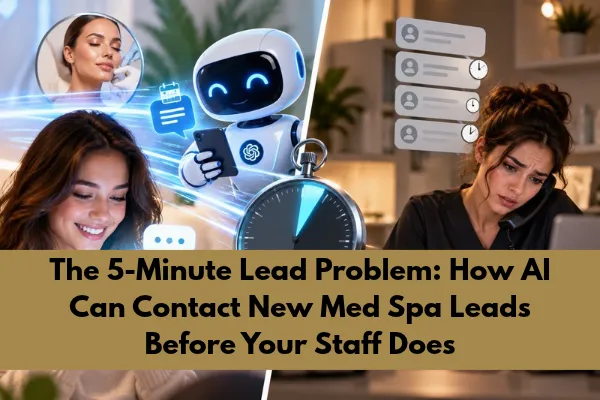
The 5-Minute Lead Problem: AI Contacts Med Spa Leads First
Your ads are doing their job. Facebook, Instagram, Google, website chat, even missed calls. The pings never stop. Then silence. Your calendar does not move. Sound familiar? That stall between lead and first reply is the 5-minute lead problem. If you do not contact a new med spa lead in the first few minutes, your odds nosedive. We see it every week. Strong campaign. Slow reply. Lost booking.
Here is the fix. Set up an AI first-response system that replies in under 60 seconds. It qualifies, gives the right next step, and books. All while your team checks out a client. No more babysitting DMs. No more late-night forms going cold by morning. A simple workflow, done right, stops the leak.
In this article we map your lead sources, find the delays, add an instant AI acknowledgment, ask sharp qualification questions, open a clean booking path, set clear escalation rules, and track lead-to-appointment rate so you can prove the gain. The idea is simple. The setup needs care. I will show you how we do it and what to avoid so you do not trip compliance or wreck your team’s day.
Your staff can be busy. Your new leads should never have to wait.
Use AI to respond to new med spa leads within minutes, start the conversation, and help turn more of the leads you already generate into booked appointments.
Get AI Following Up With Your Leads 24/7
What an AI First-Response System Actually Does
Think of it as a 24/7 lead concierge. When a new inquiry hits, the system detects it, replies within 30-60 seconds, and keeps the chat moving. It keeps going until one of two things happens. The appointment gets set or a human takes over.
How it works under the hood, in plain English:
Capture every channel, Facebook Lead Ads, Instagram DMs, Google Business Messages, website forms and chat, click-to-call missed calls, even text-to-landline.
Normalize the data, name, phone, source, time, consent status, tags.
Respond with a compliant, friendly text or DM within 60 seconds. Tone matches your brand. It auto-detects language and flips to Spanish if needed.
Qualify with 2-4 smart questions. Area of concern, timing, budget range, new or returning, and red flags like Accutane within 6 months for lasers.
Book by dropping your online scheduler or placing the hold inside your practice CRM. Double confirmation and a calendar invite go out right away.
Escalate to a human based on rules, urgency, or safety keywords.
Track the right metrics, speed to first touch, contact rate, appointments set, show rate, cost per appointment.
Who it is for, honestly, any med spa spending $1, 000+ per month on ads. Also for teams tied up at the front desk. Also for any owner tired of, “We saw your message this morning.” If you see more than 30 leads a month, the system pays for itself in most markets.
How it differs from the old auto-reply, it runs real conversation. Not a one-line “We will call you soon.” It asks, listens, reads intent, and moves to booking. And it works with your team. When you need a person, it gets one, fast.
Regulatory and safety note, this is not an FDA device. It is a communication workflow. You must follow TCPA for texting, CAN-SPAM for email, 10DLC brand and campaign registration for business texting, and HIPAA if you handle any protected health info. Keep intake light in DMs and SMS. Push anything clinical to secure forms.
Why we use this now, years ago we used basic autoresponders. Then chatbots. They helped a bit. The big jump came with modern AI that reads intent and handles branches without getting stuck. Today, we reply in under a minute with context and still hand off cleanly to a person.
Map Where Your Leads Actually Come From
Before you add anything, map every source. You need clarity, not guesses. Here is the short list we audit first:
Facebook Lead Ads forms
Instagram DMs and comments
Google Business Messages and Click-to-Call missed calls
Website forms, quiz funnels, and chat widgets
Landing pages for promos, Botox day, new device launches
Third-party marketplaces and directories
Write down three numbers for each source, average daily volume, average reply time, and appointment set rate. If you do nothing else today, do that. You will find gaps in minutes. We always do.
Where Response Delays Hide, And Why Minutes Matter
Here are the usual choke points we keep seeing:
After-hours leads, replies the next day, 12-18 hours late. These are the coldest by morning.
DMs during service hours, staff is in a consult, replies in 30-90 minutes. Too slow.
Form submissions routed to email, the inbox is crowded, reply in 1-4 hours.
Missed calls without text back, no reply at all, or a call return after 1-2 hours.
Speed matters. A lot. Industry studies found that reaching out within 5 minutes can raise contact rates by 3-10x compared to waiting 30 minutes or more. In our clinics and partner accounts, dropping first contact to under 60 seconds often doubles appointment set rate within 2-3 weeks. Not every market. Not every month. Often enough that we treat it as a rule.
Build The Instant AI Acknowledgment That Stops Lead Decay
The first message sets the frame. Keep it clear, short, and helpful. Here is a template that works:
“Hi Sarah, this is the concierge for [Your Med Spa]. Thanks for reaching out about Botox. Are you hoping for weekday or Saturday? We can hold a spot and text you the details.”
Key parts baked in:
Brand identifies itself, not a mystery number.
Mentions the treatment they asked about, Botox, filler, laser hair removal, acne care.
Asks a simple either, or question to get a fast reply, weekday or Saturday.
Offers a next step, hold a spot, then send details.
Compliance, include opt out, “Reply STOP to opt out.”
Language matters. We see a 15-25% higher reply rate when the opener asks a simple choice, instead of a vague “How can we help?” Last month, a lead picked Saturday in 19 seconds. Booked in three minutes. No staff involved.
The Qualification Questions That Move People To Book
You need enough data to route and book. Do not turn DMs into a chart. Keep it tight:
“Is this your first visit with us?”
“Which area are you hoping to treat first, forehead, lips, jawline, sun spots?”
“What timing works best, next 48 hours, this week, or next week?”
“Rough budget, under $300, $300-$600, or $600+?”
“Any recent tanning, Accutane in the last 6 months, or active breakouts?” for laser or peel interest.
“Do you prefer downtown or our north location?” if you run multi-site.
Pro tip, the AI should ask only 2-4 questions before it offers times. Long threads lose people. We learned that the hard way.
How many leads are you losing while your staff is busy?
Every minute a new lead waits is another opportunity for them to contact the med spa down the street. Put AI on the front line so new inquiries get an immediate response instead of sitting untouched.
Stop Losing Leads to Slow Follow Up
Create a Booking Path That Works 24/7
There are three clean ways to book without a person staring at a screen:
Direct link to your online scheduler, opens right in the thread, confirms by text. Fast and simple.
Calendar hold inside your CRM, the AI offers two times, places a soft hold, then finalizes once the client taps one.
Deposit flow for high-demand promos, a small hold fee reduces no-shows by 20-40% in our data. Use it sparingly, be clear about refund rules.
The system should send a confirmation, add prep notes, parking tips, and a reschedule link. If the client goes quiet after picking a time, trigger a nudge at 30 minutes, then 2 hours. It saves more bookings than you think. We recover about 1 in 6 this way.
Smart Escalation Rules So Humans Jump In At The Right Moment
AI should not guess on safety or pricing edge cases. Set rules:
No reply after 5 minutes, ping your front desk in Slack, Teams, or SMS. A quick human hello often revives the thread.
High-intent signals, “I can come in today, ” “I have a wedding this weekend, ” push to human now.
Screening flags, pregnancy, Accutane, recent laser elsewhere, escalate for human review.
Complex quotes, full-face filler plan, combination packages, get a consultant involved.
After-hours balance, between 7 pm and 7 am, limit to soft booking and info, then hand off at open.
Every escalation should include context. Send the full thread, the lead source, and suggested next steps. Your team should not dig through three inboxes to catch up.
Track The Numbers That Prove It Worked
If you do not measure, it turns into a vibe, not a result. Track these seven:
Speed to first touch, seconds from lead to first reply. Goal, under 60 seconds.
Contact rate in 24 hours. Goal, 60-80% depending on channel.
Qualified lead rate. Goal, 50-70% for paid social, higher for referrals.
Appointment set rate. Baseline is often 15-25%. With fast reply it moves to 35-55%.
Show rate. Add reminders and prep notes. Goal, 80-90% for consults, 90%+ for paid holds.
Cost per appointment. Ad spend plus software divided by booked visits. Aim to improve by 20-40% in 30 days.
Revenue per appointment. Track day-of and 90-day follow-up for true ROI.
Put these on a simple dashboard. Review weekly. If one number slips, fix that step, not the whole system.
Solution Comparison, What Actually Works
Treatment | Best For | Cost Range | Results Timeline | Duration |
|---|---|---|---|---|
AI First-Response Concierge [RECOMMENDED] | High lead volume, after-hours coverage, consistent booking | $300-$1, 200/mo + setup | 1-2 weeks to see lift | Always on, 24/7 |
Manual Staff Only | Low volume clinics, boutique practices | $0-$6, 000/mo in labor | Varies, reply in 30-180 minutes | Business hours only |
Basic CRM Auto-Reply | Immediate acknowledgment, no conversation | $0-$200/mo | Instant, but low conversion gain | Always on |
Cost And ROI, With Real Numbers
Budget ranges change by stack and market, but these ballparks hold:
Software, $300-$800 per month for AI assistant, texting, and routing.
Phone and text, $0.0075-$0.015 per SMS, voice minutes extra.
Setup, $1, 500-$5, 000 one time if you bring in a pro, or a few long weekends if you build it yourself.
Team time, 6-10 hours to train and test.
Quick math. You spend $2, 500 on ads in a month. You get 120 leads. Manual follow-up books 24 consults at a 20% set rate. With fast AI reply, you move to 45 consults at 37.5%. If your average day-of revenue is $350, that is $7, 350 more revenue in 30 days. The stack costs $1, 200 all-in that month. Net gain is $6, 150 before labor. Even if your market runs colder, the payback is usually in weeks, not quarters.
Safety, Compliance, And Data Privacy
Do it right, and you sleep at night. Here is the short compliance checklist we use:
Consent on every form and ad. Clear language, “By submitting you agree to receive texts. Reply STOP to opt out.”
10DLC registration for business texting, brand and campaign approved before you scale volume.
TCPA rules, send only during allowed hours in your state, honor do-not-call, log opt outs.
HIPAA, keep DMs and texts non-clinical. Push intake to secure forms inside your EMR or HIPAA-ready CRM.
Data retention, set automatic redaction timelines for messages if needed, 30-90 days works for most.
Human review for anything that smells clinical, side effects, contraindications, adverse events.
One more point. Train your AI with safe language. It must never diagnose, never recommend a prescription, and always defer to a licensed provider for medical advice.
People Also Ask, 10 Practical FAQs
Will this feel robotic to my clients?
Done well, no. Keep the opener short, use normal words, and answer like a person. We A/B test tone. “Hi there” beat “Hello” by 12% on reply rate in one account.How fast should the first reply be?
Goal is under 60 seconds. Under 30 seconds is even better for DMs and Google Messages.Does this replace my front desk?
No. It handles the first touch, basic questions, and booking. Your team still does consults, complex quotes, and care.What about Spanish or other languages?
Use auto-detect and verified templates. Spanish threads often lift contact rate by 10-20% in mixed markets.What if AI answers something wrong?
Use guardrails. A blocklist of medical topics, a confidence threshold, and fast escalation. Also, version your prompts and review transcripts weekly.Can this work after hours and on weekends?
Yes. That is the point. Keep it to booking and FAQs at night. Medical questions wait for open hours.How do you stop no-shows?
Send a reminder 24 hours and 3 hours before. Include parking and prep notes. Offer a waitlist. Deposits reduce no-shows by 20-40% for promos.Will it work with my current CRM?
Most modern CRMs with webhooks or APIs connect fine. Keep one source of truth for calendar and tags.What about duplicate leads?
Deduplicate by phone and email. Merge threads. If someone returns within 30 days, greet them like a friend, not a stranger.How long does setup take?
DIY in 2-4 weeks. With an experienced team, 7-14 days to live in most cases.
How to Launch a 60-Second AI Response System at Your Med Spa
Here is exactly how we roll this out, plus what to avoid:
Step 1: Map Lead Sources And Baseline (Week 1)
Export leads from Facebook, Instagram, Google, and your CRM. Time ten random inquiries per channel. Measure reply time and booking rate. Cost, your time. Mistake to avoid, trusting dashboard averages without spot-checking actual threads.Step 2: Set Up Compliant Messaging (Week 1)
Register 10DLC, add consent language to every form and ad, and set quiet hours. Cost, $50-$150 for registration plus your texting plan. Pro tip, approve templates for promos and after-hours ahead of time.Step 3: Build The Instant Acknowledgment (Week 2)
Create 3 openers per service line. Add STOP language, Spanish versions, and a fallback if the name is missing. Aim for 30-60 seconds from trigger to send. Mistake to avoid, long first messages.Step 4: Add 2-4 Qualification Questions And Booking (Week 2)
Write questions for Botox, filler, laser, and skin health consults. Connect your online booking. Decide on deposits for high-demand days. Pro tip, ask timing before budget. It feels easier and gets more replies.Step 5: Define Escalation And Human Handoff (Week 2-3)
Set rules for no reply at 5 minutes, safety flags, and VIPs. Route alerts to Slack or SMS with the full thread. Mistake to avoid, sending your team to multiple inboxes.Step 6: QA With 50 Test Leads And Go Live (Week 3)
Run 50 test submissions across channels. Check tone, timing, booking, and opt-out. Fix edge cases. Then go live. Expect a 20-40% lift in set rate inside 2-3 weeks if your offer is solid.Step 7: Track, Review, And Tune Weekly (Ongoing)
Post a weekly scorecard, speed to reply, contact rate, set rate, show rate, revenue per appointment. Change one thing at a time. Pro tip, rotate openers monthly to avoid fatigue.
Where An AI Setup Partner Is Worth It
Knowing the workflow is the easy part. Wiring every channel, staying compliant, catching edge cases, and keeping it reliable, that is the job. If you are tired of duct tape, bring in a team that does this all day. They will set it up, train your staff, and keep it humming. You focus on results, not webhooks.
Final Thoughts
Your ads earned attention. Do not waste it. The 5-minute lead problem is fixable with a simple system that replies fast, asks smart, books cleanly, and hands off when it should. Build it once. Watch the calendar match your marketing. Enjoy the quiet relief of not babysitting DMs at midnight. If you want help, we can map it, connect it, and make it run, every minute of every day.