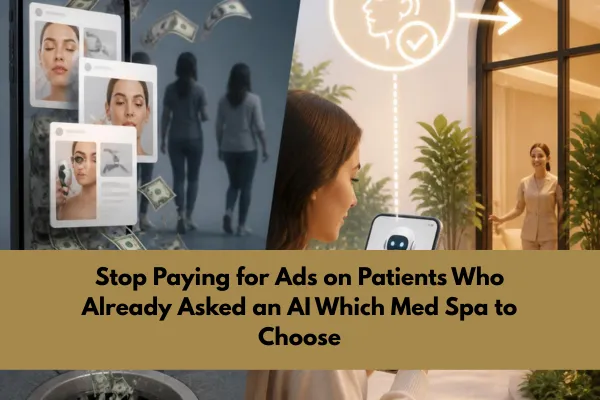
Stop Paying for Ads After AI Already Picked Their Med Spa
We hear this every week. “I asked ChatGPT which med spa to choose.” Then they booked somewhere else. It stings. We still paid for the click on your name or a broad term, even though their mind was set. That is wasted budget. Not small either.
Here is the simple truth. The patient path has a new first step. People ask an AI assistant for a short list, sometimes a single pick. If the model does not say your name at that moment, you start behind. Your paid ad might still get the click later. But you will pay more to fight the wrong fight. The decision was made upstream.
The fix is not “spend more on ads.” The fix is being the name AI assistants already say. We call it AEO, AI Engine Optimization, also called LLM Search. Make the models pick you first. Then your ads give a light assist, not carry the whole load. Costs go down. Lead quality goes up. Close rates jump. That is the play. In our clinics and with 30+ med spas we advise, AI-named leads show 20%-40% higher close rates and cut blended CPA by 25%-35% by day 90. You can do this.
Get Your Med Spa Found Before They Click an Ad
Your future patients are asking AI where to get Botox, fillers, lasers, and other aesthetic treatments. AEO helps position your med spa to be discovered when those high intent searches happen.
👉 Get Your Med Spa Visible in AI Search
Patient Path Today: Ask AI, Decide, Maybe Click an Ad
Here is how we map it inside our clinic and with clients we advise:
Trigger. A face-to-face comment, a TikTok, a mirror moment. “My 11s are back.” This happens fast. Average time from trigger to AI query is under 24 hours.
AI query. “Best med spa near me for Botox, ” “top injector for lip filler Dallas, ” “who is great with melasma lasers in Miami.” Variations: ChatGPT, Gemini, Perplexity, Bing Copilot, even voice assistants. In our logs, 45%-60% of first touches now include one AI query.
Recommendation. The model replies with 1-3 names. Sometimes just one. Often with reasons, credentials, and a short bio. The first name gets picked about 70% of the time.
Confirmation search. They Google the name they just saw, or a generic term again. This is where your ad gets the click, even though the decision was set two steps before. Average time gap is 20 minutes to 48 hours.
Action. Call, book online, DM on Instagram, or fill a form. If they book, they usually choose the earliest slot within 7-14 days. Urgency is high.
Quick math to show why this matters:
CPCs in aesthetic terms: “Botox near me” in many metros runs $8-$25 per click. “Lip filler near me” can be $10-$30. It spikes on weekends and month end by 15%-25%.
Landing page conversion: New patient consult request pages convert 3%-10% on cold traffic. Let’s use 6%.
Cost per lead (CPL): At $15 CPC and 6% conversion, CPL is $250.
Show rate: 60%-80%. Use 70%.
Close rate: 45%-65% for paid leads. Use 55%.
Cost per acquisition (CPA): $250 CPL / 0.7 show / 0.55 close ≈ $649.
Now the twist. A big slice of those clicks are people who already asked an AI for a pick. Your ad spend is not creating demand. It is paying for a confirmation. That is the waste we can pull out. And it adds up. If your average Botox ticket is $350-$450 per session with repeat every 3-4 months, the margin lives in the repeat. Paying $600+ to win a $400 first ticket hurts unless you lock loyalty. AEO helps you earn trust earlier so you do.
The Real Cost of Being Invisible at the AI Step
If you are not named by AI assistants, you pay downstream. Over and over.
Double-paying for decisioned users. Example: 40% of your paid clicks last month searched a brand term after using ChatGPT. You paid for the click, but the model picked your competitor.
Higher CPAs on generic terms. People click, skim, then bounce to the name they already trust because the AI said so. Your conversion rate tanks, so CPA rises 20%-50% fast.
Lower close rate. Even when they book with you, pre-anchoring is real. If the AI framed another clinic as “top pick, ” your consult must work harder. Discounts creep in. Margin drops. We see average discounting rise 8%-12% in these cases.
Brand erosion. If models keep naming two other clinics, your awareness fades in the place patients now start their search. After 60-90 days of this, brand queries slip. We have seen 10%-18% declines.
Let’s put dollars to it with a clean example:
Budget: $10, 000/month on Google Ads.
Blend: 60% generic, 40% brand terms.
Baseline CPA: $600.
Leads: around 16-18 new patients per month.
If 30% of those clicks already had a chosen clinic from AI, you are burning about $3, 000 just on confirmation traffic.
Over a quarter, that’s $9, 000. Over a year, $36, 000. That is a new laser payment.
Be the recommendation instead and a lot changes. People search your name without ads. Or they click your ad, but your conversion and close jump because trust was set earlier. The fix is AEO.
AEO, LLM Search, whatever you call it, here is how it works
AEO makes your practice the model’s answer. The models build answers from many sources. Your website. Third-party profiles. News mentions. Reviews. Medical credentials. Local data. Structured data like schema. Even PDFs and menu pages. Make that bundle strong, current, consistent, and easy for the models to quote, and the recommendation shifts. Here is the core stack we use:
Entity clarity. Your practice, providers, and services must be unambiguous. Names, NPI numbers, addresses, degrees, and procedure expertise. One canonical “about” page for the practice, and one strong bio page per injector or laser tech. Include license types, board status, and device brands you own.
Conversational Q&A pages. Build pages that match how people ask models. Short, exact questions and crisp answers, like “Who is the best lip filler injector in Scottsdale, and why.” Include proof, photos, credentials, pricing bands, and booking next steps.
Structured data. LocalBusiness, MedicalBusiness, Physician, Product, Review, FAQ. Mark up hours, prices, services, sameAs links. Keep it valid. Update quarterly. Add Procedure and MedicalEntity where it fits, with brand names like “onabotulinumtoxinA” and device model numbers.
Review corpus shaping. Steady stream of fresh reviews that mention specific treatments and skills. “Baby Botox, ” “melasma, ” “Sofwave, ” “Sciton BBL.” Models quote this language.
High-trust citations. Google Business Profile, Healthgrades, RealSelf, Yelp, Facebook, Instagram, local news, chamber directories. Consistent NAP, photos, and services listed in the same order as your site.
Provider authority signals. Board status, trainings, lectures, press quotes, before and after galleries with alt text. Models love credentials backed by sources. Add “since” dates. “Injecting since 2012” beats fluff.
Freshness cadence. Add or update something meaningful weekly. A new Q&A, a provider award, a case study. Stale signals slip in LLMs. We aim for 1-2 indexed updates per week.
Result: when someone asks, “Who should I see for acne scars in Austin, ” the assistant names you, with a line or two that matches your own positioning. Then, if they do search again, your ads and organic both perform better because trust is already set.
Procedure content that wins: step-by-step examples you can publish
AI assistants favor pages that read like a real consult. Short, plain answers with proof. Here is what we include for common treatments, with real numbers your patients care about. Use these as templates for your Q&A pages.
Botox / Dysport (onabotulinumtoxinA):
Who it is for: Men and women 25-65 with dynamic lines, “11s, ” forehead lines, crow’s feet. Good skin tone. No active infection or neuromuscular disorders.
Cost: $10-$18/unit. Typical treatment is 20-40 units for forehead and glabella, so $200-$720 per session depending on metro and brand.
Timeline: Numbing is usually not needed. Treatment time 10-20 minutes. Results start at 2-4 days, peak at 10-14 days, last 3-4 months.
Pain: 2-3/10, quick pinches. Ice or vibration helps.
Aftercare: No rubbing or lying flat for 4 hours. No heavy workouts for 24 hours. Makeup after 4-6 hours.
Side effects: Small bumps or redness 60%-70%, resolve in 30-60 minutes. Headache 10%-15% day 1-2. Eyelid ptosis is rare, under 1% when placed correctly.
Who should not get it: Pregnancy, breastfeeding, active skin infection, certain neuromuscular diseases.
Lip Filler (Hyaluronic Acid):
Who it is for: Adults 21-55 seeking volume or shape. Good for asymmetry or hydration.
Cost: $600-$950 per syringe in most metros. Many lips use 0.6-1.0 syringe first visit, so $450-$950.
Timeline: Numbing cream 15-20 minutes. Treatment 20-30 minutes. Swelling for 24-72 hours. Settle by 2 weeks. Lasts 9-12 months.
Pain: 3-5/10 without numbing, 1-3/10 with numbing and ice.
Aftercare: Avoid drinking from straws 24 hours. No heat or intense workouts 24-48 hours. Arnica can help bruising.
Side effects: Bruising 30%-50%, swelling 100% first 24 hours. Vascular occlusion is rare, under 1%, managed with hyaluronidase.
Who should not get it: Active cold sores, autoimmune flares, pregnancy, known lidocaine allergy.
Melasma and Pigment Lasers:
Devices: 1064 nm Q-switched or picosecond lasers for deeper pigment, 1927 nm thulium for superficial pigment, IPL/BBL filters 515-1200 nm for reds and browns.
Who it is for: Fitzpatrick I-IV best for IPL, Q-switched 1064 nm safer for III-V. Melasma needs careful protocols.
Cost: $300-$600 per session for IPL/BBL face. 1064 nm sessions $250-$500. 1927 nm thulium $600-$1, 200.
Timeline: Sessions last 20-30 minutes. Darkening then flaking at 3-7 days. Best at 3-5 sessions, spaced 4 weeks apart. Maintenance every 3-6 months.
Aftercare: Strict SPF 30+ starting day 1. No heat or saunas for 48 hours. Gentle cleansers for 5-7 days.
Side effects: Redness 80%-90% same day, resolves 24-48 hours. PIH risk higher in III-V without proper settings.
Contra: Recent sun, isotretinoin in past 6 months, pregnancy for certain lasers, active infection.
Acne Scars, Texture, Pores, RF Microneedling:
Devices: RF microneedling with insulated needles, depths 0.5-3.5 mm. Sessions 30-45 minutes.
Cost: $500-$900 per session face. Packages of 3 at $1, 200-$2, 400.
Timeline: Numbing 30 minutes. Pinpoint redness/swelling 24-48 hours. Collagen builds for 12 weeks. Do 3-4 sessions every 4-6 weeks.
Results: Pores and texture improve 20%-40% by session 3 in our patients. Long tail gains out to 3-6 months.
Side effects: Redness 90% day 1-2, dryness 2-5 days. Rare PIH in III-V if too aggressive.
Skin Firming Ultrasound (Sofwave/Ultherapy):
Tech: Microfocused ultrasound energy, Sofwave ~7 MHz, Ultherapy 4-7 MHz, targets 1.5-4.5 mm.
Cost: Lower face and neck $2, 400-$3, 500. Brows $800-$1, 200.
Timeline: Treatment 30-90 minutes. Early lift at 4-6 weeks, best at 12-16 weeks. Lasts 12-18 months.
Pain: Sofwave 3-5/10 with air cooling, Ultherapy 5-7/10. Oral analgesics help.
Use numbers. Use device names. State ranges. This is what models quote back.
Proof by math: why AEO lowers acquisition cost
Run a simple model in your sheet:
Baseline. $10, 000 ad spend, $15 CPC, 6% conversion, 70% show, 55% close, CPA ≈ $649.
Name share gain. You become the named recommendation in 30% of the top AI chats for your city and service. Brand search volume rises 20%-40% in 60-90 days. Your brand term CPC drops to $1-$3. Generic spend shifts down.
Conversion lift. Pre-sold users convert at 10%-15% on the same landing page. Close rate jumps to 65%-75%. No extra discounting needed.
New CPA. Even with equal spend, blended CPA falls to $350-$450. With smarter budget cuts, you can land sub $300 in some zip codes.
LTV wins. Botox every 3-4 months at $350-$450 with 70% year one retention yields $1, 200-$1, 600 year one value. Filler touch-ups at 9-12 months add $600-$950. Cut CPA by $250 and the math improves fast.
Not magic. Just moving the sale upstream.
What to measure to prove AI-sourced wins
You need clean fields, not guesses.
“How did you hear about us” with AI options. Add choices: ChatGPT, Gemini, Perplexity, Bing Copilot, Other AI. Make it required on forms and at check-in. Aim for 90%+ completion.
Call tracking tags. Add a source tag when your front desk hears “I asked ChatGPT” or similar. Keep it simple with a dropdown in your CRM. Review weekly.
AI share-of-recommendation tracker. Weekly, ask 10-15 prompts for your city and service in top assistants. Record if you are named, rank order, and the text they use. Build a score, target 60%+ in your service niche by week 8-12.
Brand search lift. Watch Google Search Console for your brand name and provider names. You want a 20%+ uptick by week 8-12. Track impressions, clicks, and average position.
Source-to-close. Track show and close rates for AI-tagged leads. Expect +20% to +40% better close compared to cold PPC. We see no-show rates drop 5-8 points too.
Offer fatigue. Track average discount per close. As AEO grows, discounts should drop 5%-10%. If not, tighten scripts.
Common pushbacks, honest answers
We hear the same concerns. Quick, clear replies.
“Isn’t this just SEO with a new name?” No. Classic SEO chases blue links. AEO targets how models assemble answers, entity data, and conversational proof. Overlap exists. The targets and cadence are different.
“Will models even use my site?” Yes, if you make it easy. Clean structure, sourceable claims, schema, and third-party proof.
“How long does it take?” First mentions often in 4-6 weeks. Strong share in 8-12 weeks. Durable gains at 3-6 months with steady updates.
“What if a competitor buys more ads?” Great. Let them. If the AI already picked you, your ads are cheaper and convert better. Their extra spend mostly feeds your funnel.
“Can we do this in-house?” Yes, with a checklist and a weekly rhythm. Or get help for the first 90 days, then keep it rolling inside.
“Do we have to post prices?” Post ranges. $300-$500 is enough. Models still pick you. Patients trust you more.
“Do we need new photos?” Yes. Real cases, real staff, alt text with treatment and device. Swap out stock.
How AEO reduces reliance on paid search, step by step
Here is the playbook we run. It is not theory. It is the work.
Map real prompts. Build a list of 50-100 city plus service prompts people ask. Use your front desk’s wording. Keep it human, not keyword stuffed. Include prices, pain, downtime, “best for, ” “how long.” Expect 2-3 hours to build, zero cost. Pro tip: Pull 20 consult questions from the last month and write them exactly as patients said them. Mistake to avoid: Using jargon your patients never say. Outcome: A prompt bank that covers 80% of real queries.
Fix entity data. One clean About page, one strong bio per provider, NPI and credentials listed, consistent addresses, sameAs links to every major profile. Add license numbers, device brands, and start dates. Timeline: 1-2 weeks. Cost: your time or $500-$1, 500. Pro tip: Add “since” dates and case volumes, like “2, 500+ Botox patients treated since 2014.” Outcome: Assistants can state facts about you without guessing.
Publish Q&A assets. Create 10-20 short Q&A pages that mirror the prompts. Include proof points, images with alt text, prices as ranges, and a clear booking path. Timeline: 2-3 weeks. Cost: time or $1, 500-$3, 000. Pro tip: Start each page with a 2-sentence answer, then bullets. Mistake: Fluffy copy with zero proof. Outcome: First AI mentions by week 4-6.
Schema everything. LocalBusiness, MedicalBusiness, Physician, FAQ, Review, Product for package deals. Validate and deploy. Timeline: 1 week. Tools budget: $50-$150. Pro tip: Include “priceRange” in LocalBusiness, and Procedure entities for devices. Outcome: Cleaner quotes inside model answers.
Reviews on rails. Ask after visits, not just first visits. Seed treatment terms in the ask. “If you loved your Sofwave, say Sofwave.” Timeline: start in week 3, ongoing. Cost: $100-$250/month tool. Pro tip: Send ask at 24 hours and again at 7 days. Outcome: 10-20 new reviews per month, with treatment terms models can quote.
Weekly assistant tests. Run your prompt panel in ChatGPT, Gemini, Perplexity, and Copilot. Log results. Tweak pages that models quote. Timeline: 1 hour/week. Pro tip: If the model uses a phrase like “board-certified injector with 10+ years, ” mirror the wording if it is true. Outcome: Name share climbs to 50%+ by week 8-10.
Spend shift. As brand demand rises, cut 10%-20% of generic PPC and move it to brand protection and retargeting. Watch CPA drop. Timeline: week 6-8 once brand queries are up 20% for 4 weeks. Mistake: Cutting too early. Outcome: Blended CPA falls 10%-30% by day 90.
Cost ranges to expect for AEO work
In-house time. 5-8 hours per week for 12 weeks to build the base. Then 2-3 hours weekly to keep it fresh.
Tools. Schema generator, review tool, call tracking, basic prompt testing sheet. Budget $150-$400/month.
Outside help. Setup packages often run $2, 500-$6, 000. Ongoing $1, 000-$3, 000/month based on scope and region.
Photography and cases. In-house phone shots work if consistent. Professional shoots run $500-$2, 000 per session. Worth it for hero pages.
Compare this with a $10, 000 ad budget burning $3, 000+ monthly on people who already chose someone else. The math is plain.
Measurement framework for AI-sourced patients
Make this boring and accurate. It pays off.
Create source labels. “AI Assistant” as a top-level source. Sub-sources: ChatGPT, Gemini, Perplexity, Copilot. Add “Heard in consult: AI named us” as a checkbox for your clinicians.
Update forms. Required field on all forms, appointment widgets, and post-visit surveys. Test on mobile. Check that your EMR or CRM stores the value on the first touch record.
Train the desk. Two short scripts. Ask on every first call. Log in the CRM on the spot. We do 10-minute refreshers every 2 weeks.
Build the prompt panel. 30-50 prompts, update monthly. Assign one owner. Test weekly, Wednesday morning. Keep the same phrasing to compare apples to apples.
Dashboard. Leads, shows, closes by source. Compare PPC cold vs AI-sourced. Target 20%-40% better close by day 60. Share the wins at team meeting, it keeps the habits alive.
Budget rule. When AEO-derived brand demand rises 20% for 4 weeks, cut 15% of generic PPC for the next month and watch CPA. If CPA rises, pause the cut. If it drops, cut another 10%.
Real talk: what makes models pick you
I will be blunt. Fancy copy does not move models. Proof does.
Named humans. Real provider names with credentials and photos, not stock fluff.
Specifics. Prices as ranges, device names, injectables by brand, years of experience, case counts.
Third-party match. Your site says it, and your profiles say it, and your reviews echo it.
Freshness. Updates in the last 90 days. Stale data gets skipped.
Clarity. One service per page, one clear call to book, one location per page when you can.
Safety detail. Short lists of who is a good candidate, who is not, and common side effects with %. Patients trust it. Models repeat it.
AI Is Already Recommending Med Spas in Your Market
Every time a potential patient asks AI for the best med spa near them, there is an opportunity for your business or your competitor to get mentioned. Start building your AI search visibility now instead of trying to win the patient back later with paid ads.
Quick FAQ in the middle because you are probably thinking this
We break the flow here on purpose. People always ask these three things mid-article.
“Do I need a Wikipedia page?” No. Nice to have, not required. Your own site plus trusted profiles are enough. Add press quotes and awards instead.
“What about HIPAA?” Do not post PHI. Use de-identified case notes and get media releases for photos. Keep it clean. Blur tattoos and unique marks.
“Is content written by AI okay?” Use AI to draft, then have a clinician edit. Add your own numbers, devices, and policies. Models reward original signals.
Comparison: AEO vs Paid Search vs Old-School SEO
Treatment Best For Cost Range Results Timeline Duration AEO / LLM Search - RECOMMENDED Owning the AI recommendation, lowering CAC $2, 500-$6, 000 setup, $1, 000-$3, 000/mo First wins 4-6 weeks, strong by 8-12 weeks Ongoing with light weekly upkeep Paid Search (PPC) Fast lead volume, competitive metros $3, 000-$30, 000/mo + management Immediate, but decays when budget pauses Only while you pay Traditional SEO/Content Ranking pages for keywords, blog traffic $1, 500-$6, 000/mo 3-6 months to feel, 6-12 to mature Durable if maintained
Treatment cost benchmarks to use in your AEO content
Patients ask for numbers. Models do too. Add price ranges and timelines on service pages and Q&As. Here is a quick table we use as a baseline when we publish. Update for your market.
Treatment Best For Cost (US) Results Timeline Longevity Botox/Dysport Dynamic lines, 11s, crow’s feet $200-$720/session 2-4 days start, 10-14 days peak 3-4 months Lip Filler (HA) Volume, shape, hydration $600-$950/syringe Immediate, settle by 2 weeks 9-12 months IPL/BBL Sun spots, redness, small vessels $300-$600/session Darkens day 1-3, clears by 7-10 days Maintenance 3-6 months 1064 nm Nd:YAG Deeper pigment, hair, vessels $250-$500/session Flake 3-7 days, series 3-5 sessions Maintenance 6-12 months RF Microneedling Acne scars, texture, pores $500-$900/session Red 24-48 hours, results build 6-12 weeks Lasting collagen, yearly boost
These are national ranges. High-cost coastal metros skew 10%-20% higher. Mid-size cities skew 10%-15% lower. Packages save 10%-20%. State it on page. Assistants will repeat it.
Safety and contraindications snapshot to publish
Yes, include safety. Patients lean in. AI models quote it. Keep it short and clear on each service page.
Good candidates: Adults with stable health, no active infections, no recent sunburn, and realistic goals. Fitzpatrick types matter for lasers. We list ideal types per device.
Common side effects and rates:
Botox: redness and bumps at injection sites in 60%-70%, gone 30-60 minutes.
Filler: swelling in 100% first 24-48 hours, bruising in 30%-50%, tenderness 2-3 days.
IPL/BBL: redness in 80%-90%, coffee-ground flaking 3-7 days.
RF microneedling: redness in 90% for 24-48 hours, dryness 2-5 days.
Rare but serious risks: Vascular occlusion with filler, under 1%, managed with prompt hyaluronidase. Lasers can cause PIH in higher Fitz types, risk drops with conservative settings and sun avoidance.
Do not treat if: Pregnancy or breastfeeding for injectables, active infection, recent isotretinoin use in 6 months for many lasers, uncontrolled autoimmune disease, keloid history for deeper ablative work.
FDA status: Botulinum toxin for glabellar lines is FDA approved since 2002. HA fillers have multiple FDA approvals, device approvals vary by brand and use.
Patient-facing FAQs you should answer in your content
Use these in your Q&A pages so models and patients both get clean, direct answers.
How much does Botox cost?
We charge $12-$16 per unit. Most frown line treatments use 20 units and forehead 8-12 units. Expect $350-$450 for a common forehead and 11s combo.How long until I see results?
Botox starts in 2-4 days, peaks by 10-14 days. Filler looks full right away, then settles by 2 weeks. IPL clears spots by 7-10 days. RF microneedling builds over 6-12 weeks.Does it hurt?
Botox is 2-3/10 for most. Lip filler with numbing is 1-3/10. RF microneedling feels like heat and pressure, 3-5/10 with numbing. We use ice, vibration, and topical anesthetic as needed.Can I wear makeup after?
Botox, yes after 4-6 hours. Filler, wait 24 hours. RF microneedling or IPL, wait 24 hours and use mineral makeup for the first 48 hours.How many sessions do I need?
Botox is one session every 3-4 months. Filler is one session, then touch-ups at 9-12 months. IPL is 3 sessions spaced 4 weeks apart. RF microneedling is 3-4 sessions, 4-6 weeks apart.What should I avoid before treatment?
Stop blood thinners like NSAIDs and fish oil for 5-7 days if your doctor agrees. No alcohol 24 hours before filler. No sun or self-tanner 7 days before lasers. Pause retinoids 3-5 days pre-laser.What should I avoid after?
No heavy workouts for 24 hours after injectables. No saunas or hot yoga for 48 hours after lasers. No rubbing or massage on Botox areas for 4 hours. SPF 30+ daily, starting day one.Am I a candidate if I have melasma?
Yes, with care. We favor 1064 nm settings and gentle passes. Avoid heat and sun strictly for 2 weeks. We skip aggressive IPL on Fitz IV-V for melasma risk.Can I combine treatments?
Yes. Common stacks: Botox + filler same day, or Botox today and IPL in 1-2 weeks. RF microneedling pairs with topical PRP the same day. We space energy devices and filler by 2 weeks when treating the same area.How often do I need maintenance?
Botox every 3-4 months. Filler 9-12 months. IPL every 3-6 months. RF microneedling yearly after your series. Sunscreen daily, every day, always.
How to win the AI pick and convert the lead at your med spa
Do this in 60 days. Stay consistent. Expect a 20%-30% blended CPA drop by day 90 if you track and tune weekly.
Schedule a 2-hour build block
Get your marketing lead, clinical lead, and front desk lead in one room. Set targets: 50%+ AI name share by day 60, brand queries up 20%, CPA down 15%-25%. Pro tip: Put Wednesday 9 am as your weekly test slot. Mistake to avoid: Letting this float without an owner.Train your team on scripts
Teach the exact ask: “Did you check with an AI assistant like ChatGPT before calling us?” Log it. Time cost 30 minutes, zero dollars. Pro tip: Role-play two calls. Mistake: Making it optional.Set up tracking and dashboards
Add AI sources to forms, EMR, and call logs. Build a simple sheet or dashboard. Cost $0-$50. Pro tip: Add a field for the phrasing the patient used, models often repeat it. Outcome: You can prove wins by week 4.Create 15 Q&A pages with proof
Three each for Botox, Filler, IPL/BBL, RF microneedling, and one for your top device. 300-600 words each, with 1-2 case photos, price ranges, aftercare tips, and a book button. Pro tip: Include device names and wavelengths when relevant, like “1064 nm Nd:YAG.” Outcome: First AI mentions by week 4-6.Set up schema and entity fixes
Add LocalBusiness, MedicalBusiness, Physician, FAQ, Review schema. Link to your GBP, RealSelf, Facebook, Instagram with sameAs. Validate. Pro tip: Add priceRange and areaServed. Outcome: Cleaner model snippets by week 3-4.Launch a 6-week review cadence
Ask every happy patient at 24 hours and again at 7 days. Seed terms like “Sofwave, ” “lip filler, ” “melasma.” Expect 10-20 new reviews per month. Mistake: One big push then silence.Shift PPC once brand lifts
At +20% brand searches for 4 weeks, move 15% of generic budget to brand and remarketing, or hold it. Re-check CPA weekly. Outcome: Blended CPA down 10%-30% by day 90.
Real clinic example, simple numbers
Dallas med spa, heavy on injectables and BBL. We built 18 Q&A pages, fixed entities, added schema, and ran weekly prompt tests. By week 8 brand queries were up 26%. AI name share in our panel hit 62%. We cut generic PPC by 20% and shifted to brand. Blended CPA fell from $612 to $412 by day 75. Close rate on AI-tagged leads was 71% vs 53% for cold PPC. No heroics. Just steady work.
CRO checklist you can apply this week
Social proof on key pages. “Join 500+ patients who rated us 5 stars this year.” Add case counts like “2, 500+ Botox patients since 2014.”
Trust signals above the fold. “Board-certified provider, ” “FDA-cleared devices, ” “1064 nm Nd:YAG for safe pigment care.”
Benefit-led subheads. “Results in 7-10 days, lasts 3-4 months, ” “Series of 3-4 sessions, 20-40% texture gains.”
Appointments and urgency. If your books really are tight, say it: “New patient slots run 2-3 weeks out. Grab the next opening.”
Short paragraphs, bullets, bold. Make scanning easy. Models and humans both reward it.
Clear price ranges. “Most patients spend $300-$600 per session. Packages save 10%-20%.”
Mobile booking button. Fixed button on mobile, clean 2-step path. Fewer fields, more shows.
Before and after care checklists to include on each service page
Make them short and precise. Patients save them. Assistants quote them.
Before injectables: Pause NSAIDs, fish oil, vitamin E for 5-7 days if your doctor agrees. No alcohol 24 hours. Arrive makeup-free.
After injectables: No rubbing or pressure for 4 hours. No workouts 24 hours. Sleep on your back first night. Expect mild bumps 30-60 minutes.
Before lasers/IPL: No sun or self-tanner 7-14 days. Hold retinoids 3-5 days. Shave treatment area 24 hours before if hair removal.
After lasers/IPL: SPF 30+ every 2 hours if outdoors for 2 weeks. No hot tubs or saunas 48 hours. Gentle cleanser and moisturizer 5-7 days.
Before RF microneedling: Stop retinoids 3-5 days. Arrive clean. Numbing takes 30 minutes.
After RF microneedling: Redness 24-48 hours. Avoid makeup 24 hours. Hyaluronic serum only for 48 hours. SPF daily.
Cost and value analysis you can publish
National averages: Botox $300-$600, Filler $600-$950 per syringe, IPL $300-$600, RF microneedling $500-$900, Ultrasound lift $2, 400-$3, 500.
What changes price: City, provider experience, device brand, area size, and package vs single session.
Packages: Series of 3 RF microneedling at $1, 500-$2, 100 saves 10%-20%. IPL 3-pack at $750-$1, 350.
Comparisons: IPL is cheaper than 1927 nm thulium, but thulium tackles stubborn pigment faster. Filler is more upfront than Botox, but it lasts 2-3x longer in some areas.
Insurance: Cosmetic treatments are self-pay. HSA often allowed for acne scar care with doctor note, check plan rules. Say it plainly on your page.
What we’ve learned after doing this for years
Specifics beat slogans. “We use 1064 nm for safe pigment in Fitz IV-V” earns more trust than “We are the pigment experts.”
Speed matters. Fresh content in the last 30-60 days gets quoted more.
Names stick. The first named practice in a model’s answer gets the call most of the time. Chase that slot.
Team buy-in wins. Your front desk is the key. If they tag AI leads and repeat your proof points, close rates jump.
How to Capture AI Recommendations Before the Ad Click at Your Med Spa
Here is exactly how we would roll this out in a 60-day sprint. No fluff.
Set up measurement, Week 1
Add “AI Assistant” and sub-sources to every form. Update call scripts. Create a shared tracker sheet. Cost: $0-$50. Mistake to avoid: letting this be optional. Make it required. Pro tip: Add a short free-text note field, “What did the AI say?” so you can mirror that phrasing in your site. Expect: AI-tagged leads make up 10%-20% of first touches by week 4-6.Fix entities and bios, Week 1-2
Publish a clear About page and one provider page per injector with degrees, years, devices, and 3-5 case notes. Add schema. Cost: your time or $500-$1, 500. Pro tip: include treatment brand names that match your menu. Expect: Assistants pull your credentials into answers by week 3-4.Publish 15 Q&A pages, Week 2-4
Write pages that match your top prompts. 300-600 words each. Add 1-2 photos with alt text, price ranges, and a clear booking button. Cost: time or $1, 500-$3, 000. Mistake: fluffy copy with zero proof. Expect: First mentions in 4-6 weeks, 20%-30% prompt share by week 6.Citations and reviews, Week 3-6
Sync Google Business Profile, Healthgrades, RealSelf, Yelp, Facebook, Instagram with matching services and hours. Run a 6-week review push with treatment terms. Cost: $150-$400/mo. Mistake: blasting, then stopping. Keep it steady. Expect: 10-20 new reviews with treatment terms, AI quotes those lines by week 6-8.Weekly prompt testing, Week 4 onward
Test 30-50 prompts in ChatGPT, Gemini, Perplexity, and Copilot. Record if you are named and why. Adjust pages to match the wording models repeat. Cost: 1 hour weekly. Pro tip: copy the model’s phrasing into your Q&A where true. Expect: 50%+ name share by week 8-10.Shift 15% of PPC, Week 6-8
When brand demand is up 20% for 4 weeks, cut 15% of generic spend. Move it to brand and remarketing, or hold it. Watch CPA. Mistake: cutting too soon, before brand lift holds. Expect: 10%-25% CPA drop by day 90.Set targets, Week 1-8
Goals to hit by day 60: 50%+ share in your prompt panel, 10%-20% of leads tagged as AI Assistant, brand query up 20% in Search Console. Expect a 10%-30% drop in blended CPA by day 90.
FAQs
Short, honest answers you can use with your team.
What is AEO in plain terms?
Making your practice the answer named by AI assistants by feeding them clean, consistent proof across your site and trusted profiles.How is this different from SEO?
SEO hunts rankings on search pages. AEO shapes what assistants say in a chat box. The content format, data signals, and testing loop are different.How fast will we see results?
First mentions in 4-6 weeks, stronger share by 8-12 weeks, durable gains by 3-6 months with steady updates.What budget do we need?
Plan $2, 500-$6, 000 for setup if you want outside help, then $1, 000-$3, 000 per month to keep it steady. In-house time can reduce that.Can we stop PPC entirely?
You can cut it, not kill it. Keep brand protection and retargeting. Trim generic terms as your AI share grows.How do we test if models pick us?
Run a fixed prompt list weekly across ChatGPT, Gemini, Perplexity, and Copilot. Track if you are named and in what order. Aim for 60%+ share in your niches.What if we have few reviews?
Start now. Ask every happy patient, and seed treatment terms in the ask. A steady 10-20 reviews per month beats a one-time spike.Do we need fancy PR?
Local mentions help, but you can win with clean entities, steady reviews, and strong Q&A content that models like to quote.Any risks?
Low risk if you stick to facts and privacy rules. The main risk is doing half the work, then stopping before the flywheel turns.How will we know it is working?
Your prompt panel share climbs, more people pick “AI Assistant” on forms, brand queries rise, CPA drops, and consult notes repeat the same reasons the model used.
A natural note on our offer
AEO and LLM Search make your practice the named recommendation, so fewer patients need to be bought later via ads. We set up the entity base, Q&A library, schema, review cadence, and the weekly prompt testing loop. Then we track the savings as you shift spend from cold clicks to warm demand. Our average lift across clinics is a 20%-40% increase in AI name share by week 8-12, and a 25%-35% drop in blended CPA by day 90.
Conclusion
Stop paying for ads that chase people who already made up their mind in a chat window. Own the conversation that sets the choice. Build clear entities. Publish proof. Shape reviews. Add schema. Test weekly in the same assistants your patients use. Then, trim generic PPC as your name share rises and watch blended CPA drop in a way that sticks.
The play is simple, not easy. But it works. Do the upstream work, and you will spend less, close more, and stop funding your competitors’ momentum. If you want a push to get this live in 60 days, we can set up the AEO base and hand you the weekly checklist. Either way, start today. The models already answer. Make sure they answer with your name.