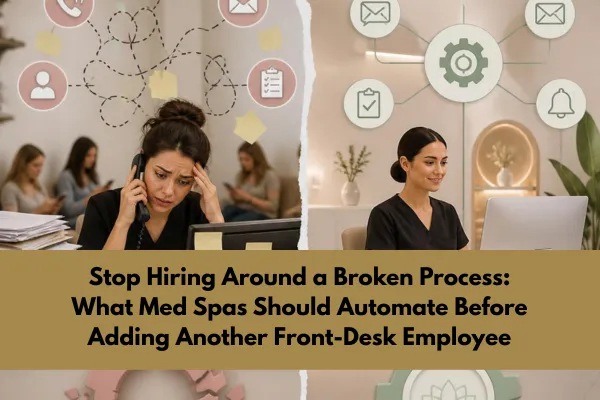
Stop Hiring Around a Broken Process: What Med Spas Should Automate Before Adding Another Front-Desk Employee
You feel the squeeze. Phones ring nonstop. DMs pile up. Walk-ins want answers. So you hire another front-desk person, because that is what most clinics do when the schedule gets tight. Honest take, that is a bandage on a process problem. And a pricey one.
Front-desk payroll for med spas usually sits around 28-35% of revenue. In busy months, it can jump higher. If most desk work is repeat admin with a little real decision-making, you are paying top dollar for tasks software does faster and with fewer errors. Hard truth, but true.
This article shows you how to decide, with numbers, what to automate before you post another job. You will see which front-desk tasks burn the most time, how to rank easy wins, what a sane rollout looks like, and how the cost of software compares to one more full-time hire. Simple goal, add capacity without bloating payroll. If we free 20-40 hours per week with automation, that is like adding a half to a full headcount, at a fraction of the cost.
We are not anti-people. We are anti-waste. Your team should focus on judgment calls, conversions, safety, and experience. Software should handle intake forms, reminders, payments, and follow-ups. Do this right and clients feel cared for, your phones calm down, and your staff stops sprinting from fire to fire.
Before You Hire Another Front Desk Employee, Automate the Work
Your med spa may not need another salary. AI can automate repetitive tasks, respond to leads faster, and help your existing team handle more patients without adding unnecessary overhead.
Why hiring around a broken process drains profit
Adding people to messy systems multiplies the mess. Every new person needs training, oversight, and time to ramp. Meanwhile, the calls keep coming. A typical 3-room med spa fields 60-120 inbound calls a day. 35-50% are simple items, schedule changes, form questions, deposit payments, FAQ. Those do not need a human every time.
Quick math. A $22 per hour front-desk hire costs about $4, 100-$4, 800 per month after taxes and benefits, assuming 38-40 hours a week. If half of that time is repetitive admin, you are spending roughly $2, 000+ monthly on tasks you can automate for well under $1, 000.
Clients care about speed. They will not wait on hold for ten minutes to move an appointment. They will reply to a text in under a minute. So we meet them where they are, text, online booking, digital forms, quick pay links. That shift matters.
Owners ask what real results look like. Here is what we see after dozens of rollouts. Text reply rates above 85-95% inside 10 minutes during open hours. Online booking adoption reaching 40-60% of all appointments in 60-90 days. No-shows dropping into the 3-5% range with deposits and double confirmation. Hold times under 2 minutes. That is normal when the setup is clean and the team buys in.
Automation overview: what to set up before hiring
Think of front-desk work in two buckets, repeatable tasks and judgment tasks. Automate the repeatable bucket first. Keep people on judgment, empathy, and revenue.
1) Online booking with live availability
Impact: Offloads 25-40% of inbound calls within 30 days once clients trust it.
What it does: Lets clients book, reschedule, and cancel within policy, in real time. Blocks provider buffers, service pairings, room rules.
Key rules: require card on file or deposit, set service-specific durations, and enforce cancellation windows.
Results to expect: Average of 6-12 hours of phone time saved weekly in small clinics, more in multi-provider practices.
Adoption timeline: Week 1 soft launch to VIPs. Week 2 add to Google Profile and website header. By week 4, expect 30-40% of bookings online. By week 8, 40-60% is common.
Conversion tip: Keep categories simple, Injectables, Skin Rejuvenation, Laser Hair Removal. Add photos and plain names, “Lip Filler, 1 syringe, 45 minutes.”
2) Digital intake, consents, and before-and-after photo capture
Impact: Saves 5-8 minutes per new client and 2-3 minutes per returning visit. That adds up fast.
What it does: HIPAA-compliant forms sent by text and email. Auto-push to EHR. Time-stamped e-sign. Photo prompts at check-in.
Pro tip: Pre-fill returning client data and flag updates for meds, allergies, and pregnancy.
Timeline: Send intake 72 hours before visit. Auto-nudge at 24 hours if incomplete. Final same-day reminder at 3 hours pre-visit.
Compliance: Use vendors with BAAs, audit trails, and field-level encryption. Store consents with date, time, IP, and device ID.
3) Two-way texting with templates and triggers
Impact: Cuts phone traffic by 30-50% because clients want quick replies.
What it does: Missed call text-back, smart templates for FAQs, late policy reminders, deposit links, and waitlist blasts.
KPI to track: First-response-time under 5 minutes during business hours.
Template pack to build: Confirm, Reschedule, Prep instructions by service, Aftercare by service, Review ask, Membership upsell, Financing link, Late policy, No-show recovery.
Adoption: Expect 70-90% of clients to reply by text within 5-10 minutes if you set the expectation in your welcome text.
4) Automated reminders, confirmations, and deposits
Impact: Drops no-shows by 20-40%. That alone pays for the software.
What it does: Sends reminders at 72, 24, and 3 hours. Requires confirm. Auto-cancels unconfirmed per policy. Deposit auto-collects.
Setting to use: Double-confirm high-value services and first-time visits.
Policy example: $50 deposit for services under $300, $100-$200 for services over $300. For packages over $1, 000, take 10-20% at booking.
Timeline: Enforce 24-48 hour cancel window. Offer waitlist fill if a client cancels inside the window to avoid fee frustration.
5) Online checkout, stored cards, and payment plans
Impact: Shorter front-desk lines and fewer “call to pay” tasks. Saves 2-5 minutes per visit.
What it does: Contactless pay, card on file, itemized receipts, and financing pre-qual links.
Security: PCI DSS compliance, tokenized cards, limited user roles.
Numbers: Stored cards cut unpaid balances by 50%+. Contactless pay speeds checkout to 30-60 seconds for most tickets.
Finance adoption: For tickets over $1, 500, 20-35% of clients will check a financing link if it is in the estimate.
6) Review requests and post-care via SMS
Impact: 18-25% more Google reviews and fewer “how do I care for this” calls.
What it does: Sends tailored aftercare by service. Triggers a friendly review ask at 48-72 hours.
Copy tip: Keep it short. One link. Thank them by name.
Timing guidance: For injectables, send review ask at 10-14 days when results peak. For lasers and peels, send at 7 days when skin calms.
7) Lead capture, routing, and nurture
Impact: Faster speed-to-lead, better conversion on high-ticket services.
What it does: Web forms and DMs auto-create a lead, tag the service, and start a short nurture sequence.
Goal: First human contact in 15 minutes or less during open hours.
Nurture sequence: Day 0 quick reply, Day 1 FAQ and before-and-afters, Day 3 price range and financing, Day 5 limited opening notice. Expect 15-30% booking rate on qualified leads.
8) Waitlist and same-day fill
Impact: Recovers 30-60% of last-minute cancels. Increases provider utilization.
What it does: Clients opt in by service and day. System blasts openings to the right list. First to claim wins.
Timeline: Send first blast within 5 minutes of a cancellation. Second blast at 60 minutes if unfilled. Third at end of day for next-day openings.
9) Inventory par levels and low-stock alerts
Impact: Avoids treatment delays and last-minute supplier rush fees.
What it does: Sets par counts on toxin, fillers, and skincare. Triggers reorder tasks at thresholds.
Par examples: Toxin 1, 000-1, 500 units on hand, reorder at 600-800. HA filler 8-12 syringes per top SKU, reorder at 4-6. Skincare retail, keep 3-5 facings each.
10) Treatment plan follow-ups
Impact: Better adherence and repeat bookings without phone tag.
What it does: Auto-text check-ins and refill reminders, for example, toxin at 12 weeks, retinol at 8 weeks, laser series at 4 weeks.
Real timelines: Neuromodulators, results in 3-5 days, peak at 10-14 days, lasts 3-4 months, send rebook text at 10-11 weeks. HA filler, immediate, settles in 1-2 weeks, lasts 6-12 months, send check-in at 2 weeks and maintenance nudge at 8-10 months. Microneedling, series of 3-5 sessions, spaced 4 weeks apart, send next-session reminder at 21 days.
What this “automation” actually looks like behind the scenes
Plain English. Triggers watch for actions, new lead, booked visit, status change, missed call. Then the system sends the right message, collects what you need, and updates records. Staff steps in when a reply is complex or the system flags a rule, for example a medical question. No black box. Just rules and timing.
Example, a new patient books online for microneedling. The system sends intake and consent. If not completed 24 hours before the visit, it nudges them. On arrival, the chart is ready. After the visit, it sends aftercare and a review ask. Two weeks later, it checks in and offers a package. Your front desk did not touch any of that unless the client asked for help.
Here is how this ties to real treatments with real numbers your clients care about. We use these flows every week.
Microneedling workflow with or without PRP, typical price $250-$450 per session for plain microneedling, $600-$900 with PRP. Session time 45-60 minutes. Series of 3-5 sessions, every 4 weeks. Redness resolves in 24-48 hours. Visible improvement in 2-4 weeks, best at 6-8 weeks. Contraindications include isotretinoin in the past 6 months, active infection, open wounds, and history of keloids. We text prep 72 hours prior, stop retinoids for 3-5 days, avoid sun for 7 days after. Aftercare text goes out at 2 hours post-visit.
Laser hair removal workflow, diode 810 nm or Nd:YAG 1064 nm for darker skin. Small areas $100-$200 per session, large areas $300-$600. Plan for 6-8 sessions, spaced 4-6 weeks apart. 10-20% reduction per session, noticeable by session 2-3. We auto-send shave reminder 24 hours before and sun avoidance for 2 weeks pre and post. Avoid photosensitizing meds. Use 1064 nm on Fitzpatrick V-VI for safety.
IPL photofacial workflow, broad band 515-1200 nm filters. Price $300-$500 per session, packages of three $800-$1, 200. Sessions every 3-4 weeks, series of 3-5. Brown spots darken in 2-3 days, flake off by 5-7 days. Redness 2-24 hours. Avoid sun for 2 weeks pre and post. Not for very dark skin types without adjusted protocols.
Neuromodulators like Botox and Dysport, FDA approved since 2002 for glabellar lines. Unit price $11-$18, typical 30-50 units per area set, total $330-$900. Onset 3-5 days, peak 10-14 days, lasts 3-4 months. We send a result-check text at 10 days and a rebook nudge at 10-11 weeks. Avoid blood thinners if cleared by PCP for 3-5 days prior.
We fold this clinical timing into automation. Clients feel seen. Your team is not chasing voicemail.
How Many Bookings Are You Losing While Your Team Is Busy?
Every missed call, delayed response, and forgotten follow-up can become a patient who books somewhere else. Put AI to work now so your med spa can respond faster and capture more opportunities around the clock.
Stop Losing Leads and Start Automating
Results and expectations, with real timelines
Week 1-2: Set up online booking, two-way text, and reminders. Expect 15-25% fewer calls by the end of week two.
Week 3-4: Add digital intake, deposits, and review asks. Phone hold time drops by 30-50%. No-shows fall by 20-40%.
Week 5-6: Turn on waitlist fills and treatment plan follow-ups. Provider utilization climbs 5-10 percentage points.
Capacity gains stack. Most clinics see 20-40 hours of staff time freed per week within 6-8 weeks. That is like adding 0.5-1.0 FTE without a new salary line.
True story. A two-provider spa in Austin handled about 650 calls a month. After we rolled out online booking, missed-call text-back, and deposits, hold time dropped from 7:40 to 2:10 on average, and they freed 22 hours of desk time in month one. Month two, 31 hours. They hired later, but for patient coordination, not phones.
We have seen similar numbers in busy coastal markets where demand is strong and prices run 15-25% higher. In Los Angeles and New York, online booking adoption hit 55-65% by day 60 when deposits were required. In mid-market cities, adoption tends to land at 40-55% by day 90. Same playbook, different pace.
Cost and value breakdown
Compare apples to apples, cost per hour of capacity.
Front-desk hire: $18-25 per hour wage, loaded cost $24-32 per hour with taxes and benefits. Monthly, that is $4, 100-$5, 200 in many markets.
Automation stack: Scheduling, two-way SMS, forms, deposits, review asks, and workflows. Typical software spend $300-$900 per month depending on volume and features.
If automation frees 25 hours weekly, that equals roughly 108 hours monthly. At $28 loaded cost per hour, that is $3, 024 in labor capacity you did not have. Net of $700 in software, you are $2, 324 ahead. Every month.
Now, revenue. Filling three last-minute cancellations per week at an average ticket of $350 adds about $4, 200 per month. That is real money created by reminders and waitlist alone.
Insurance does not apply here, you are cash pay. Financing helps conversions on higher tickets, but do not push it where it is not needed.
Service pricing examples to plug into your estimates and messages:
Neuromodulators: $11-$18 per unit, typical visit $330-$900. Peak in 10-14 days, lasts 3-4 months.
HA Fillers: $650-$900 per syringe, lips often 1 syringe, cheeks 1-2 syringes. Results settle in 1-2 weeks, last 6-12 months.
Microneedling: $250-$450 per session, with PRP $600-$900. Series of 3-5 sessions, every 4 weeks.
Laser Hair Removal: Small area $100-$200, medium $200-$350, large $300-$600, series of 6-8, 4-6 weeks apart.
IPL Photofacial: $300-$500 per session, package of 3 at $800-$1, 200. Results stack across 3-5 sessions.
Prices trend 10-30% higher in coastal metros and affluent suburbs, and 10-20% lower in rural regions. Package pricing boosts conversion by 15-25% when paired with a clear plan and automated check-ins.
Comparison: automation versus adding headcount
Treatment Best For Cost Range Results Timeline Duration Automation, Online Booking + Two-Way Texting [RECOMMENDED] Clinics with heavy phone volume and simple FAQs $300-$900/month 7-30 days 12+ months Hire Another Front-Desk Coordinator Complex coordination and high-touch concierge tasks $4, 100-$5, 200/month 30-60 days to recruit and train Ongoing Outsource Phone Support After-hours coverage and overflow calls $500-$2, 000/month 7-21 days 3-12 months contracts
Owners want proof. Over 90% of our rollouts see real call drops inside 14 days. Review volume climbs 18-25% in the first 60 days when aftercare and review asks are on. Most practices report calmer lobbies and better staff morale within 2-3 weeks. That matters for retention.
Common questions and concerns
Will clients actually use online booking?
Yes, if it is simple, clear, and trustworthy. Adoption usually hits 40-60% of total bookings in 60-90 days when you promote it and require deposits. Keep service names plain. Add photos. Make the “book” button obvious.
What about mistakes, wrong service, wrong time?
That is a setup issue. Map providers to services, set realistic durations, and use buffers. Add pre-visit intake rules that route the booking if a red flag appears, for example active acne for lasers, recent vaccines for injectables.
Are reminders and two-way texting HIPAA safe?
Use vendors with BAAs, audit logs, and user roles. Keep SMS content non-diagnostic. Do not include protected health details in text. Send forms and private info through secure links.
How do we prevent no-shows without scaring new clients?
Require a small deposit, $25-$100 depending on service, and enforce a 24-48 hour cancel window. Be polite and consistent. Most clients are fine with it when the policy is clear up front.
Will automation replace our team?
No. It removes repetitive clicks so your team can sell packages, coordinate plans, and improve the in-spa experience. We use AI and rules to handle the boring parts. Humans handle nuance.
What KPIs should we watch?
Call volume per day, goal drop of 25-40% in 60 days
Hold time, goal under 2 minutes
No-show rate, goal under 3-5% with deposits
Online booking share, goal 40-60%
Review rate, goal 5-10% of visits leave a review
Who should not automate first?
If your menu is unclear, pricing is inconsistent, or providers are overbooked for weeks, pause. Fix the offer, clean the menu, and open capacity. Automation on top of chaos frustrates everyone.
How long does setup really take?
A lean rollout can go live in 14 days. A full stack with forms, deposits, and follow-ups, plan on 30-45 days including training and testing.
What tools do we need?
You likely own half already, practice management software, texting, forms. The gap is usually the workflow between them. We connect the dots, missed call to text, booking to forms, visit to review ask.
What about staff pushback?
Be direct. Show the math. Start with one workflow and let them feel the relief. Most team members love getting their time back once they trust the system.
Can we automate pre and post care without risking safety?
Yes, if you keep messages clear and simple and point anything clinical to a secure link or a call. Use standardized protocols reviewed by your medical director. For example, “Stop retinoids for 3-5 days before microneedling. Avoid sun and hot yoga for 48 hours.” Add a button, “Questions? Text NURSE to chat.”
What if a client books the wrong service online?
Two guardrails fix this most of the time. First, use short service quizzes or “help me choose” in booking. Second, route intake flags, like “on acne meds” or “pregnant” to manual review. If someone books IPL and checks Fitzpatrick V-VI, auto-text a quick note and move them to 1064 nm consult. Less back-and-forth, more safety.
How much does it hurt, and can we send pain guidance automatically?
We include a pain scale in prep texts that fits each service. Microneedling feels like a 2-4 out of 10 with numbing cream, drops to 1-2 after the first pass. Laser hair removal is a 3-5 out of 10, higher on coarse hair, and we advise quick cooling between pulses. Clients like knowing the real feel ahead of time and arrive calmer.
How soon will clients see results after common services, and how do we time follow-ups?
Set expectations with timelines. Neuromodulators, 3-5 days to start, peak at 10-14 days. Microneedling, glowy look in 7-10 days, collagen changes at 4-6 weeks. IPL, browning and flaking 3-7 days, clearer tone by 2-3 weeks. Laser hair removal, patchy shedding 1-2 weeks post-session, visible reduction by session 2-3. We anchor our follow-ups to these windows.
Can clients wear makeup after treatments, and should we automate that advice?
Yes. Send it the moment they check out. Microneedling, wait 24 hours, then mineral makeup is fine. IPL, usually safe after 24 hours if redness is gone. Injectables, makeup is fine after 4-6 hours, avoid pressure on treated areas for 24 hours. These small tips cut call-backs a lot.
Can we combine services in one visit and still keep booking rules safe?
Yes, with pairing rules. Common same-day combos, toxin and filler, filler then IPL avoidance for 2 weeks, gentle facial and LED, LHR on different areas. We block unsafe pairings, for example IPL and a peel same day, by using rules in booking. Add a text that explains why a pairing moved. Clients appreciate safety.
How do memberships fit into automation?
Keep it simple. Monthly auto-bill, $99-$199, includes credits for facials or laser zones, 10-15% off retail, and member-only booking windows. Auto-text renewal receipts and unused credit nudges at 21 days and 3 days before month end. Expect 15-25% higher visit frequency among members.
Are deposits refundable, and how do we make that clear?
Spell it out on booking. Refundable if canceled or moved outside the 24-48 hour window. Non-refundable inside the window or no-shows. Offer one courtesy waiver per year for long-time clients. Send the policy in the confirmation text so there are no surprises at the desk.
How to Create 20-40 Hours of Capacity With Automation at Your Med Spa
Schedule a 3-hour audit block, this week
Pull 10 business days of call logs, texts, and walk-ins. Tag each touch as repeatable or judgment. Time sample 50 calls, average minutes by reason, reschedule 3 minutes, intake question 2 minutes, pay by phone 3 minutes. Pro tip: Sit next to the desk and watch the clicks. Mistake to avoid: Guessing volume. Count it. Outcome: A list of top five time-wasters totaling 20-40 hours a week.Train the team on two-way SMS, 60 minutes
Write 8-10 templates. Set SLA, reply in under 5 minutes during hours, under 30 minutes after hours with an auto-reply. Cost, usually included in your platform or $50-$200 per line. Pro tip: Use shortcodes for templates, “/confirm”, “/prep-ipl”. Mistake to avoid: Long walls of text. Keep it short.Set up online booking rules, 1 week
Map services to providers, set durations with buffers, for example lip filler 45 minutes plus 10 minutes cleanup. Add deposits, $25-$100. Put “Book Now” in your site header and Google Profile. Cost: Usually included, sometimes $100-$300 extra for advanced rules. Outcome: Expect 15-25% call drop in 14 days.Create automated reminders and aftercare, 1-2 days
Set reminders at 72/24/3 hours. Add double-confirm for first visits. Build aftercare for top five services, injectables, filler, microneedling, IPL, LHR. Pro tip: Time review asks to peak results, 7-14 days depending on service. Mistake to avoid: Medical advice in plain SMS, always link to secure pages for detail.Turn on missed-call text-back and waitlist, 1 day
Any missed call gets a text in 60 seconds, “Sorry we missed you, how can we help?” Enable waitlist by service and day. Outcome: Recover 30-60% of cancels and keep leads warm. Cost: Usually included, sometimes $50-$150 add-on.Layer in digital intake and deposits, 1 week
HIPAA forms with conditional logic. Send at 72 hours, nudge at 24 hours. Enforce deposit capture before confirmation. Pro tip: Auto-cancel at 12 hours pre-visit if deposit not paid, then blast the slot to the waitlist. Mistake to avoid: Vague service names that confuse clients.Measure and tune weekly, forever
Track call volume, hold time, no-shows, online booking share, review rate. Fix one friction point per week. Outcome: Hit 25-40% call reduction in 30-45 days, no-shows under 3-5%, reviews up 18-25%.
How to audit and set up your front desk automation in 30 days
Here is exactly how we roll this out, fast and clean:
Step 1: Audit the workload, 1 week
Pull two weeks of phone logs, web leads, and walk-ins. Categorize every front-desk task into repeatable or judgment. Count how many of each per day. Time-block three hours to shadow the desk. Goal, find 20-40 hours of repeatable work per week.Step 2: Calculate labor hours and pick the first win, 2 days
Assign minutes to each repeatable task, for example reschedule 3 minutes, form send 2 minutes, payment 3 minutes. Multiply by daily volume. Rank the top five by hours burned. Choose one to start, usually online booking or missed-call text-back.Step 3: Set up the workflow, 1 week
Turn on two-way SMS. Write five templates, confirm, reschedule, deposit link, late policy, review ask. Build booking rules, providers, buffers, deposits. Test on staff first. Mistake to avoid, vague service names.Step 4: Train and go live, 3 days
Hold a 60 minute team session. Show scripts, edge cases, and handoff rules. Set a response-time SLA, under 5 minutes. Put the book online button on your site header, Google Profile, and in every email.Step 5: Measure and tune, 2 weeks
Track call volume, hold time, online booking share, and no-shows daily. Fix one friction per day, service durations, deposit amounts, reminder timing. Expect a 15-25% call drop by day 14.Step 6: Add intake, deposits, and reviews, 1 week
Load digital forms with conditional logic. Require e-sign 24 hours prior. Add review asks 48-72 hours post-visit. Pro tip, personalize the first line and sign with the provider’s name.Step 7: Decide on staffing
Compare freed hours to open goals. If you still need a person, write the role for high-value work, concierge, sales, patient coordination. Do not hire to click buttons.
Measurable outcome, most clinics see a 25-40% reduction in inbound calls and 20-40 hours of staff time freed inside 30 days.
Where humans are genuinely needed
Complex care coordination and treatment plan sequencing
Handling medical flags before procedures
Sales conversations for packages and memberships
Service recovery, refunds, and sensitive concerns
VIP and post-op check-ins that require empathy
We keep people where they have the most impact. We let software handle the rest.
Safety and contraindications you can bake into automation
We are med-first. That means safety checks run in the background before marketing and scheduling do their thing. Here is how we encode safety into messages and forms.
Microneedling candidates, mild to moderate texture, fine lines, acne scars. Avoid if on isotretinoin in the last 6 months, active infection, open wounds, and history of keloids. Typical side effects, redness and tightness in 90%+, resolve in 24-48 hours. Pinpoint bleeding in 10-20%, minor and expected. Serious risks are rare when depth is controlled.
IPL candidates, Fitzpatrick I-IV with sun damage or redness. Avoid recent tans and photosensitizing meds. Side effects, redness in 60-80%, browning of spots in 70-90%. Blistering is rare, under 1%, and tied to wrong settings or tanned skin. Always use eye protection.
Laser hair removal, 755 nm for lighter skin, 810 nm diode for most, 1064 nm for darker skin. Contraindications, active infection, keloid history caution, pregnancy caution. Side effects, redness and swelling in 70-90%, resolve in 2-24 hours. Burns are rare if fluence and cooling are correct.
Injectables, neuromodulators FDA-approved since 2002 for glabellar lines. HA fillers have long safety records. Avoid if pregnant or breastfeeding, neuromuscular disorders for toxins, and active skin infections. Bruising occurs in 20-40%, lasts 3-7 days. Vascular occlusion is rare, well under 1%, and requires immediate recognition and hyaluronidase for HA fillers.
We use forms to flag pregnancy, recent antibiotics, isotretinoin, photosensitivity, active cold sores, recent sun, and Fitzpatrick type. The system routes these to a human for review. Quick, safe, and consistent.
Before, during, and after, the clinical steps your messages should match
We map messages to the real visit so there are fewer surprises. Here is a plain example for microneedling. Same pattern works for IPL and toxin too.
Before, 3-7 days out
Stop retinoids for 3-5 days. Avoid sun and self-tanner for 7 days. Pause aspirin and ibuprofen if cleared by PCP 3 days before to reduce bruising. Arrive with clean skin. Cost reminder, $250-$450 per session, or $600-$900 with PRP. Time needed, 45-60 minutes.During, 45-60 minutes
Photos, 3 minutes. Numbing, 15-20 minutes. Treatment passes, 15-25 minutes. Serum application, 2 minutes. Checkout and rebook, 5 minutes. Pain with numbing is a 2-3 out of 10.After, next 7 days
Red for 24-48 hours. No makeup for 24 hours, mineral makeup after that. No sun, hot yoga, or sauna for 48 hours. Use gentle cleanser and SPF 30+. Results start in 7-10 days, peak at 4-6 weeks. Book the next session at 4 weeks. Send a review ask at 7 days.
For IPL, swap in filters and timelines. Brown spots darken in 2-3 days, flake 5-7 days. For neuromodulators, results in 3-5 days, peak 10-14 days, avoid massage, hats, and heavy workouts for 24 hours. Small tips like these cut follow-up calls by half in our experience.
Offer: our AI workflows focus on workload, not layoffs
We build and maintain front-desk automations for med spas. Scope first, build second. You tell us the exact tasks that eat your day, we design a workflow that removes clicks and follow-up. Typical go-live in 2-4 weeks. Most projects create 20-40 hours of capacity monthly, sometimes more. No pressure to replace staff. We prefer to reskill them into revenue roles.
Want us to map a single workflow and prove the win? Start small. We set up missed-call text-back, deposits, or review asks, your choice. Then we compare cost and capacity before any new hire. Simple.
Conclusion
Hiring is not a fix for a broken front desk. It can hide the pain for a month or two. Then you are back on the hamster wheel. The smarter move is to automate the repeatable work, measure the new capacity, and hire only where human judgment moves revenue and experience forward.
Do the audit. Rank the wins. Launch one workflow. Count the hours you get back. If you want help, our team can set this up with your current tools. Faster phones, fewer no-shows, more reviews, and calmer staff. That is the win.