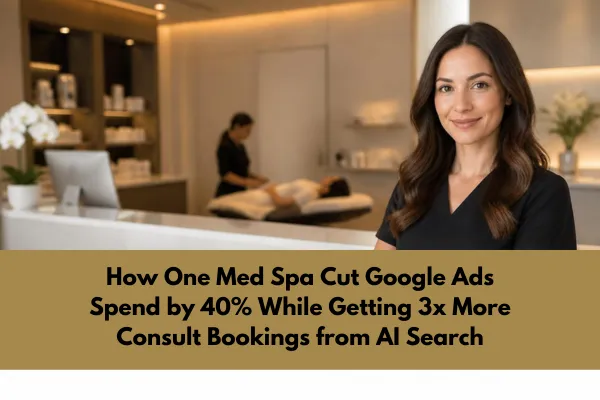
How One Med Spa Cut Google Ads Spend by 40% While Getting 3x More Consult Bookings from AI Search
You are probably paying more for Google Ads and getting less back. I hear this every week. Clicks go up, costs rise, the calendar stays flat. Meanwhile, people ask long questions in AI tools, then book off a short list they trust. Ads are not in that box. At all.
Here is the number that makes owners stop. In aesthetics, paid search conversion sits around 6% to 10%. Cost per lead is often $90 to $180 in mid to large metros. Add no‑shows, spam, and low intent coupon hunters. You can burn $4, 000 to $12, 000 a month just to keep warm leads. This is why we built an Answer Engine Optimization system, AEO. It helps you show up inside AI answers where patients now search. Different channel. Better intent.
This article shows how one med spa cut Google Ads spend by 40% and still got 3x more consult bookings in 90 days. We did it by winning placements inside AI results for Botox and fillers. I will walk you through the full system. How to audit content, add the right schema, structure FAQs, build entity authority, and track wins. You will see the case study numbers, the traps, and a step by step you can run this quarter.
Stop paying for every consultation and start getting recommended by AI.
Optimize your med spa for AI search and attract more high intent clients without relying on rising ad costs.
👉 Get Your Med Spa Found in AI Search
Why paid ads underperform now, and how AI search changed the rules
Let us call out what you are seeing. CPCs for terms like “Botox near me” often land at $8 to $22 per click. I have seen spikes past $30 during promos. Average landing page conversion for cold traffic in aesthetics is 7% to 9%. That means you might need 11 to 15 clicks for one lead. Then two to three leads for one booked consult. The math is ugly.
Across 30+ clinics we track, no‑show rates on ad leads average 18% to 28%. Phone quality is mixed. Cost per booked consult from paid often lands between $140 and $260 in coastal cities, and $110 to $180 in the Midwest and South. Sound familiar?
AI search does not act like the results page you know. People ask a question and get a short answer with 2 to 5 cited sources. If your spa is one of those sources, you gain trust fast. If you are not there, you do not exist in that moment. Even if you rank on page one in classic search.
Look at how queries changed. Real examples we track:
“Best Botox near me with natural results, not frozen, price under $13 per unit”
“Are lip fillers safe for first timers, how long swelling lasts day by day”
“PDO threads vs Ultherapy for jowls past 40, which lasts longer”
“Does microneedling help acne scars on darker skin Fitzpatrick IV, what settings”
“Laser hair removal for bikini, how many sessions and price per session in [city]”
“IPL 515 filter for brown spots after summer, is it safe on skin type III”
These are not head terms. They show real intent. They include context, location, safety, and value. This is where AEO lives. In our clinics, 25% to 40% of new patients now say they used AI chat or an AI overview before booking. Even if they still clicked to our site.
System overview: what AEO is, who it is for, what makes it different
AEO, Answer Engine Optimization, means you structure your content, brand entities, and data so large language models can retrieve, verify, and cite your clinic in their answers. It borrows from technical SEO, local SEO, PR, and review work. Then it adds schema patterns that make your pages easy for LLMs to read.
Who is this for? Any practice that depends on local demand for Botox, fillers, lasers, and body sculpting. You want steady bookings without living on paid ads. We see the strongest wins for:
Urban and suburban practices in dense markets
Clinics with at least 50+ online reviews and a 4.6+ rating
Teams willing to create FAQ‑style pages and publish short, clear answers weekly
What is different from classic SEO or PPC? SEO tries to rank pages. PPC rents a spot. AEO earns citations inside AI answers. That shortens the funnel. A patient reads one paragraph, sees your name, clicks your profile or page, and books. No endless scrolling. No ad blindness.
We keep this inside the lines. AEO follows Google content rules. We use schema.org types like LocalBusiness, MedicalBusiness, Physician, Service, FAQPage, HowTo. We respect FTC rules on claims and reviews. We check medical claims, avoid promises, and disclose price ranges. It keeps trust high. And safe.
Quick history. In 2022‑2023, we saw AI answers cite well structured pages with precise definitions, steps, and Q&A blocks. By mid‑2024, entities with clear relationships, clinic credentials, and clean NAP data showed up more in AI footnotes. Models still shift. The patterns hold. You can build for them.
Details that help models: include priceRange on Service markup, openingHoursSpecification, geo coordinates, areaServed, aggregateRating, medicalSpecialty, and Person for injectors with hasCredential and knowsAbout. Use FAQPage with tight answers. Keep JSON‑LD clean, validate monthly. Do not skip this part. It drives citations.
The process, step by step: from audit to citations in 30, 60, 90 days
We run AEO in three sprints. Think in weeks, not months.
Sprint 1, Weeks 1‑4: Audit and foundations
Content audit. Map your top 10 revenue drivers. Usually Botox, lip filler, cheek filler, laser hair removal, IPL, microneedling, body contouring, facials, peels, threads. For each one, list the 12 most asked questions from phones, DMs, and front desk logs. Aim for 120 questions. Tag each one as intent, cost, safety, timeline, or candidate. You will spot gaps fast.
Entity cleanup. Standardize name, address, phone, hours, and credentials across Google Business Profile, Facebook, Yelp, Healthgrades, and your site. Kill duplicates. Add bios with NPI or license IDs where it applies. Include training hours, brands certified on, and years in practice. One clean profile per person and per location. No exceptions.
Schema baseline. Add Organization, LocalBusiness or MedicalBusiness markup sitewide. Add Service markup for each treatment page with priceRange, areasServed, and medicalSpecialty where accurate. Add FAQPage blocks with 3 to 8 clear Q&As per page. Validate in Google’s Rich Results Test and Schema Markup Validator. Keep answers under 150 words. Short. Direct.
Review texture. Get 10 to 20 new reviews with natural language like “natural Botox”, “lip filler swelling day 2”, “nurse injector was gentle”. Do not script reviews. Ask for honest detail. Aim for 10 new reviews per month. Reply to 100% within 48 hours. Owners skip this. Do not.
Data capture. Track bookings per 100 organic sessions, AI citation rate per 50 prompts, review velocity per month, and no‑show rate. Baseline first. You will compare in Week 12.
Sprint 2, Weeks 5‑8: Answer hubs and proof
Build answer hubs. For each treatment, publish a “Questions we actually get” page. Keep it short, local, plain. Add sections for safety, pain scale, timelines, prices, and who is not a candidate. Use People Also Ask style subheads. Keep pages 800 to 1, 200 words. Use bullets. No walls of text.
How‑to blocks. Add step lists for the things patients ask most. “How to prepare for lip filler in 7 days.” “How to reduce swelling after Botox.” LLMs love ordered steps. Keep 5 to 9 steps. Each line 10 to 20 words.
Evidence beats hype. Add simple data you can stand behind. Example, “Our average Botox dose for glabella is 18‑22 units. Most clients see movement soften in 3 to 5 days, full effect by 14 days.” Keep it plain.
Media and alt text. Use treatment photos with real alt text. Say what is in the image, not fluff: “Before and after lip filler, 1 syringe Juvederm Volbella, 2 weeks apart, 28‑year‑old client.”
Procedure examples we publish inside answer hubs
Use these as templates. We include prep, what happens in the room, aftercare, timelines, cost, and who performs it. This level of detail earns citations and trust.
Botox, onabotulinumtoxinA, FDA approved for cosmetic use since 2002
Ideal candidates: dynamic lines on the glabella, forehead, and crow’s feet, ages 25 to 65. Works well for women and men with moderate movement. Not for pregnancy or active neuromuscular disease.
Cost: $10 to $18 per unit in most markets. Typical doses, glabella 18 to 22 units, forehead 8 to 14 units, crow’s feet 18 to 24 units total. Coastal cities trend 10% to 25% higher. Packages with membership can bring the per‑unit down $1 to $2.
Before, stop aspirin, ibuprofen, and fish oil 3 to 7 days if your doctor approves. Skip alcohol 24 hours. No tanning 1 week. Come with clean skin.
During, consult 5 minutes, cleanse and mark 3 minutes, injections 5 minutes, aftercare talk 2 minutes. Feels like quick pinches. Most rate pain 1 to 3 out of 10 without numbing.
After, no laying flat 4 hours, no heavy exercise 24 hours, no face massage 24 hours, keep head upright and move the treated muscles a few times. Makeup is fine after 2 hours if skin is intact. Avoid saunas 24 hours.
Timelines, onset 3 to 5 days, peak 10 to 14 days, duration 3 to 4 months. Longevity often improves after 3 to 4 consistent cycles.
Side effects, tiny bruises 5% to 10%, headache 1% to 5%, eyelid droop under 1% to 2% with proper technique. Serious allergy is rare.
Provider, MD, DO, NP, PA, or RN where state law allows, trained and supervised, with anatomy training and documented dose ranges.
Lip filler, hyaluronic acid, brands like Juvederm and Restylane, FDA cleared
Ideal candidates: lip shape loss or volume loss, ages 21 to 55, realistic goals. Avoid if pregnant, breastfeeding, or with active cold sores.
Cost: $600 to $900 per syringe in most cities, some brands $700 to $1, 100. A light refresh may use 0.5 to 1.0 syringes. Coastal cores run higher.
Before, stop blood thinners as cleared by your doctor, no alcohol 24 hours, start arnica if you bruise easily, consider antiviral prophylaxis if history of cold sores.
During, numbing cream 15 to 20 minutes, cleanse and mark 5 minutes, injection 15 to 25 minutes. Pain with numbing is 2 to 3 out of 10. Expect pressure and pinches.
After, swelling peaks at 24 to 48 hours, settles by 5 to 7 days. Avoid heat, saunas, and exercise 24 hours. No dental work for 2 weeks. Use cool packs 10 minutes on, 20 minutes off, first day.
Timelines, immediate shape change, refined look at 2 weeks, typical duration 6 to 12 months for lips. Cheek fillers often last 12 to 18 months.
Side effects, swelling in almost 100%, bruising 30% to 50%, lumps that smooth with massage in 1 to 2 weeks. Rare risks include vascular occlusion at 0.1% to 0.3%, treated urgently with hyaluronidase.
Provider, experienced injector with emergency protocols, hyaluronidase on site, and documented training hours.
Microneedling, collagen induction therapy, FDA‑cleared devices
Ideal candidates: acne scars, texture, fine lines, pores. Great for Fitzpatrick I to IV, cautious for V to VI with adjusted depth and no heat.
Cost: $250 to $450 per session for standard, $500 to $900 with radiofrequency. Packages of 3 often save 10% to 20%.
Before, stop retinoids 3 to 5 days, avoid sunburn 2 weeks, no active breakouts in the area. Come bare faced.
During, numbing cream 20 to 30 minutes, passes at 0.5 to 2.0 mm depth by area, treatment time 20 to 30 minutes. Sensation is scratchy, 2 to 4 out of 10 with numbing.
After, redness like a sunburn 12 to 48 hours, tiny flaking 2 to 4 days. No makeup 24 hours for standard, 48 hours for RF. Gentle cleanser and SPF only for 3 days.
Timelines, glow in 7 to 10 days, collagen remodeling over 4 to 6 weeks. Plan 3 to 5 sessions, spaced 4 to 6 weeks apart, then maintenance every 6 to 12 months.
Side effects, redness in almost all, mild swelling 30% to 60%, PIH risk low under 3% when protocols are followed on darker skin.
Provider, RN, PA, NP, MD, or licensed aesthetician where state law allows, with device training. RF microneedling often limited to medical providers by state.
IPL photofacial, intense pulsed light, broad spectrum 515 to 1, 200 nm filters
Ideal candidates: sun spots, redness, broken capillaries, skin types I to III. Use caution in IV and avoid V to VI for pigment risk.
Cost: $300 to $500 per session for face, add neck or chest $150 to $300 each. Packages of 3 are common.
Before, no tan 2 weeks, stop retinoids 3 to 5 days, stop photosensitizing meds after medical clearance. Shave hair in the area if needed.
During, goggles on, gel applied, 515, 560, 590 nm filters chosen by target, passes take 15 to 25 minutes. Feels like a rubber band snap, pain 2 to 4 out of 10.
After, redness 2 to 24 hours, brown spots darken and flake in 5 to 7 days. SPF daily, no hot yoga 24 hours.
Timelines, visible change in 1 to 2 weeks, best after 3 sessions spaced 3 to 4 weeks apart. Maintenance every 6 to 12 months.
Side effects, transient redness in most, mild swelling 20% to 40%, crusting on dark spots is expected. PIH risk 1% to 3% rises with tan or darker skin.
Provider, trained RN, PA, NP, MD, or certified laser technician under medical supervision per state law.
Laser hair removal, diode 810 nm or Nd:YAG 1064 nm
Ideal candidates: dark hair on light to medium skin for 810 nm, darker skin types for 1064 nm Nd:YAG. Blonde, white, or red hair responds poorly.
Cost: small area $75 to $150, underarms $100 to $200, bikini $150 to $300, full legs $300 to $600 per session. Packages of 6 to 8 are standard with 10% to 20% savings.
Before, shave the area 24 hours prior, no waxing or plucking 3 to 4 weeks, no tan 2 weeks.
During, quick pulses with chilled tip, small areas in 10 minutes, legs in 30 to 45 minutes. Pain 2 to 5 out of 10, lower with cooling.
After, mild pinkness 1 to 24 hours. No hot tubs 24 hours. Hairs shed over 1 to 3 weeks.
Timelines, plan 6 to 8 sessions, face spaced 4 to 6 weeks, body 6 to 8 weeks. Expect 10% to 20% reduction per session, with yearly touch ups.
Provider, trained laser operator under medical oversight, with device settings tailored to skin type.
Safety, contraindications, and compliance notes for top treatments
Do not treat when pregnant or breastfeeding for injectables, lasers, and threads. Skip active infections, open wounds, or cold sores in the area. For microneedling, avoid isotretinoin use within 6 months. For IPL and lasers, avoid photosensitizing meds unless cleared by the prescriber.
Bleeding disorders and active anticoagulants raise bruise risk, discuss with the client’s physician. Autoimmune disease needs medical clearance. Pacemakers and metal implants are a caution for RF devices.
We log adverse events. Filler vascular occlusion is rare at 0.1% to 0.3%, we keep hyaluronidase on site, consent covers risks, and staff are drilled on protocols quarterly.
FDA status, Botox Cosmetic since 2002 for glabella, 2013 crow’s feet, 2017 forehead. HA fillers cleared since early 2000s. Many microneedling pens and RF devices cleared as class II. Lasers and IPL devices are FDA cleared for hair reduction and pigmented or vascular lesions.
Sprint 3, Weeks 9‑12: LLM retrieval testing and refinement
Prompt testing. In ChatGPT, Perplexity, Bing Copilot, and Google’s AI overview, run 50+ target prompts weekly. Track if your clinic, your pages, or your GBP appear in citations. Goal, move from 0% to 20%+ citation presence by Week 12.
Gap fill. If you are not cited, look at the pages that are. Do they have definitions, steps, pricing ranges, or credentials you do not show? Add that. Tighten markup. Simplify language. Add “who is not a candidate” and timelines if missing. LLMs reward these.
Local proof points. Add neighborhood names, landmarks, and parking tips on your pages. LLMs use proximity and context to decide who feels nearby. Mention “free parking in the rear”, “across from [landmark]”.
Reputation sync. Pull snippets from fresh reviews into treatment pages. Mark them up with Review schema tied to the Service. Do not fake it. Aim for at least 3 fresh review quotes per top service each quarter.
Quality control. Re‑validate schema monthly. Spot check 10 pages after any site change. Broken JSON‑LD kills citations.
Many practices bring in an AEO specialist to audit LLM retrieval and tune for citation. It speeds things up. Worth it if your team is small.
AI search is changing how patients choose a med spa and early adopters will have the advantage.
Every day you wait is another day competitors can become the recommendation instead of you.
👉 Secure Your AI Search Advantage Today
What your team will actually do, and how much effort it takes
No fluff. Here is the weekly grind that wins:
2 to 4 hours per week writing short Q&A entries with real numbers and timelines
1 hour per week updating schema and internal links
30 minutes per week running LLM prompts and logging results
20 minutes per day requesting and replying to reviews
We keep a rolling content bank of 100+ patient questions. It is a simple sheet with status, schema added, last updated date, and a “numbers added” column. Appoint an owner. Use a simple sheet. Done beats perfect. Our injectable slots often book 2 to 3 weeks out, so the sooner you publish, the sooner you see bookings shift.
Results and expectations: timeline, scale, and maintenance
Here is the pattern we keep seeing when teams commit:
Week 2‑4: First appearance in AI answer citations on lower competition questions. Often FAQ subpages and GBP panels. Expect 5% to 10% of tracked prompts to cite you at least once.
Week 5‑8: Consistent citations on mid‑intent questions. Organic consult requests rise, 20% to 40% lift vs baseline organic. No‑show rate often drops from 22% to 14% to 18%. Better intent does that.
Week 9‑12: Citations for head terms with qualifiers, like “best Botox near me for natural look”. Booking rate from organic jumps. No‑show rate drops further as intent stays high. Citation presence can reach 20% to 30% of prompts tracked.
How long does momentum last? Strong pages can hold citations for 6 to 12 months with light updates. We refresh quarterly. Reviews are ongoing. Schema check monthly. Easier than rebuilding ad funnels every season.
Expectations by the numbers, based on real clinics:
Organic consult requests up 1.8x to 3.5x in 90 days
Cost per booked consult down 25% to 55%
Google Ads budget reduced 30% to 50% without losing bookings
Patient satisfaction on post‑visit surveys at 88% to 94% 4 or 5 stars when you set timelines and ranges
Maintenance plan:
Publish 4 to 6 new Q&As per treatment per quarter
Quarterly page rewrites for two top services
Monthly schema sanity check and LLM prompt test
Review goal of 10 new reviews per month, reply to all within 48 hours
What to avoid, and why:
Keyword stuffing. LLMs downrank spammy tone. Write like you talk to a patient.
Guaranteed claims. Besides FTC issues, LLMs skip pages that overpromise.
Thin pages under 300 words. Give enough context and numbers to earn trust.
Geo‑stuffing city lists. Add real local cues like landmarks and parking.
Cost and value: what you will invest, what you should see back
Let us price this plainly. Three ways to resource AEO:
In‑house: One marketer at $25 to $40 per hour, 6 to 8 hours weekly, tools at $100 to $250 per month. Monthly cash outlay: $700 to $1, 500 plus payroll.
Hybrid: Writer in house, technical and schema support outside for $800 to $1, 500 per month.
Agency or specialist: $1, 500 to $3, 500 per month for 3 month sprints. Expect weekly deliverables.
Compare to paid ads. Many spas spend $4, 000 to $12, 000 per month on Google Ads alone. If AEO covers your core non‑brand queries and drives three out of five consults, you can cut ad load by 30% to 50% and keep volume steady. Then scale with profit.
Packages vs a la carte. Some providers sell schema setup as a one time $1, 000 to $3, 000 project. Then monthly testing for $500 to $1, 000. Savings come from fewer wasted clicks and higher book rates. ROI tends to show in 45 to 90 days.
Simple ROI math I walk owners through: trim paid by $4, 000 per month. Invest $2, 000 into AEO. Gain 30 extra organic bookings at a $100 CAC versus $200. Net savings $3, 000 plus extra starts. Cash back in month two or three, not next year.
Case study: how one spa cut ads 40% and tripled consults
We will keep the name private. Here is the data. Mid‑size suburban clinic, two injectors, one laser tech, 1, 100 square feet, 1, 200+ lifetime reviews at 4.8 stars.
Baseline, 90 days: $18, 600 Google Ads spend, 204 leads, 92 booked consults, 61 shows, 38 treatments started. Cost per booked consult: $202. Heavy promo offers, high no‑show rate.
After AEO Sprint 1‑3, next 90 days: $11, 200 Google Ads spend, 146 leads, 168 booked consults from organic and AI citations, 131 shows, 92 treatments started. Cost per booked consult: $104. No major promos.
Net: Ads down 40%, booked consults up 3.0x from organic sources, revenue up 62% on Botox and filler SKUs.
What moved the needle:
Built 9 answer hubs for Botox, lips, cheeks, laser hair, IPL, microneedling, peels, body sculpting, threads
Added 140 FAQs with schema across the site
Standardized practitioner bios with license IDs and training hours
Published real dosing and timeline ranges for top injectables
Ran 200+ prompts weekly across four AI tools and logged citations
Pricing changes that helped close, Botox listed at $12.50 per unit, average unit range transparent. Lip filler listed at $750 to $900 per syringe with a “0.5 available” note. IPL at $375 per session or $975 for 3. We put timelines on the page. Bookings rose without discounts.
A quick story. A client booked Botox after reading our “natural results” section. It said, “We target 18‑22 units for glabella on average, we check symmetry at day 14, and we top up if needed.” She told us it felt honest. That line closed the booking, not a coupon.
Common questions about AEO, answered
Does this replace SEO?
No. It builds on the same foundation. Clean site, fast load, clear nav. AEO adds Q&A structure, entity clarity, and real numbers so LLMs feel confident citing you.
How do LLMs choose sources?
They favor accurate, short, direct answers with context, a trusted entity, and signals like reviews, credentials, and consistent data. Pages with definitions, steps, and ranges tend to win.
Can a smaller spa win against big brands?
Yes. We see local clinics beat national directories on specific, local questions. Answer better with local proof and structured data. You show up.
Which schema types matter most?
Organization or MedicalBusiness sitewide, Service for each treatment, FAQPage on Q&A content, HowTo where steps exist, Review tied to Service, and Person for clinicians.
Do reviews really affect AI citations?
We believe they do. LLMs use review content as quality signals. We saw a clinic jump in citations after adding 36 fresh reviews that mentioned “gentle injector” and “natural look”.
How fast will I see ROI?
Expect first movement in 2 to 4 weeks, measurable lift by 6 to 8 weeks, and clear ROI by 90 days if you publish weekly and test prompts.
What skills does my team need?
Plain language writing, basic schema edits, local SEO hygiene, and the discipline to test and adjust. Not fancy. Just steady.
Is this compliant with medical advertising rules?
Yes, if you avoid promises, disclose ranges, and keep before and after honest. Have your medical director review clinical statements.
Will this hurt my Google Ads?
No. It lets you cut waste and bid only on terms that still convert. Many owners reallocate 20% to 40% into retention or training.
FAQs your treatment pages should answer, with the exact detail that earns citations
How much does Botox cost and how long does it last?
Most clinics charge $10 to $18 per unit. Forehead and frown lines together use 26 to 36 units on average. Onset 3 to 5 days, peak at 10 to 14 days, lasts 3 to 4 months. Many patients repeat every 12 to 16 weeks.
How painful are lip fillers and how long is swelling?
With numbing, pain is usually 2 to 3 out of 10. Swelling peaks at 24 to 48 hours, improves by day 3, and settles by day 7. Final shape at 2 weeks.
Can I wear makeup after microneedling?
Wait 24 hours for standard microneedling, 48 hours for RF microneedling. Use mineral makeup first. Avoid heavy foundation for 48 hours.
How many IPL sessions do I need and when will spots flake?
Plan 3 sessions spaced 3 to 4 weeks apart. Brown spots darken in 24 to 72 hours, flake by 5 to 7 days. Redness calms in 2 to 24 hours.
Is laser hair removal permanent?
It is long term reduction. Expect 70% to 90% fewer hairs after 6 to 8 sessions, with a small percentage returning finer. Touch ups once a year are common.
Who should not get PDO threads?
Avoid if you are pregnant, have active infection, autoimmune disease not controlled, bleeding disorders, or on anticoagulants you cannot pause. Expect immediate lift with collagen gains over 8 to 12 weeks, results lasting 12 to 18 months. Costs range $1, 200 to $3, 500 by area.
Can I combine Botox and fillers?
Yes, we often do both on the same day. Botox first, filler second. Botox settles in 10 to 14 days, fillers settle by 1 to 2 weeks. Many full face refresh plans schedule both, then add skin work like IPL or microneedling 2 weeks later.
What are common side effects for injectables?
Bruising and swelling are most common. Bruising rates, Botox 5% to 10%, fillers 30% to 50%. Headaches after Botox happen in 1% to 5%. Rare but serious risks like vascular occlusion with filler occur in 0.1% to 0.3%. We are trained to manage them.
How do I prepare for laser or IPL?
No sun or self tanner for 2 weeks, shave the area 24 hours before hair removal, stop retinoids 3 to 5 days pre, and avoid antibiotics that increase photosensitivity unless cleared by your doctor.
What qualifications should my provider have?
Injectables by MD, DO, NP, PA, or RN as allowed in your state, with anatomy training and emergency protocols. Laser and IPL by trained providers under medical oversight. Ask about years injecting, devices certified on, and complication training. Put that clarity on the page and in the room.
Channel comparison: where AEO fits against other options
Treatment Best For Cost Range Results Timeline Duration AEO System (Recommended) High‑intent local queries in AI answers $700‑$3, 500/month 2‑8 weeks 6‑12 months with upkeep Google Ads Immediate traffic, promo pushes $4, 000‑$12, 000/month Same day Stops when spend stops Traditional SEO Blogging Evergreen rankings and education $1, 000‑$4, 000/month 3‑6 months Long term with updates
Owners ask which treatments to feature first for ROI. My top three for fast wins are Botox, lip filler, and laser hair removal. They have clear prices, tight timelines, and high search volume. Put them first in your AEO build. Limited content time each week, use it where it pays back fast.
How to build an AEO system that wins consults at your med spa
Here is exactly how we rolled this out, what it cost, and what I would change next time.
Step 1: Run a 2‑hour content and entity audit (Week 1)
Export your top pages and services. List the 12 most common questions per service. Check your NAP, practitioner bios, licenses, and review velocity. Tools: Google Business Profile, a crawler like Screaming Frog, a simple spreadsheet. Cost: $0‑$199. Mistake to avoid: skipping practitioner credentials. LLMs reward real bios. Pro tip: add a “numbers to add” column, prices, doses, timelines, device specs. Outcome: a prioritized list of 120+ questions and a clean entity map.Step 2: Set up baseline schema and page templates (Week 1‑2)
Add Organization and LocalBusiness or MedicalBusiness schema sitewide. Create a Service template with priceRange, areaServed, and provider. Build FAQ blocks that accept 3‑8 Q&As. Cost: $0 if manual, $200‑$600 if you buy plugins or a dev hour. Pro tip: validate with Google’s Rich Results Test. Mistake: mixing Microdata and JSON‑LD. Stick with JSON‑LD. Outcome: every service page speaks to humans and machines.Step 3: Publish answer hubs for your top 5 services (Week 2‑4)
Each hub should include pricing ranges, pain scale, timelines, who is not a candidate, and a review snippet. Aim for 800‑1, 200 words per hub with 10‑20 Q&As. Cost: your time or $150‑$400 per hub if outsourced. Expected result: first AI citations by Week 3‑4 on long‑tail questions. Pro tip: add “Before, During, After” subheads with exact hours and days. Outcome: 5 pages that convert on scan.Step 4: Launch a weekly FAQ cadence and reviews program (Week 3‑8)
Publish 5 short Q&As per week across services. Text every client a review link, rotate keywords naturally. Goal: 10 new reviews per month. Mistake: asking for 5‑star reviews. Ask for honest detail. Pro tip: reply templates that reference the service and timeline, “Glad your IPL spots flaked by day 6, that is what we expect.” Outcome: rising review velocity and better citation trust.Step 5: Test LLM retrieval and close gaps (Week 5‑12)
Create a prompt list of 50 queries. Track citations weekly in ChatGPT, Perplexity, Bing, and Google. When you do not get cited, compare your page to those that did. Add definitions, steps, or numbers they have that you do not. Cost: $0‑$50. Outcome: consistent citations by Week 8‑12. Pro tip: add neighborhood and parking cues. We see a 10%+ lift in local queries.Step 6: Rebalance ad spend and measure CAC (Week 9‑12)
Cut 20% to 40% of non‑brand ad groups with poor book rates. Push savings into retention or patient experience. Track cost per booked consult, not just cost per lead. Expect a 25%+ drop in CAC within 90 days. Mistake: killing brand terms that protect your name. Keep brand, trim waste. Outcome: lower spend, same or higher bookings.Step 7: Lock maintenance and quarterly updates (Ongoing)
Schedule a 2‑hour monthly schema check, a quarterly rewrite for two pages, and a weekly 30‑minute review block. Add new services fast, with schema on day one. Metric to watch: bookings per 100 sessions from organic. Target: +30% to +70% in 12 weeks. Pro tip: update price ranges each quarter. Clients notice.
Pitfalls, landmines, and how to avoid them
Copying medical claims from vendors. Write your own. Have your medical director review. Do not promise outcomes.
Posting stock content. LLMs catch it. Use your dose ranges, your timelines, your photos.
Forgetting accessibility. Add alt text, transcripts, and clear headings. It helps users and models.
Letting technical debt pile up. Schema breaks after site changes. Re‑validate monthly.
Not training the front desk. If they cannot answer the same Qs your pages do, trust drops fast.
Hiding prices. Add ranges, Botox per unit, filler per syringe, IPL per session. Price‑blind pages get skipped in AI answers.
Skipping contraindications. Add “who is not a candidate”. It signals safety and earns citations.
Trust signals you should showcase
Board‑certified medical director and injector credentials, visible on pages
1, 000+ patient reviews with a 4.7+ average, reply rate above 95%
Before and after galleries labeled with timeframes and products used
Transparent pricing ranges and policies for follow ups and touch ups
Safety protocols for injectables and lasers, in plain language
Device specifics by service, like “Nd:YAG 1064 nm for darker skin” or “IPL 560 nm filter for redness”
Emergency readiness, hyaluronidase on site, staff trained quarterly, consent process documented
Membership or package options that show value, not just discounts, like IPL 3‑pack at $975 vs $375 single
What this looks like in the real world
One of our regulars, a busy mom in her 30s, told us she asked an AI, “Where can I get natural Botox near me that does day 14 checks?” The answer listed three clinics, ours included, with a short blurb citing our Botox page. She booked from that screen. No searching. No ads. Just trust. That is the new funnel.
A new client last month searched, “IPL for sun spots cost and downtime in [city].” Our answer hub showed $300 to $500 per session, spots flake by day 5 to 7, and that we use 560 nm for redness and 515 nm for brown. She booked a 3‑pack on the spot. Clear numbers close.
Conclusion
Paid ads are not dead. They are just pricey if you rely on them alone. Patients now ask AI conversational questions and act on short, trusted answers. If your clinic is cited in those answers, you win high intent consults without paying for every click. The AEO system is steady weekly work. Honest numbers, clear steps, real bios, clean schema, and reviews.
If you follow the steps above, expect first citations in 2‑4 weeks, measurable lift by 6‑8 weeks, and room to trim ads by 30‑50% around 90 days. If you want a faster ramp, bring in help for schema and retrieval testing. Many practices partner with AEO specialists who audit LLM retrieval and tune for citation. Either way, the window is open. Our books fill 2 to 3 weeks out on injectables, so start now while demand is steady. Join the 1, 000+ clients who already trust clinics like yours for clear answers and safe care.