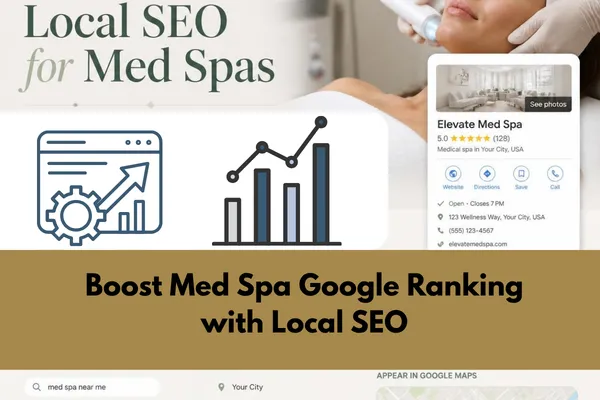
Boost Med Spa Google Ranking with Local SEO
Local SEO, Med Spa Marketing, Google Business Profile
How Can a Med Spa Rank Higher on Google?
A med spa can rank higher on Google by focusing on local SEO fundamentals: fully optimize the Google Business Profile, keep Name/Address/Phone details consistent across the web, create dedicated pages for each treatment, earn and respond to reviews, improve technical SEO, and add relevant schema and local citations. For med spas, trust matters too — use accurate service descriptions, clear provider credentials, and compliant content. The strongest results come from treating Google Business Profile, the website, and reviews as one connected system that supports both visibility and patient confidence.
The Fastest High-Impact Fixes
From an engineer’s perspective, local SEO works like a system of interdependent components. No single tactic is enough in isolation. Your Google Business Profile, NAP consistency, treatment-focused service pages, review generation, technical SEO, and schema markup all feed into the same outcome: relevance, prominence, and trust. When one of these is missing or misconfigured, the whole system underperforms, even if other parts look strong on the surface.
In practice, the most efficient order of operations is usually: first, fully optimize your Google Business Profile; second, clean up NAP consistency across your website, directories, and social profiles; third, build or improve treatment-specific service pages; fourth, put a repeatable review generation process in place; fifth, address core technical SEO issues; and finally, implement and validate schema markup. This sequence delivers quick wins while laying a stable foundation for everything else that follows, including Map Pack visibility and organic traffic growth.
Med spas operate in a health-adjacent, “your money or your life” (YMYL-adjacent) space, so trust carries even more weight. Google is cautious with content that can affect someone’s wellbeing or financial decisions. That means your med spa trust signals — real provider credentials, accurate and conservative service descriptions, compliant testimonials, and clear contact details — are not just marketing polish. They are core inputs into how both users and algorithms evaluate your brand’s reliability and expertise over time.
What Matters Most for Med Spa Google Visibility
While Google does not publish its ranking formulas, its documentation and observable behavior point to three broad concepts that med spas can influence: relevance, prominence, and trust. Thinking in these terms helps you prioritize concrete actions instead of chasing unverified “hacks” or promises of guaranteed rankings, which no one can reliably deliver in a compliant way.
- Relevance is about how closely your med spa matches a user’s search. You influence relevance with accurate Google Business Profile categories, clearly written service descriptions, treatment-specific service pages, and content that uses natural language related to your procedures and location. If someone searches “Botox near me” or “laser hair removal in [city],” Google needs clear signals that you actually provide those services in that area.
- Prominence reflects how well-known and established your practice appears online. For med spas, this often shows up through reviews, citations, and backlinks. A steady stream of honest reviews, consistent listings in reputable directories, and relevant links from local or industry websites signal that your practice is active, recognizable, and worth surfacing in the Map Pack and organic results for local queries.
- Trust overlaps with Google’s E-E-A-T framework: Experience, Expertise, Authoritativeness, and Trustworthiness. You can strengthen these signals by publishing accurate and conservative service information, including provider bios with real credentials, keeping your NAP consistent, and maintaining compliant, non-misleading content. For a med spa, trust is not only about ranking — it directly affects whether a prospective patient is comfortable booking a consultation or treatment.
Google Business Profile: Your Highest-Leverage Local SEO Asset
For most med spas, the Google Business Profile is the single highest-leverage local SEO asset. It is often the first touchpoint a prospect sees in Maps or local search results. A complete, accurate, and regularly updated profile can significantly improve visibility for “near me” and city-based searches, while also making it easier for patients to call, get directions, or visit your website without friction. Treat it like a core product configuration, not a one-time form you fill out and forget.
Start by ensuring your profile is fully claimed and verified. Use your legal business name without unnecessary keywords. Set the primary category to “Medical Spa” if that best represents your main service line, then add relevant secondary categories for services you actually provide (for example, “Skin Care Clinic” or “Laser Hair Removal Service” when appropriate). Keep your NAP details — business name, address, and phone — accurate and aligned with what appears on your website and other listings. Enter precise hours, holiday schedules, and contact options so patients can rely on the information they see in search.
Next, configure your services list and business description. For each service, add a clear, patient-friendly description that explains what the treatment is, who it is typically for, and what someone can expect from a consultation — without making medical promises or guarantees. Use natural language that reflects how patients actually search, but avoid keyword stuffing. Your main business description should summarize your core treatments, service area, and differentiators in straightforward, factual language. Regularly update your Google Business Profile with posts about new services, seasonal offers, or educational content. For a step-by-step review of your profile, see our Google Business Profile audit guide.
Reviews and Responses: Building Trust and Local Prominence
Reviews are one of the clearest med spa trust signals you can influence. They help prospective patients evaluate your practice, and they contribute to local prominence in Google’s ecosystem. In practice, both the number of reviews and the review velocity — how consistently new reviews come in — matter. A profile with a moderate but steadily growing number of recent, honest reviews often looks more credible than one with a large batch from years ago and no recent activity.
Build a simple, repeatable review generation process. Ask satisfied clients for honest feedback shortly after their visit, using channels that fit your workflow: follow-up emails, SMS reminders, or in-office QR codes. Make it easy for them to access your Google review link, and clearly request an honest review without offering incentives or violating platform policies. Over time, this consistent approach supports both your local SEO signals and the real-world reputation of your med spa in your community.
Respond to every review professionally, whether positive or negative. Thank patients for their feedback, keep responses concise, and avoid confirming any specific health or treatment details in public replies to respect privacy. When someone leaves a critical review, acknowledge their experience and invite them to contact your practice directly to discuss it further. Avoid any practices that conflict with Google’s review policies, such as gating, fake reviews, or pressure tactics. If you want review generation to integrate with broader patient outreach, see our med spa reactivation campaign guide for a structured approach.
Treatment-Specific Pages and Local Content
Many med spas rely on a single “Services” page that lists everything they offer. From an SEO and user-experience standpoint, this is equivalent to packing an entire application’s logic into one file: it works, but it does not scale or perform particularly well. Creating one dedicated page per major treatment usually performs better for both search engines and patients. Each page becomes a focused endpoint that can match a specific query like “microneedling in [city]” or “chemical peel near me” more precisely than a general list ever could.
On each treatment page, clearly name and describe the service in everyday language. Address common questions about how the treatment works, who it may or may not be appropriate for, and what a consultation typically involves, without making clinical promises or implying guaranteed outcomes. Mention the provider or team responsible for the service, include location-relevant language (such as the neighborhood or city you serve), and end with a clear, non-pressured call to action inviting visitors to request a consultation or contact your office for more information. This supports both relevance and conversion in a straightforward, compliant way.
Local intent pages can also help capture nearby searches. Examples include pages focused on your city or primary service area that summarize your core treatments and highlight what makes your med spa distinct locally. These pages can link to your individual treatment pages, creating a logical site structure that is easy for both users and search engines to navigate. For a deeper look at why your site architecture matters, see why your med spa website is your most important marketing asset and our broader local SEO guide.
Technical SEO: The Foundation That Supports Everything Else
Technical SEO is the infrastructure layer of your website. Just as a well-designed backend makes an application faster and more reliable, a technically sound website makes it easier for Google to crawl, index, and understand your content — and easier for patients to use it on real devices. The goal is not to chase every possible optimization, but to ensure that the fundamentals do not get in the way of visibility or bookings. For med spas, that usually means focusing on mobile usability, page speed, HTTPS, crawlability, site structure, broken links, and duplicate content.
Mobile usability is critical because a large portion of local searches happen on phones. Your pages should load cleanly on smaller screens, with readable text, tappable buttons, and forms that are easy to complete. Page speed supports both user experience and SEO; slow pages tend to lose visitors before they convert. HTTPS is now a baseline expectation — it protects data in transit and signals that your site takes security seriously. Crawlability and clean site structure ensure that search engines can reach and interpret your key pages without running into dead ends or confusing loops.
Broken links and duplicate content are common, avoidable problems. Broken links waste crawl budget and frustrate users. Duplicate or near-duplicate pages can dilute your relevance signals and make it harder for Google to determine which version to prioritize. A simple, periodic technical SEO audit can surface these issues before they become larger obstacles. From there, you can prioritize fixes that have the highest impact on both rankings and conversions, such as repairing key internal links, consolidating overlapping content, and improving the performance of your most visited service pages.
Trust Signals and Compliance for Med Spas
Med spa content sits close to health and appearance decisions, which places it in a trust-sensitive, YMYL-adjacent category. Google applies additional scrutiny to pages that may influence wellbeing or financial outcomes. That does not mean you need to overcomplicate your content, but it does mean that accuracy, compliance, and transparency are non-negotiable. Think of your website and Google Business Profile as documentation that needs to be correct, clear, and current, not as a place for exaggerated marketing claims or guarantees.
Start with accurate service descriptions. Explain what each treatment is designed to do, how it is typically performed, and what someone can expect from a consultation or series of treatments, while avoiding promises about specific outcomes. Include provider bios with real credentials, training, and relevant experience. This supports E-E-A-T by showing the real people behind the practice and the expertise they bring. Testimonials, when permitted and compliant in your jurisdiction, should be honest, representative, and free from unrealistic claims or implied guarantees. When in doubt, keep wording factual and conservative rather than aspirational or absolute.
E-E-A-T for a med spa is reinforced over time through consistent, trustworthy behavior: up-to-date content, clear contact information, transparent policies, and a pattern of professional responses to reviews and inquiries. Combined with NAP consistency, citations on reputable directories, and natural backlinks from relevant local or industry sites, these med spa trust signals help both patients and search engines feel more comfortable engaging with your brand. While no single change guarantees a specific ranking outcome, a strong trust foundation supports more stable, sustainable visibility in local search results.
Your Prioritized Med Spa Local SEO Action Plan
Phase 1 — Fix the Foundations
- Claim and fully complete your Google Business Profile, ensuring you have ownership and access for ongoing updates.
- Set the correct primary category (Medical Spa) and add only relevant secondary categories that reflect real services.
- Add complete services with concise descriptions, accurate hours, and up-to-date business details, including phone and website URL.
- Audit your NAP across your website, Google Business Profile, directories, and social profiles — fix any inconsistencies in name, address, or phone number so all sources align.
- Respond to all existing reviews in a professional, privacy-conscious way; set up a simple process to collect new reviews consistently from satisfied clients.
Phase 2 — Build Relevance and Content
- Audit your current service pages and identify treatments that do not yet have a dedicated page or have thin, outdated content.
- Create or improve dedicated pages for each core treatment, using clear, patient-focused explanations and compliant language that reflects how people search.
- Add location-relevant language to key pages, such as your city, neighborhood, or region, in a natural way that supports local SEO without keyword stuffing.
- Write or update your homepage and about page to reflect your real team, credentials, treatment focus, and service area, strengthening your E-E-A-T profile.
- Publish helpful content that answers common patient questions, such as FAQs about preparation, aftercare, or consultation expectations, using straightforward, non-promissory language.
Phase 3 — Strengthen Technical SEO and Authority
- Run a basic technical SEO audit focusing on mobile usability, page speed, HTTPS, crawl errors, and broken links, prioritizing pages that drive the most traffic or bookings.
- Fix the highest-priority technical issues first, such as non-secure pages, major layout problems on mobile, or key service pages that load slowly or return errors.
- Add
LocalBusinessorMedicalBusinessschema markup to your site to help search engines understand your practice details in a structured way. - Add
FAQPageschema to FAQ sections andServiceschema to major treatment pages, ensuring all markup matches visible on-page content. - Fix any duplicate content issues by consolidating overlapping pages, using canonical tags when appropriate, and keeping one clear, primary version of each key topic.
- Build or clean up local citations in relevant directories, ensuring your NAP is consistent, and pursue relevant local and niche backlinks through partnerships, sponsorships, and educational content.
These steps compound over time. Local SEO behaves more like long-term system tuning than a one-time patch. The most reliable approach is to focus on consistent execution of the fundamentals, monitor how your Google Business Profile metrics and website performance change, and adjust your priorities based on real data instead of chasing quick fixes or guaranteed outcomes. When you are ready for deeper support, you can also request a marketing audit to review your current setup.
Frequently Asked Questions
What is the fastest way for a med spa to improve Google rankings?
A med spa usually sees the fastest impact by fixing the Google Business Profile first, then cleaning up Name/Address/Phone consistency, adding or improving treatment-specific pages, and making review collection and responses part of the normal workflow. This sequence addresses visibility in the Map Pack, on-page relevance, and med spa trust signals at the same time, without relying on speculative tactics or promises that cannot be guaranteed.
Does Google Business Profile matter more than the website?
Google Business Profile is often the most important local visibility asset for Maps and nearby searches, but it works best together with the website rather than by itself. A strong website supports relevance, trust, and conversion, while Google Business Profile helps prospects find the practice in the first place. In practical terms, you want both configured correctly: the profile to surface your med spa in local search, and the website to explain your services clearly and convert visitors into consultation requests.
Should every med spa treatment have its own page?
Yes, when the treatment is a core service and has meaningful search demand or business value. A dedicated page can better match user intent, explain the service clearly, and give search engines a stronger relevance signal than one broad services page. For less common or very closely related treatments, it can be reasonable to group them, but your main revenue-driving services typically benefit from their own well-structured, content-rich pages.
How do reviews help a med spa rank locally?
Reviews help because they build trust, improve click confidence, and support local prominence signals. When prospects see a consistent pattern of recent, balanced, and honest reviews, they are more likely to click your profile, visit your website, or call your office. Responding professionally also shows active management and helps prospects feel more confident choosing the practice. While reviews alone do not control rankings, they are an important part of a healthy local SEO system for med spas.
What schema should a med spa use?
A med spa can usually benefit from LocalBusiness or MedicalBusiness schema, FAQPage schema on FAQ sections, and Service schema on major treatment pages. Any review schema must be accurate and policy-compliant, and the markup should match what is actually shown on the page. Schema does not override poor content or technical issues, but it can help search engines interpret your information more reliably when combined with strong on-page and local SEO fundamentals.
How long does it take for med spa SEO to work?
Timing depends on competition, the current state of the website, and how consistently the work is implemented. Local SEO is usually a compounding effort rather than an instant fix, so the best approach is to improve the highest-impact fundamentals first and measure progress over time. Many med spas begin to notice changes in visibility and engagement as they complete foundational tasks, but stable, long-term performance typically reflects months of focused, ongoing optimization rather than a single change.
What should a med spa track to measure SEO success?
Track the basics that reflect visibility and action: Google Business Profile activity, search impressions, calls, direction requests, form fills, booking requests, and the performance of key treatment pages. The goal is to connect ranking improvements to real patient interest and consultations. Monitoring these metrics over time helps you see which changes are most effective, where to allocate more effort, and how to adjust your strategy without relying on guesses or vanity metrics alone.
Ready to Improve Your Med Spa's Google Visibility?
Local SEO for med spas is most effective when you treat it as a connected system rather than a list of isolated tasks. Your Google Business Profile, reviews, treatment-specific service pages, technical SEO, and schema markup all work together to support relevance, prominence, and trust. When you improve one component while ignoring the others, results are often limited. When you align them around clear goals — more qualified local visibility and more consultation requests — the impact tends to compound over time in a measurable, practical way.
You do not need to implement everything at once. A structured roadmap, executed consistently, is usually more effective than a burst of activity followed by long gaps. Start with the foundations: Google Business Profile optimization, NAP consistency, and review generation. Then deepen your service pages, refine your technical SEO, and layer in schema markup and authority-building tactics. If you want a more detailed, step-by-step framework, explore our full med spa SEO playbook and our library of med spa SEO resources.
With the right structure, clear priorities, and a focus on compliant, patient-centered content, your med spa can build stronger visibility in Google and turn more local searches into real-world consultations. The process is iterative, but each release — each improvement to your profile, pages, or technical health — moves you in a more stable, sustainable direction. If you would like support applying these principles to your specific situation, you can connect with our team for a focused conversation about your next steps.