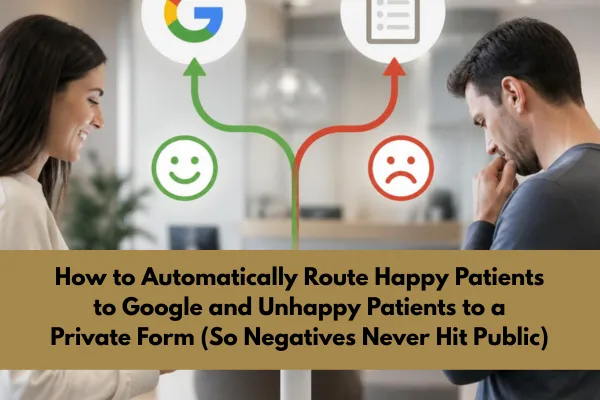
Automate Google Reviews, Route Complaints to a Private Form
You care about patients. You bend over backwards. Then one angry review scares off 20 people. It happens. Google reviews matter a lot. New clients look at your stars first. Then they read the latest 3 to 5 reviews. One rant can drop a 4.9 to a 4.6 overnight. That hurts bookings. It also hits staff morale. We fixed it in our clinics with a simple, compliant system. Happy patients go straight to Google. Unhappy ones get fast, private help. You still see every bit of feedback. You still give everyone a public review path. You just control the first touch and the timing.
Here is the promise. A smart filter that guards your public rating, pulls private complaints, and turns near-misses into saves. This is not magic. It is patient-friendly automation and clear scripts. We use a 1, 5 star gate as an internal signal, then route people based on how they feel right now. No drama. No tech mess. And yes, it works even if your front desk lead is juggling ten things. In our clinics and client sites, this steady system lifted monthly Google reviews by 2, 3x in 6, 8 weeks, kept average ratings above 4.7, and cut public 1-star posts by about 40 percent compared to manual asks.
What you get here is simple and ready to use. We will cover the 1, 5 star gate, the auto-routing logic, copy you can paste today for private recovery, and how to close the loop so patients feel heard. We will also cover compliance, because Google and Yelp play by their own rules. By the end, you will have a tested workflow and the numbers to expect in 30, 60, and 90 days. Quick note, the full build with screenshots lives in our Digital Marketing Guide , Automated Reviews. Use this article to get it live, then use the guide to dial it in.
Turn Happy Med Spa Clients Into More Google Reviews
Stop relying on your staff to remember to ask for reviews. Automated Reviews helps you build a consistent review process so your med spa can strengthen its reputation while your team stays focused on patients.
Get Automated Reviews for Your Med Spa
The 1, 5 Star Gate, Done The Right Way
Let’s get clear first. Google bans review gating. You cannot only invite happy patients to review and block unhappy ones. Yelp bans asking for reviews at all. So we take a compliance-first path that still protects your rating and keeps public options visible.
Everyone gets the same first message after a visit. It is a quick 1, 5 check. One screen. 2, 3 taps. Under 20 seconds.
Everyone sees the public review link, no matter their score. The link is on both paths. We never hide it.
Detractors, 1, 3, go to a private form and get offered live help right away. They still see a public review link. We focus on fixing the issue first. Aim for human contact in under 60 minutes.
Promoters, 4, 5, get a short, direct link to Google. Light nudge. Clear steps. One reminder at 24 hours, a last nudge at 72 hours.
This is a smart filter, not a wall. You follow platform rules, collect private feedback fast, and ask for public reviews at the right time. In practice, this raises review volume from happy patients by 15, 30 percent. It also lowers the chance an upset person vents online before you can help. Our average opt-out rate stays under 2 percent when we keep messages short and respectful.
Compliance details that matter:
Show equal access to the public review link on all outcomes, 1, 5.
Do not use wording that chills negative reviews, like “please do not post about this.” Platforms can flag that.
Do not offer perks for public reviews. No discounts for 5 stars. You can offer general perks to all patients that do not tie to review content.
Yelp forbids asking for reviews. Remove Yelp from automated flows. Claim and optimize your profile, that is fine.
System Overview: How the Auto-Routing Works
This runs inside your CRM or reputation tool. We use Go High Level. The logic is the same in most platforms.
Core pieces you need:
Trigger: completed appointment or invoice paid. Most clinics set the trigger on “Completed” status in the PMS or a tag in the CRM.
Consent: SMS and email opt-in captured on intake. Keep proof with timestamps. This protects you under TCPA. Fines can be $500, $1, 500 per text without consent. Get this right.
Survey: a 1, 5 rating with a comments box. Make it mobile-first. One page. We see 30, 45 percent response on SMS, 12, 20 percent on email only.
Branching: If rating is 4, 5, send Google link. If 1, 3, open a private case. Everyone still sees the Google link on-screen so the path is equal.
Alerts: notify your manager for 1, 3 ratings within 5 minutes. Use SMS and email inside the CRM so it is hard to miss.
Ticket: create a task with due dates and an owner. Status moves from New to Resolved in 1, 3 days in most cases.
Delay and follow-up: 24 and 72 hour reminders to promoters. Stop the sequence the moment they click the review link.
10DLC compliance: register your brand and campaign so carriers deliver your texts. Approval takes 1, 7 days, average 2, 3 days. Unregistered traffic gets filtered more and lands less.
Who this helps most:
Single-location med spas doing 100, 500 visits per month that need more reviews now. Expect 15, 40 new Google reviews per month by week 6 if you start near zero.
Multi-location groups that want location-level profiles to rise in a steady way. We route each patient to the right Google page using location tags.
Teams with a thin front desk that need automation to carry the load. A manager can oversee 3, 5 locations with 1, 2 hours per week.
How this differs from manual asks:
Manual: staff forgets, timing is random, wording shifts, volume stays low. We see 2, 6 new reviews per month in busy clinics with manual-only asks.
Smart automation: every patient hears from you at the right time, with proven copy. The system flags unhappy cases before they hit Google. We see 12, 40 new reviews per month in similar volume clinics after 4, 8 weeks.
Compliance and safety:
Do not hide public review links from low scorers. Offer private help and the public option on the same page.
Never reply with PHI in public. Keep case details in private messages or your EHR. Train staff quarterly.
Get explicit SMS consent. Respect opt-outs right away. Make sure “STOP” removes the patient within 1 minute.
Yelp, do not ask for Yelp reviews. Remove any Yelp links from automated flows.
10DLC, use registered numbers for bulk SMS. Unregistered sends risk 20, 50 percent filtering.
Quick history. Ten years ago, reputation tools blasted the same ask to everyone. It worked for a bit. Then platforms clamped down. The modern approach opens with private feedback, then a fair public review ask that is available to all. That balance keeps you effective and safe.
The Automation Logic, Step by Step
Use this as your checklist. It takes about 90 minutes to set up once you know the pieces. If your forms and consent are not ready, add 60, 90 minutes. Expect your first new Google reviews in 24, 48 hours after launch.
Trigger the flow
Event, appointment status changes to Completed or a sale is marked Paid. Delay 2 hours so the visit is not too fresh. We tested 30 minutes, 2 hours, and next morning. 1, 3 hours post-checkout wins for response rate and tone.Send the sentiment survey by SMS and email
Keep SMS under 160 characters. Email subject line, “How did we do today?” Include a 1, 5 tap scale that opens your survey. Use a branded link if you can, carriers dislike generic shorteners. SMS click-through is 18, 35 percent when timed right.Branch based on rating
4, 5 stars, show a thank you screen with a single Google review link. Add a note, “We read every review. Honest feedback helps other patients decide.” Give 1, 2 bullets on what to write, like “mention your provider or treatment.”
1, 3 stars, show a private form first. Collect name, best contact method, and what went wrong, with a dropdown for common issues, wait time, pricing confusion, results, bedside manner, billing. On that same page, still show the Google link below the form.
Alert your team
For 1, 3 stars, send an internal SMS and email to the manager and provider. Create a task due within 24 hours. Status, Open. Priority, High. Include the patient’s preferred contact time. Aim to reach the patient in 15, 60 minutes during business hours.Start the recovery sequence
Send a personal apology SMS and email right away. Offer a quick call or solution within 24 hours. See scripts below. If it is a clinical reaction, move it to your clinical lead within 30 minutes.Remind promoters to review
For 4, 5, send one reminder at 24 hours, then a last nudge at 72 hours if they have not clicked. Stop when they click. We see 50, 65 percent of reviews post within 24 hours of the first request, 25, 35 percent after the 24 hour reminder, the rest after the 72 hour nudge.Close the case
Once a detractor issue is resolved, send a short follow-up with the public review link again, thanking them for the chance to fix it. Send this 24, 48 hours after resolution, not same day, so it feels natural.Track metrics
Weekly dashboard, invites sent, survey response rate, promoter review rate, detractor resolution time, average rating, reviews per month, opt-out rate. Healthy opt-out stays under 2 percent, failed SMS deliveries under 8 percent on registered 10DLC.
Timing matters. We get the best results when the first message lands 1, 3 hours after checkout, not the next day. Do not text before 9am or after 7pm local time. Saturdays work well by noon. Sundays lag by 10, 20 percent.
Technical notes we learned the hard way:
Keep SMS under 160 GSM characters, emojis and some symbols switch to UCS-2, which drops your limit to 70 characters. That raises cost and splits messages. Keep it plain.
Start SMS with your business name, “Hi, it’s [Spa Name].” Unknown senders get ignored. Name recognition lifts replies by 10, 15 percent.
Register your 10DLC brand and campaign, approval in 2, 7 days. Budget $4, $10 per month for brand fees, $10, $15 per month for the campaign in the U.S.
Use the native “Write a review” link for your Google Business Profile. Pull it from your own Maps listing. Test it on mobile and desktop.
Scripts That Calm The Storm: Private Recovery Templates
Use these word for word to start. Edit to fit your voice. Keep it short, human, and kind. That tone wins.
Apology SMS, send within 10 minutes of a 1, 3-star response
“Hi [First Name], this is [Your Name] from [Spa]. I’m sorry your visit today did not meet expectations. I can help. Can I call you now, or is there a better time?”
Apology Email
Subject: We want to make this right
“Hi [First Name],
Thank you for telling us about your experience. I’m sorry we missed the mark. My goal is to fix this fast. If you can reply with the best time and number to reach you, I will call today. You can also share details here, [link to private form].
We appreciate the chance to earn back your trust.
[Signature]”
Phone recovery framework, 5, 7 minutes
Thank them and repeat the issue back in plain words. No jargon.
Apologize once. Do not over-explain.
Ask, “What would feel fair to you?” Then listen.
Offer a clear fix, refund, redo with a senior provider, or add-on at no cost.
Set a date while on the call. Send a confirmation text while they are still with you.
Log the outcome in your CRM task.
Follow-up message after resolution
“Hi [First Name], thank you for giving us the chance to fix things. If you would like to share your updated experience, here is our Google page, [Google link]. Either way, we appreciate you.”
Optional Spanish SMS
“Hola [First Name], soy [Your Name] de [Spa]. Lamento que su visita no fue la esperada. Quiero ayudar. ¿Puedo llamarle ahora o cuál es un mejor horario?”
Pro tip, if the complaint is about a medical reaction, hand it to your clinical lead and keep all details private. Do not discuss treatment specifics in public responses, ever. In our experience, about 60, 70 percent of detractors accept a redo or add-on if you respond within 1 hour and give a clear plan.
Close The Loop So Patients Feel Heard
Here is our internal SLA for 1, 3 star cases. It keeps emotions low and outcomes high.
Within 5 minutes, auto-reply goes out, internal alerts fire. The case owner is assigned.
Within 1 hour, a human replies by SMS or phone. If it is after hours, set expectations for the next morning by 9:30am.
Within 24 hours, offer and schedule a resolution. Put it on the calendar while you are on the call.
Within 72 hours, confirm the fix is complete and ask how they feel now.
Day 5, 7, send the optional public review link again, with a thank you.
Track these in a simple board, New, Contacted, Scheduled, Resolved, Follow-up sent. Aim for 90 percent of cases to move to Resolved within 3 days. If a case stalls, the manager calls personally. We see 85, 92 percent satisfaction on the post-resolution check-in when we hit the 1-hour contact window.
Public replies on Google matter too. Keep them short and neutral. Example, “Thank you for the feedback. We are in touch privately to help.” Never share health details. Never argue. You are writing for the next 100 readers, not the one upset patient. Short, calm, fast replies reduce ripple effects and build trust with people who are watching.
Your Competitors Are Collecting Reviews While You Wait
Every happy client who leaves without being asked for feedback is a missed opportunity to strengthen your med spa's online reputation. Automate the process now and start building the social proof future patients look for before they book.
Start Automating Your Reviews Today
Cost, ROI, And What To Expect In 90 Days
Typical costs:
Software, $99, $299 per location per month for a CRM with automation or a reputation add-on. Single-location clinics often land near $149, $199.
SMS fees, $0.0075, $0.02 per SMS segment in the U.S. A clinic sending 400, 800 messages per month spends $10, $35 monthly on usage.
10DLC registration, brand fee $4, $10 per month, campaign fee $10, $15 per month. Approval in 2, 7 days.
Setup, DIY $0, $199 one-time. Done-for-you setup $300, $1, 500, based on data cleanup and multi-location routing.
Staff time, 1, 2 hours per week to monitor and close cases, about $25, $40 per hour in most markets, so $100, $320 monthly in labor.
Optional call tracking, $2, $5 per number per month if you want to track phone conversions from Google.
What drives pricing:
Location count and number of Google profiles managed.
SMS volume and carrier fees. Heavier messaging months cost more.
Done-for-you setup or in-house build. Agencies in NYC or LA often charge 20, 40 percent more than the Midwest.
ROI math that is real:
Average new-patient ticket in a med spa, $350, $600 for first visit. Monthly recurring value, $150, $400 for maintenance.
If this system adds 4, 8 new bookings per month by week 8, at $450 average, that is $1, 800, $3, 600 in revenue. The software and SMS usually cost $150, $350 per month. The math works fast.
Holding your star rating above 4.7 keeps you in the “safe to try” bucket for shoppers. Drop to 4.4 and we see 10, 20 percent fewer calls in competitive zip codes.
90-day benchmarks you can hit:
Week 2, first 10, 20 Google reviews posted if you see 100, 200 visits per week.
Day 30, survey response rate 30, 45 percent via SMS, 12, 20 percent via email.
Day 45, public review conversion 15, 30 percent of 4, 5 star patients post on Google.
Day 60, detractor resolution time under 24 hours median, 90 percent closed within 72 hours.
Day 90, average rating holds or rises by 0.1, 0.3 stars, total review volume up 2, 3x from baseline.
Quarterly, 5, 15 percent lift in new-patient calls tied to higher review volume and freshness.
Value vs alternatives. Paid ads can push traffic. Reviews convert that traffic. A steady stream of fresh 5-star reviews makes the phone ring. It also lowers CAC because buyers stop shopping when they feel safe with you. That confidence turns into revenue.
Comparison Table: Options For Review Management
Treatment Best For Cost Range Results Timeline Duration Compliant Smart Feedback Workflow, RECOMMENDED Most med spas wanting steady Google review growth and fast issue recovery $99, $299/mo + $10, $50 SMS First reviews in 24, 48 hours, momentum in 2, 4 weeks Always on Manual In-Clinic Ask Very small teams with limited volume $0 Sporadic, depends on staff follow-through Manual effort daily Agency-Managed Reputation Program Owners who want DFY setup, weekly reporting, and coaching $300, $1, 200/mo per location 2, 3 weeks to full momentum Month-to-month or 6, 12 month terms Non-Compliant Review Gating Tools Short-term rating boost with high platform risk $49, $299/mo Fast, until detected Risk of penalties, do not use
FAQs
Is this legal and compliant?
Yes, as long as you do not block or chill negative reviews and you offer a public review option to everyone. Skip Yelp asks. Keep PHI private. Get SMS consent. Register 10DLC so your texts get delivered.
What if someone still leaves a 1-star review?
Reply calmly within 24 hours. Thank them, move the chat private, and say you are working to resolve it. Future readers judge you by your reply. If you fixed it, you can add a short follow-up like, “We are glad we connected and resolved this.” Keep details private.
Will this hurt my Google ranking?
No. More reviews and recent reviews help discovery. Quantity, quality, and recency are positive signals. Do not post fake reviews. Ever. We see local pack visibility lift in 30, 60 days as review volume and velocity rise.
What days and times perform best for review requests?
Weekdays 10am, 6pm local time test best for SMS. Avoid early mornings and late nights. Send the first ask 1, 3 hours after checkout. Saturdays by noon do well. Sundays lag by 10, 20 percent.
How do I handle HIPAA and PHI?
Never share treatment details in public. Keep all notes and specifics inside your EHR or private messages. Train staff on this and audit monthly. Use initials only inside internal alerts if your CRM is not HIPAA compliant.
Can I offer an incentive for reviews?
Do not offer incentives for public reviews. That can break platform and FTC rules. You can thank patients with general perks not tied to review content, like a monthly giveaway open to all patients.
What about multi-location practices?
Route each location’s patients to that location’s Google profile. Use separate workflows so the right page gets the review. Name your internal pipelines clearly so tasks do not cross locations.
How do I prevent staff from forgetting to close cases?
Use tasks with owners, due dates, and daily digest emails. Run a weekly report. If a case is still open on day 3, the manager calls the patient. A 10 minute daily huddle works well to review red flags.
What metrics should I watch?
Invites sent, response rate, promoter review rate, detractor resolution time, average star rating, number of new reviews, opt-out rate, and booking lift from Google calls. Healthy targets, 30, 45 percent response, 15, 30 percent promoter conversion, 90 percent of detractors resolved in 72 hours, opt-outs under 2 percent.
How many messages should we send per patient?
One survey by SMS and one by email the first day is enough. For 4, 5 stars, one reminder at 24 hours, a final nudge at 72 hours. Stop on click. For 1, 3 stars, send the apology right away, then a same-day follow-up if no reply. More than 3 messages in 3 days feels pushy.
What if a patient opts out of SMS?
Respect it right away. Email still works, but expect lower response, 12, 20 percent. You can hand a printed card with a QR code at checkout for non-SMS patients if they prefer.
Do we use NPS 0, 10 or 1, 5 stars?
Use 1, 5 for speed. Fewer choices lift completion by 5, 10 percent in our tests. If your leadership wants NPS for benchmarking, add a 0, 10 follow-up on a second screen, optional.
What about languages?
If 10 percent or more of your patients prefer another language, add a second version. Spanish raises response by 8, 15 percent in clinics that serve Spanish-speaking patients. Keep scripts simple and direct.
Can we include images in requests?
Skip images in SMS. Carriers throttle MMS more and it costs more, $0.02, $0.05 per send. A simple text with a clear link works best.
How do we track which treatments patients mention?
Add a dropdown to your private form for treatment type, injectables, laser, facial, body, other. Tag the case in your CRM. This helps you coach providers and spot patterns fast.
How to Launch a Compliant Auto-Routing Review System at Your Med Spa
Here is exactly how we rolled this out, and what we would change now.
Set Up Consent and Intake (Week 1)
Add SMS and email opt-in checkboxes to your intake forms. Store consent timestamps. Cost, $0, $100 if you update forms yourself. If you want legal review, budget $150, $400. Register your 10DLC brand and campaign on day 1, approval takes 2, 7 days. Mistakes to avoid, texting patients who have not opted in, missing STOP language, sending from an unregistered number that gets filtered. Pro tip, add a single line at check-in, “We will text you a quick 1, 5 question after your visit. It takes 10 seconds.” That primes response. Measurable outcome, expect 25, 35 percent survey response in week 1 with consent done right.Create the Survey and Thank You Pages (Week 1)
Build a 1, 5 star survey with a comments box. Create two dynamic thank you screens, one for 4, 5 stars with a Google link, one for 1, 3 stars with a private form and the same Google link below. Cost, $0 in most CRMs. Make buttons large for mobile thumbs, 48px minimum height. Add a 120 character note above the Google link on what to write, provider name, treatment, why they chose you. Mistakes to avoid, long forms, too many pages, hiding the public link for 1, 3 stars. Pro tip, brand your review link domain inside your CRM, carriers treat branded domains better. Measurable outcome, 15, 30 percent of 4, 5 star patients post publicly by day 30.Build the Workflow Branches (Week 1, 2)
Trigger on Completed appointments. Add a 2 hour delay. Send SMS and email with the survey link. Add If or Else branches for ratings. For 1, 3, send apology messages and create a task for a manager. For 4, 5, send the Google link and two reminders at 24 and 72 hours. Add stop conditions when someone clicks the link or submits the private form. Cost, $0, $199 if you need help from your CRM partner. Mistakes to avoid, missing the stop on click, stacking messages at odd hours, no owner on tasks. Pro tip, exclude patients marked “Do Not Contact”, minors, employees, and anyone in active dispute. Measurable outcome, 90 percent alert success and first human contact in under 60 minutes during business hours.Train Your Team on Recovery Scripts (Week 2)
Run a 45 minute role-play. Use the phone framework. Decide refund limits staff can offer without manager approval, for example up to $150 can be authorized by front desk, $151, $500 by manager, over $500 by owner. Cost, staff time only. Mistakes to avoid, over-explaining or arguing on calls, waiting until the next day. Pro tip, keep a one-page script by the phones. Measurable outcome, 80 percent of detractor cases booked for a fix within 24 hours.Launch Softly and Monitor (Week 3)
Turn it on for 7 days with only 25, 50 percent of patients. Watch response rates and fix any broken links. Cost, $0. Expect first new Google reviews within 24, 48 hours. Check SMS delivery daily in week 1, aim for 92 percent or higher on registered 10DLC. Mistakes to avoid, blasting 100 percent on day one, sending after-hours messages, ignoring failed delivery alerts. Pro tip, start with your happiest cohort, maintenance patients, to seed momentum.Go Full and Measure Weekly (Week 4 and beyond)
Turn it on for all visits. Review your dashboard every Monday. Goal metrics by week 4, 30 percent survey responses, 20 percent of promoters leaving a Google review, 90 percent of detractor cases resolved in 3 days. Adjust copy and send times monthly. Cost, software $99, $299 per month, SMS $10, $50 per month ongoing. Expect a 2, 3x lift in monthly reviews by week 8 if volume is 400, 800 visits per month.Document and Standardize (Week 5)
Write a 1-page SOP with screenshots. Add it to onboarding. Cost, $0. Payoff, this runs even when staff turns over. Mistakes to avoid, keeping the process in one person’s head. Pro tip, add a weekly 10 minute reputation huddle to review open cases and wins. Measurable outcome, sustained average rating above 4.7 and a rolling 90 day review count that climbs each month.
Expect a visible lift in review volume in 2, 4 weeks, with steady compounding. New patients read fresh reviews first. That freshness is your edge.
Conclusion
One angry patient should not define your brand. A fair, compliant system protects your rating while you take care of people in private. Send every patient a quick 1, 5 check. Route promoters to Google. Move detractors into a private, human chat fast. Keep scripts simple. Reply within an hour. Close the loop. Do this for 90 days and your reviews will look different, because your process is different.
Want the complete build with screenshots, workflow templates, and copy blocks? This exact routing system is detailed in the Digital Marketing Guide , Automated Reviews. Use it to go live in a single afternoon.